Oak Oyster (Pleurotus dryinus)
Index Fungorum Pleurotus dryinus (Pers.) P. Kumm
MycoBank Pleurotus dryinus (Pers.) P. Kumm
Dryinus, a, um — oak, pertaining to oak.
Armillaria dryina (Pers.) J. Schröt., Kryptogamen-Flora von Schlesien 3-1(5): 513 (1889)
Lentodiopsis dryina (Pers.) Kreisel, Handbuch für Pilzfreunde. Blätterpilze: Hellblättler und Leistlinge 3: 72 (1977)
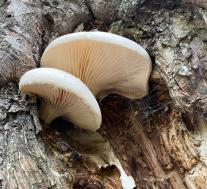
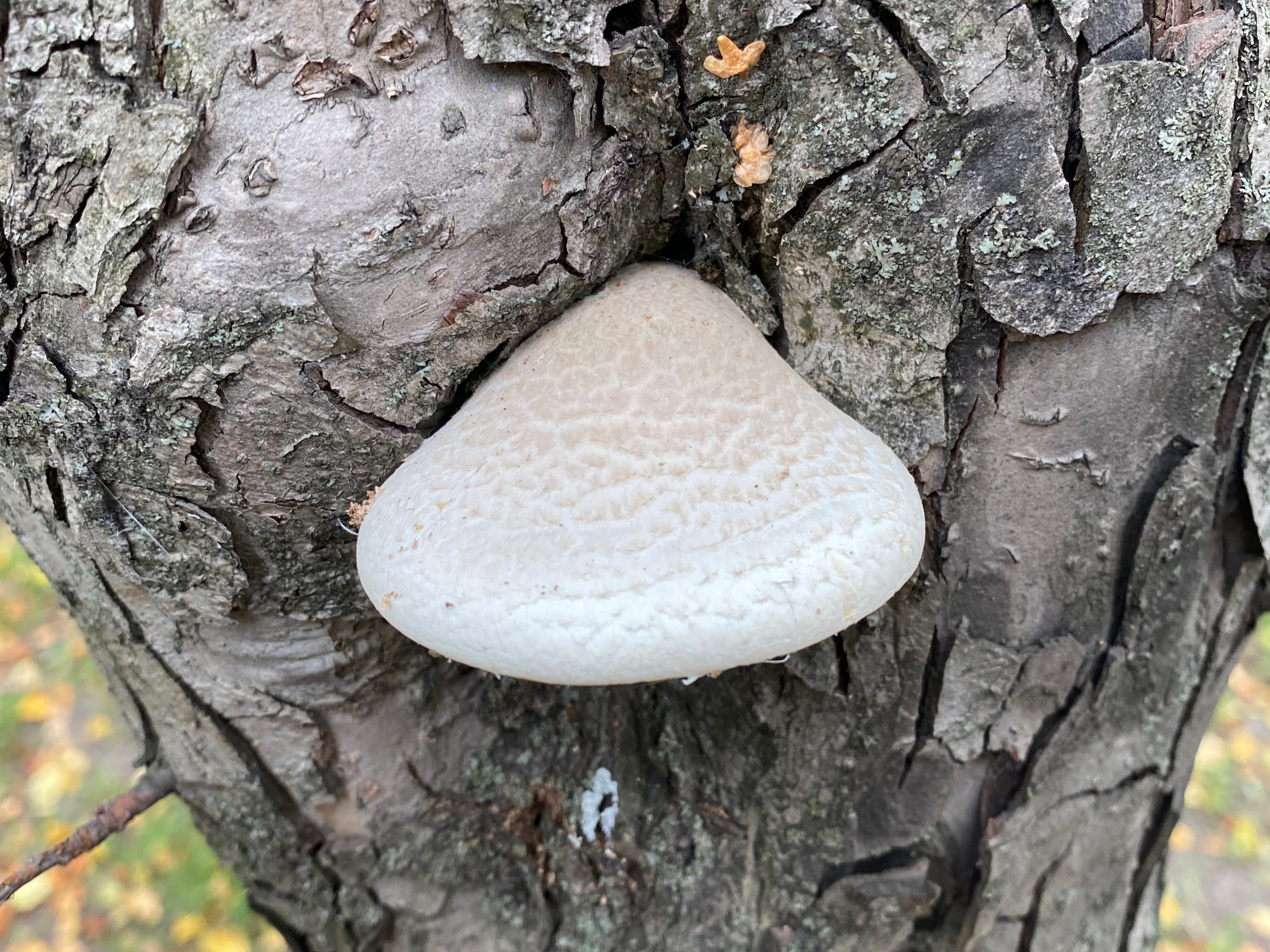
5 to 20 cm, sometimes larger; spherical, tongue-shaped, fan-shaped, convex or slightly depressed-expanded. Margin incurved. White, gray, cream, or brownish shades. Cap surface smooth, or with small appressed brownish scales. Gills broad, crowded, branched, decurrent on the stem. In the stem region anastomosing, forming irregular cells; white, greenish- or lemon-yellow, cream, or light brown in old fruiting bodies. In young fruiting bodies the gills are covered by a partial veil, which tears rather quickly, remaining as residual white or brownish flakes on the cap, as well as a floccose torn membranous ring on the stem.
2–10 cm long, 0.5–3 cm in diameter; solid, curved, lateral or eccentric, cylindrical or tapering toward the base; in the upper part with remnants of the partial veil, which disappear over time.
White or cream, firm-fleshy.
Odor strong, mushroom-like.
Spore print white. Spores ellipsoid to fusiform, smooth.
Grows singly or in small groups on dying trees and deadwood of deciduous species. Causes white rot of wood.
Category 3. Rare species. Relict of nemoral mycobiota.
Degradation of broad-leaved forests in the region. Possibly a temperature factor.
Category and status: 4 — status undetermined species.
Limiting factors. Not studied.
Status. 3 (R). Rare species. Relict of nemoral mycoflora.
Population size and limiting factors. The only known population in Buryatia may disappear due to logging, fires, and other factors, including accidental causes.
Speaking of widespread representatives of the genus, Pleurotus dryinus is a mushroom characterized by a partial veil. Knowing this, it is practically impossible to confuse the Oak Oyster with the Indian Oyster, Pleurotus pulmonarius, or the Common Oyster, Pleurotus ostreatus. Another oyster mushroom with a partial veil, the Veiled Oyster (Pleurotus calyptratus), occurs less frequently and fruits in the first part of the season—from late April to mid-July, practically not overlapping with the Oak Oyster.
A single population of fruiting bodies was found in the city of Cherepovets, on Stalevarov Street, on wounded substrate of Populus.
Add new comment