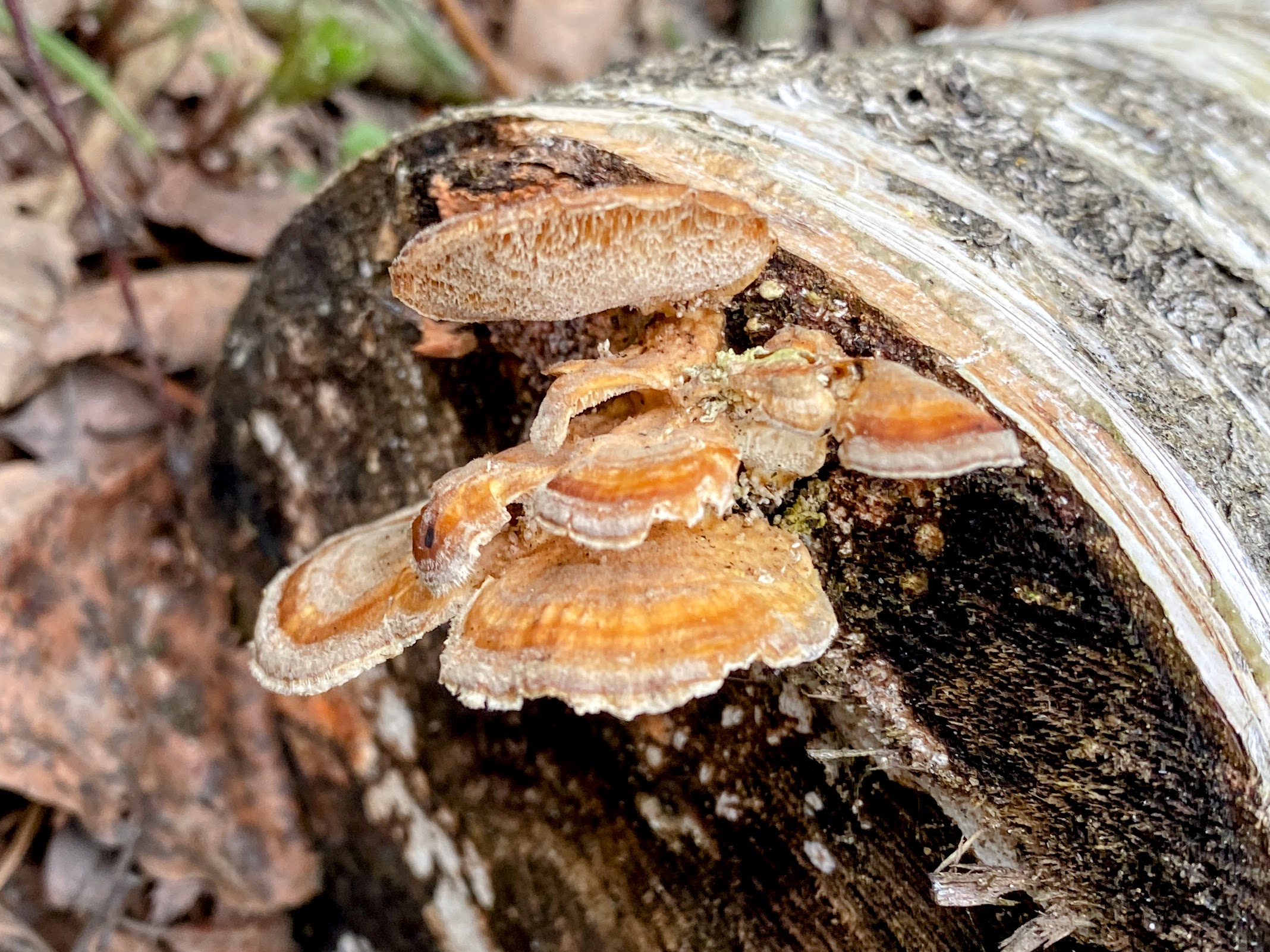
Annual or overwintering, usually imbricate (tile-like), sessile or resupinate-reflexed, half-rounded, kidney-shaped or fan-shaped, often narrowed at the base, typically convex on top, frequently with a small bump or hump near the base. Sometimes specimens fuse at the margins, forming gallery-like structures. Up to 7 cm across at the widest point and up to 1 cm thick; leathery or leathery-corky in texture.
The cap surface is faintly woolly or suede-like, nearly smooth, with concentric zoning. Zones alternate in texture (pressed-down vs. upright fuzzy or woolly, sometimes completely bare) and in color intensity: ochre-fawn near the base, lighter toward the margin, sometimes nearly white, darkening with age to rusty-ochre with a greenish bloom [1], grayish, gray-ochre, light brown-ochre, rusty-yellowish, or umber-chestnut in old basidiomes. Young basidiomes often show indistinct zoning. Faint radial grooves and small bumps may also be visible on the cap surface.
The margin of the fruiting body is thin, straight or wavy, often paler than the rest of the cap, and sterile on the underside near the edge.
The hymenophore is tubular, slightly bumpy, pure white when young, turning yellowish-fawn with age; sterile for up to 1 cm from the margin. Tubes are up to 2 mm long. Pores range from round to angular, small, with thick walls, short (1–2 mm long), initially white or cream, becoming ochre-brownish, brownish, or grayish-brown with age. Pores are round to angular, with entire edges, 3–4 per mm.
Add new comment