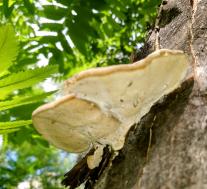
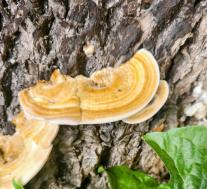
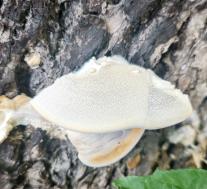
Rough-haired Trametes (Trametes hirsuta)

Траметес жёстковолосистый
Current name

Index Fungorum  Trametes hirsuta (Wulfen) Lloyd

MycoBank   Trametes hirsuta (Fr.) Pilát

Other names

Rough-haired polypore.

In English, it bears the colloquial names hairy turkey tail and hairy bracket.

Systematic position
Specific epithet etymology

hirsūtus, a, um. 1) bristly, disheveled, tousled; 2) rough, shaggy, bristly; hairy, shaggy, bushy, overgrown. From hirtus.

Synonyms

Coriolus hirsutus (Fr.) Quél., Enchiridion Fungorum in Europa media et praesertim in Gallia Vigentium: 175 (1886)

Polystictus hirsutus (Fr.) Fr., Nova Acta Regiae Soc. Sci. Upsal. Ser. 3, 1: 86 (1851) 

Hansenia hirsuta (Fr.) P. Karst., Meddeland. Soc. Fauna Fl. Fenn. 5: 40 (1879)

Boletus hirsutus Wulfen, Schriften Ges. Naturf. Freunde Berlin 8 (1): 127 (1787) 

Polystictoides hirsutus (Fr.) Lázaro Ibiza, Revista Real Acad. Ci. Madrid 14: 756 (1916) 

Microporus hirsutus (Fr.) Kuntze, Revisio generum plantarum 3 (3): 496 (1898) 

Boletus wulfenii Humb., Florae Fribergensis Specimen plantas cryptogamicas praesertim subterraneas exhibens: 96 (1793) 

Boletus hirsutulus J.F. Gmel., Systema Naturae Ed. 13 2 (2): 1437 (1792)

Bjerkandera hirsuta (Fr.) Thüm., Bull. Soc. Imp. Naturalistes Moscou 56 (2): 116 (1882) 

Boletus wulfeni Humb. (1793) 

General description

Aflatoxin B1 (AFB1) is a potent mycotoxin posing a serious threat to human and animal health. The biodegradation of AFB1 by enzymes contained in Trametes hirsuta was studied. The enzyme was identified as a lignolytic phenol oxidase. The enzyme has a molecular weight of 55.6 kDa and provides an impressive rate of AFB1 degradation.

Habit
Fruiting body
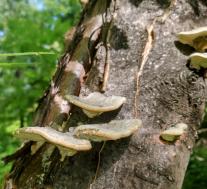
Sessile, bracket-shaped, hoof-shaped, or as an irregular crust/rosette
Hymenophore
Tubulate, poroid
Fruiting period (list)
JunJune (1st–10th)June (11th–20th)June (21st–30th)JulJuly (1st–10th)July (11th–20th)July (21st–31st)AugAugust (1st–10th)August (11th–20th)August (21st–31st)SepSeptember (1st–10th)September (11th–20th)September (21st–30th)OctOctober (1st–10th)October (11th–20th)October (21st–31st)Nov
Fruit body

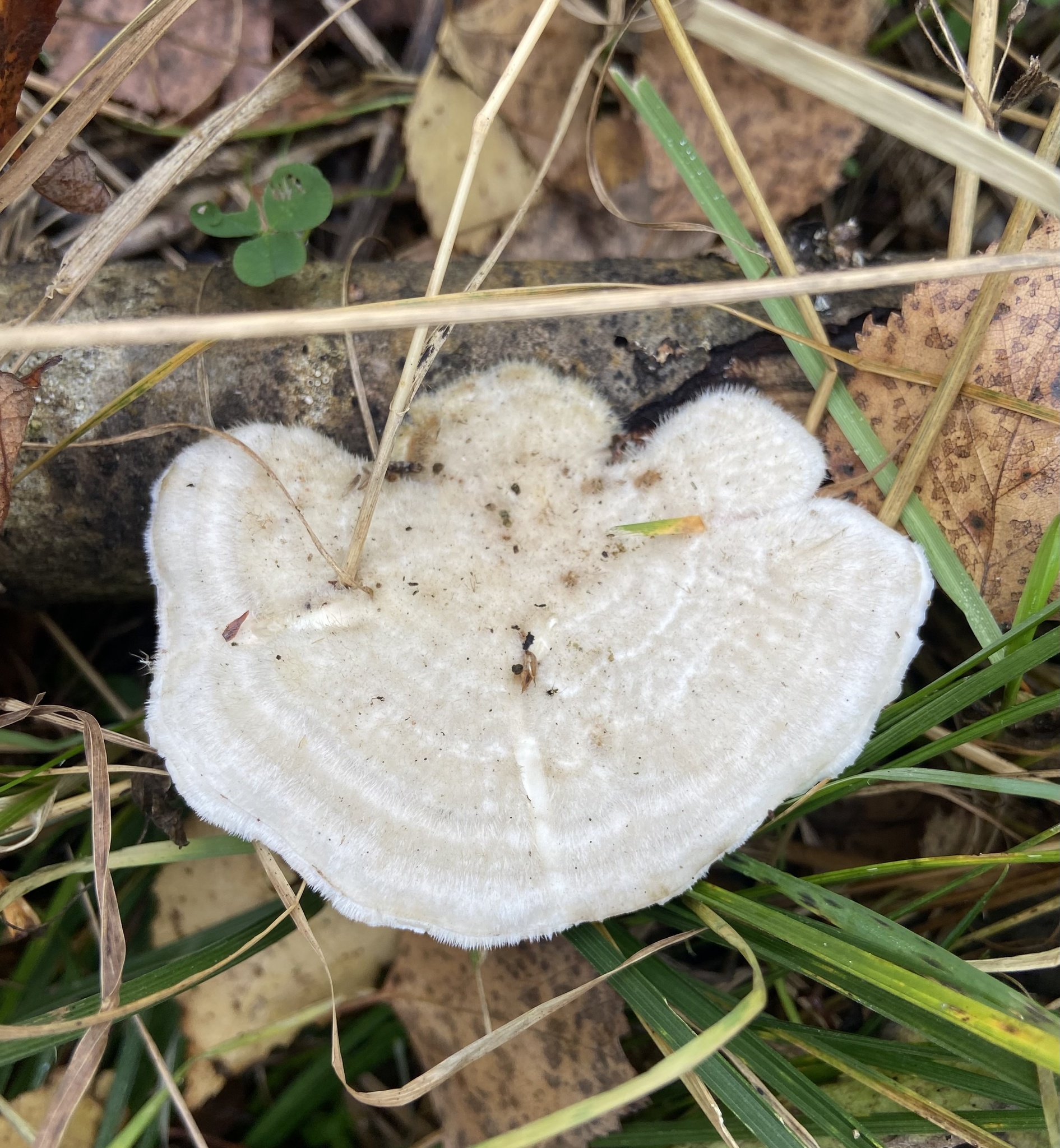
Annual or overwintering, solitary, rarely laterally fused or imbricate, sessile, rarely resupinate-reflexed or with a decurrent base, semicircular, flat, rarely almost kidney-shaped, 3–10 cm wide and up to 1 cm thick at the base.

Cap surface zoned, concentrically furrowed, coarsely hairy to almost bristly, yellowish, creamy, ashy-gray, or grayish-olive, sometimes brownish with age. At the point of attachment, there is usually a tubercle with a noticeable greenish coloration. Closer to the margin, a light beige zone is present.

Margin of the fruit body more or less thickened, rounded, entire or wavy to lobed, or thin, sharp, sterile on the underside, usually darker in color than the rest of the cap surface. Hymenophore tubular. Surface fairly even, whitish, yellowish, brownish, or gray. Pores entire, thick-walled, round to angular, 2–4 per 1 mm.

Flesh

Thin, leathery, often tough when dry, usually indistinctly zoned, white or very pale in color.

Odor

Weak, pleasant.

Microscopy

Spore print colorless in mass. Spores cylindrical, 6–9 × 2–2.5 μm.

Ecology and distribution

Found on deadwood, stumps, and fallen wood of many deciduous trees—birch, alder, aspen, bird cherry, etc., rarely on conifers (fir, spruce). Causes light rot of the corrosive type. Common throughout its range in deciduous and mixed forests, including urban plantings and parks.

Fruiting

Develops in summer or autumn; thereafter, the fruiting bodies dry out and often overwinter, persisting until the following summer.

Nutritional properties
Inedible

Not edible due to tough flesh.

Similar species

A closely related species, pubescent Trametes (Trametes pubescens), differs by white or yellowish cap coloration, often decurrent base of fruiting bodies, and angular thin-walled pores. It grows on deadwood of deciduous trees. The fruiting bodies of this polypore are short-lived and quickly destroyed by insects.

Moreover, typical T. pubescens and T. hirsuta differ significantly in the nature of the hairs on the caps: in T. hirsuta, the hairs are arranged in bundles, stiff and more or less brittle; in T. pubescens, they are of varied appearance but usually not gathered into stiff bundles, and as a rule, they are more elastic. The main distinction of T. pubescens from T. hirsuta is the thinner-walled and less regular pores in the mature state.

Link to this page for printed editions
Shipovalov A.G. Rough-haired Trametes (Trametes hirsuta) - Mushrooms of Vologda Region [Electronic resource] URL: https://xn----7sbancweblffgklubds60aja.xn--p1ai/en/rough-haired-trametes-trametes-hirsuta (accessed: 13.04.2026).
Share link

Add new comment

One file only.
2 MB limit.
Allowed types: png jpeg jpg jpe gif webp svg.
Allowed types: png gif jpg jpeg webp svg.

Plain text

  • No HTML tags allowed.
  • Lines and paragraphs break automatically.
  • Web page addresses and email addresses turn into links automatically.
Add image
Maximum 8 files.
2 MB limit.
Allowed types: png jpeg jpg jpe gif webp svg.
Allowed types: png gif jpg jpeg webp.
January (1st–10th)
January (1st–10th)
January (11th–20th)
January (11th–20th)
January (21st–31st)
January (21st–31st)
February (1st–10th)
February (1st–10th)
February (11th–20th)
February (21st–28th/29th)
March (1st–10th)
March (1st–10th)
March (11th–20th)
March (11th–20th)
March (21st–31st)
March (21st–31st)
April (1st–10th)
April (1st–10th)
April (11th–20th)
April (11th–20th)
April (21st–30th)
April (21st–30th)
May (1st–10th)
May (1st–10th)
May (11th–20th)
May (11th–20th)
May (21st–31st)
May (21st–31st)
June (1st–10th)
June (1st–10th)
June (11th–20th)
June (11th–20th)
June (21st–30th)
June (21st–30th)
July (1st–10th)
July (1st–10th)
July (11th–20th)
July (11th–20th)
July (21st–31st)
July (21st–31st)
August (1st–10th)
August (1st–10th)
August (11th–20th)
August (11th–20th)
August (21st–31st)
August (21st–31st)
September (1st–10th)
September (11th–20th)
September (21st–30th)
October (1st–10th)
October (1st–10th)
October (11th–20th)
October (11th–20th)
October (21st–31st)
October (21st–31st)
November (1st–10th)
November (1st–10th)
November (11th–20th)
November (21st–30th)
December (1st–10th)
December (1st–10th)
December (11th–20th)
December (21st–31st)