Podofomes mollis (Soft Podofome)

Датрония мягкая
Current name

Index Fungorum  Podofomes mollis (Sommerf.) Gorjón, Sydowia

MycoBank  Podofomes mollis (Sommerf.) Gorjón, Sydowia

Other names

Datronia mollis (Soft Datronia). The generic name Datronia is an anagram of the generic name Antrodia.

Systematic position
Specific epithet etymology

Mollis, e 1) soft, tender; 2) limp, slack; 3) softened, decaying; 4) flexible, supple, elastic.

Synonyms

Trametes mollis (Sommerf.) Fr., Elenchus Fungorum 1: 71 (1828) 

Antrodia mollis (Sommerf.) P. Karst., Meddeland. Soc. Fauna Fl. Fenn. 5: 40 (1879)

Polyporus mollis (Sommerf.) P. Karst., Bidrag Kännedom Finlands Natur Folk 25: 280 (1876)

Daedaleopsis mollis (Sommerf.) P. Karst., Finlands Basidsvampar: 135 (1899) - Basionym

Cerrena mollis (Sommerf.) Zmitr., Mycena 1 (1): 91 (2001)

Cerioporus mollis (Sommerf.) Zmitr. & Kovalenko, Int. J. Med. Mushr. 18 (1): 33 (2016)

Habit
Fruiting body
Sessile, bracket-shaped, hoof-shaped, or as an irregular crust/rosette
Leathery or crust-like
Hymenophore
Tubulate, poroid
Fruiting period (list)
JulJuly (11th–20th)July (21st–31st)AugAugust (1st–10th)August (11th–20th)August (21st–31st)SepSeptember (1st–10th)September (11th–20th)September (21st–30th)OctOctober (1st–10th)October (11th–20th)October (21st–31st)NovNovember (1st–10th)
Fruit body

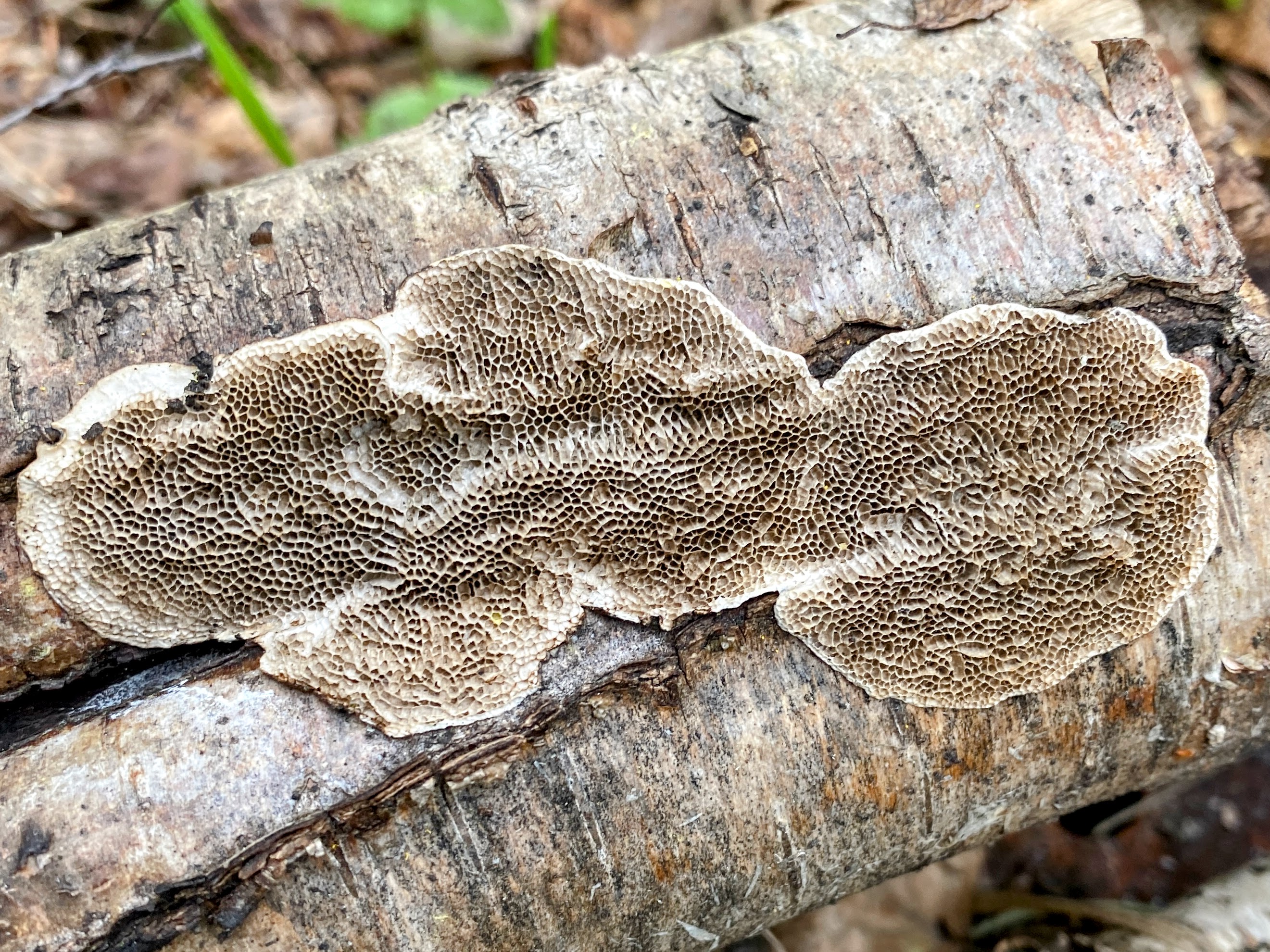
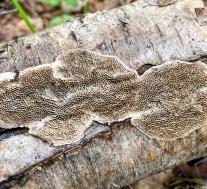
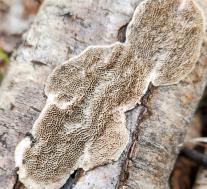
Annual, resupinate or effused-reflexed, easily separable from the substrate; initially oval or rounded, later coalescing into basidiomes of various sizes and shapes, sometimes quite large in area (can reach a meter or more in length). The margin of the resupinate part of the basidiome is well-defined and sterile. Pilei measuring 0.5–2.5 × 1–7 × 0.2–0.6 cm, ranging in shape from small narrow reflexed lobes to nearly fan-shaped, with wavy margins, laterally fused or imbricately arranged. The pilear surface is concentrically furrowed, softly pubescent and slightly velvety in young specimens, ranging from nut-brown to umber, often white at the margin; with age it becomes glabrous, coarsely roughened, dark brown, sooty-brown, or almost black, and in old age covered with a thin hard crust.

The hymenophore surface in young specimens is whitish, creamy, or light beige, browns when pressed, and covered with a delicate whitish bloom that is easily damaged by touch; later it becomes brownish-gray, sometimes grayish-umber. The tubes vary in length and, in different parts of the hymenophore, can range from 0.5 to 5 mm long, with smooth margins, straight or slanted and then open, especially on vertical substrates. Pores rather thick-walled, unequal, rounded or angular, often elongated or labyrinthine, locally becoming daedaleoid, on average 1–2 per 1 mm.

Flesh

Flesh thin, 0.5–1 mm thick, fairly soft and flexible (soft-leathery) in young fruiting bodies, later hardening and becoming rigid, ranging from isabelline to yellowish-brown with a faintly visible dark line, darkening with age.

Odor

Weak, mushroom-like.

Microscopy

Spore print white. Spores cylindrical, slightly concave on one side, somewhat oblique and tapered at the base, 8–10 × 2.5–3.5 μm.

Ecology and distribution

Grows in deciduous and mixed forests on stumps, deadwood, and fallen logs, as well as on dying trees of many deciduous species (birch, aspen, alder, willow, oak, beech, hornbeam, poplar, and others), exceptionally on conifers.

The species is widespread in the northern temperate zone, also recorded in South America; it is cosmopolitan but not frequently encountered. In Russia, it occurs in the European part, the Urals, Siberia, and the Far East.

Fruiting

Fruiting bodies begin to grow in late summer and develop until late autumn; they are capable of surviving mild winters and remain well-preserved, so they can be encountered throughout the year.

Nutritional properties
Inedible
Similar species

The species is easily identified in nature due to its very characteristic relief-like hymenophore with large, thick-walled pores.
Among polypores with effused-reflexed fruiting bodies, similarly colored pore surfaces, and large pores, Trametes trogii (Trametes trogii) should be noted; its young resupinate fruiting bodies may somewhat resemble Podofomes mollis. It can be distinguished by angular pores with thinner septa, clearly visible pubescence on the reflexed margins and edges of resupinate fruiting bodies.
From representatives of the genus Antrodia, Soft Podofome differs by the dark surface of the pilei and the color of the flesh (in Antrodia species, the flesh is white).
In some cases, old, dried solitary basidiomes of Cerrena unicolor (Cerrena unicolor) may resemble P. mollis, especially when growing on vertical substrates; they differ by pubescent pilei of light grayish-greenish coloration.
Small resupinate and slightly reflexed basidiomes of Smoky Polypore (Bjerkandera adusta) with grayish hymenophore and pilei, sometimes colored brown, are easily distinguished by their very small pores (5–7 per 1 mm).
The species Datronia stereoides (Datronia stereoides) has small fruiting bodies with significantly smaller pores (4–6 per 1 mm).

Link to this page for printed editions
Shipovalov A.G. Podofomes mollis (Soft Podofome) - Mushrooms of Vologda Region [Electronic resource] URL: https://xn----7sbancweblffgklubds60aja.xn--p1ai/en/podofomes-mollis-soft-podofome (accessed: 13.04.2026).
Share link

Add new comment

One file only.
2 MB limit.
Allowed types: png jpeg jpg jpe gif webp svg.
Allowed types: png gif jpg jpeg webp svg.

Plain text

  • No HTML tags allowed.
  • Lines and paragraphs break automatically.
  • Web page addresses and email addresses turn into links automatically.
Add image
Maximum 8 files.
2 MB limit.
Allowed types: png jpeg jpg jpe gif webp svg.
Allowed types: png gif jpg jpeg webp.
January (1st–10th)
January (1st–10th)
January (11th–20th)
January (11th–20th)
January (21st–31st)
January (21st–31st)
February (1st–10th)
February (1st–10th)
February (11th–20th)
February (21st–28th/29th)
March (1st–10th)
March (1st–10th)
March (11th–20th)
March (11th–20th)
March (21st–31st)
March (21st–31st)
April (1st–10th)
April (1st–10th)
April (11th–20th)
April (11th–20th)
April (21st–30th)
April (21st–30th)
May (1st–10th)
May (1st–10th)
May (11th–20th)
May (11th–20th)
May (21st–31st)
May (21st–31st)
June (1st–10th)
June (1st–10th)
June (11th–20th)
June (11th–20th)
June (21st–30th)
June (21st–30th)
July (1st–10th)
July (1st–10th)
July (11th–20th)
July (11th–20th)
July (21st–31st)
July (21st–31st)
August (1st–10th)
August (1st–10th)
August (11th–20th)
August (11th–20th)
August (21st–31st)
August (21st–31st)
September (1st–10th)
September (11th–20th)
September (21st–30th)
October (1st–10th)
October (1st–10th)
October (11th–20th)
October (11th–20th)
October (21st–31st)
October (21st–31st)
November (1st–10th)
November (1st–10th)
November (11th–20th)
November (21st–30th)
December (1st–10th)
December (1st–10th)
December (11th–20th)
December (21st–31st)