Pubescent Trametes (Trametes pubescens)

Траметес пушистый
Current name

Index Fungorum    Trametes pubescens (Schumach.) Pilát

MycoBank   rametes pubescens (Schumach.) Pilát

Other names

Pubescent leathery sponge.

Systematic position
Specific epithet etymology

Pūbēscens. 1) reaching maturity, becoming adult, becoming covered with hair or down; 2) mycol. pubescent, downy. Active present participle of pūbēsco, pūbui.

Synonyms

Polyporus pubescens (Schumach.) Fr., Observationes Mycologicae 1: 124 (1815) 

Coriolus pubescens (Schumach.) Quél., Flore mycologique de la France et des pays limitrophes: 391 (1888)

Tyromyces pubescens (Schumach.) Imazeki, Bull. Tokyo Sci. Mus. 6: 84 (1943) 

Polystictus pubescens (Schumach.) Gillot & Lucand, Bull. Soc. Hist. nat. Autun: 175 (1890) 

Bjerkandera pubescens (Schumach.) P. Karst., Bidrag Kännedom Finlands Natur Folk 37: 41 (1882) 

Hansenia pubescens (Schumach.) P. Karst., Bidrag Kännedom Finlands Natur Folk 48: 304 (1889) 

Agaricus pubescens (Schumach.) E.H.L. Krause, Basidiomycetum Rostochiensium, Suppl. 4: 141 (1932)

Leptoporus pubescens (Schumach.) Pat., Essai taxonomique sur les familles et les genres des Hyménomycètes: 84 (1900) 

General description

The genome of T. pubescens was published in 2017 by Zoraida Granchi and her colleagues from the OPTIBIOCAT project. The genome contains 39.7 million base pairs. According to consortium estimates, it contains 14,451 distinct genes, which is an average figure for wood-decaying fungi.

Habit
Fruiting body
Sessile, bracket-shaped, hoof-shaped, or as an irregular crust/rosette
Hymenophore
Tubulate, poroid
Fruiting period (list)
May (11th–20th)May (21st–31st)JunJune (1st–10th)June (11th–20th)June (21st–30th)JulJuly (1st–10th)July (11th–20th)July (21st–31st)AugAugust (1st–10th)August (11th–20th)August (21st–31st)SepSeptember (1st–10th)September (11th–20th)September (21st–30th)OctOctober (1st–10th)October (11th–20th)
Fruit body

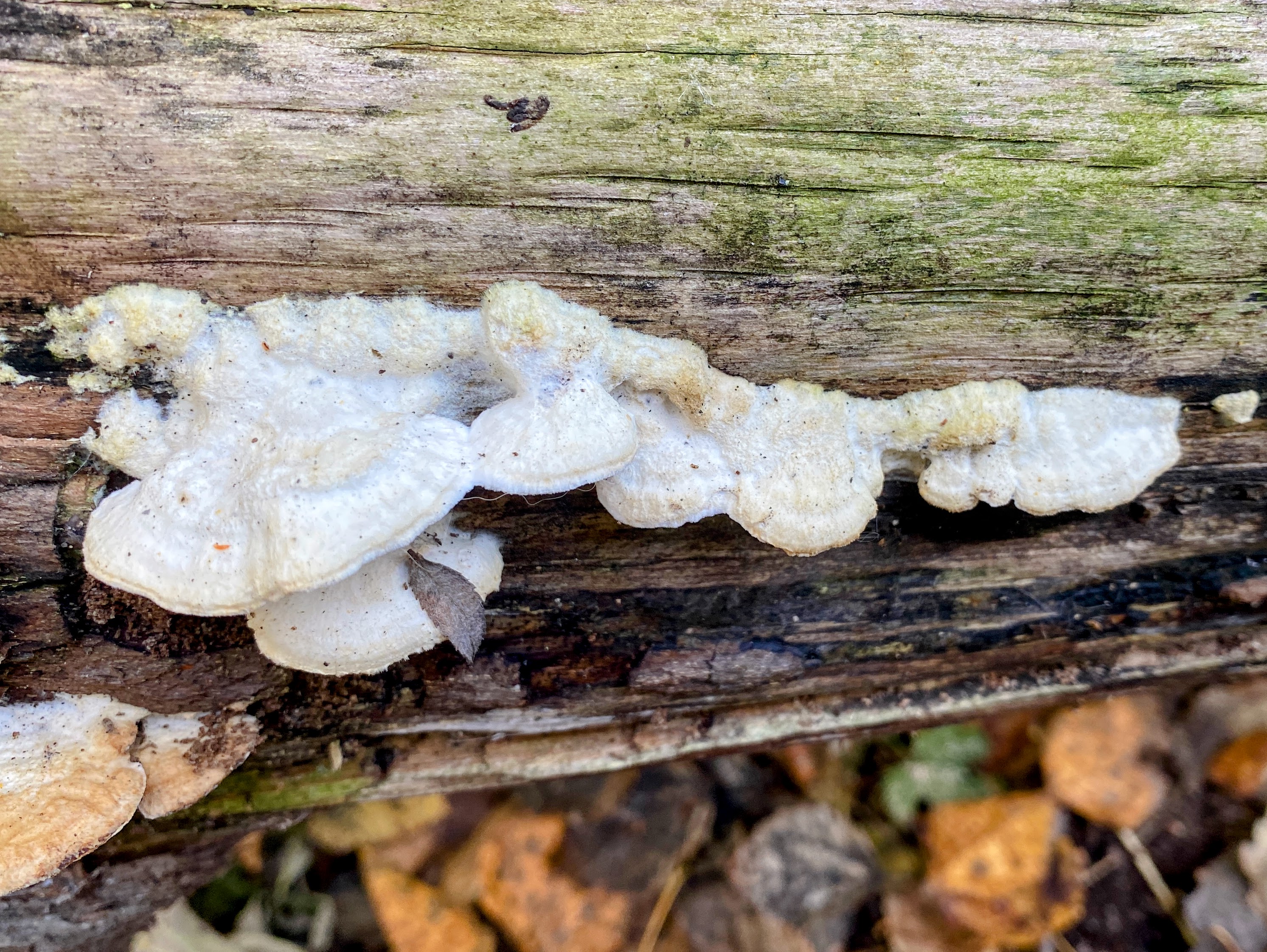
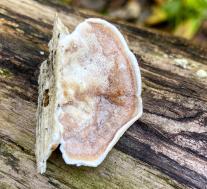
Annual, sessile, fan-shaped (attached to the substrate by one side), rarely solitary—as a rule, fruiting bodies of the pubescent trametes form an imbricate structure, fusing at the margins or overlapping. The diameter of a single fruiting body is 3–10 cm, thickness 0.5–1.5 cm. Surface zoned, tomentose, densely covered with bristly hairs. Coloration variable, from light, almost white or yellowish, to light ashen; generally lighter at the periphery, darker near the point of attachment to the substrate.

Hymenophore tubular (located on the underside of the "cap"). Tubes short (up to 5 mm long), pores angular, losing their geometric shape with age. The tubular layer is initially white, gradually darkening to brownish with age. Due to the tendency of the pubescent trametes to form indistinct fused clusters, the hymenophore of what appears to be a single fruiting body may consist of several layers of different ages.

Flesh

From soft-leathery to corky-fibrous, very light, white.

Odor

Weak, mushroom-like.

Microscopy

Spore print white. Spores 5–6 × 1.7–2.5 μm, cylindrical, slightly allantoid, smooth, hyaline.

Ecology and distribution

Found on deadwood of many deciduous trees (birch, willow, alder, aspen, rowan, etc.) at decomposition stages 2–3, in forest-steppe zones, deciduous forests, mixed forests, and taiga. A common species in the forests of the Russian Plain. Sometimes behaves as a wound parasite on weakened trees. Causes white rot. The fruiting bodies of this polypore are short-lived and quickly destroyed by insects.

Fruiting

May–October.

Nutritional properties
Inedible
Similar species

Rough-haired Trametes (Trametes hirsuta) — fruit bodies bristly, with coarse hairs, surface ashy-gray or grayish-olive, sometimes yellowish.

Notes

Pubescent Trametes is cultivated for the production of medicinal preparations. A number of studies have demonstrated its antitumor, immunostimulating, and antimicrobial effects.

Link to this page for printed editions
Shipovalov A.G. Pubescent Trametes (Trametes pubescens) - Mushrooms of Vologda Region [Electronic resource] URL: https://xn----7sbancweblffgklubds60aja.xn--p1ai/en/pubescent-trametes-trametes-pubescens (accessed: 13.04.2026).
Share link

Add new comment

One file only.
2 MB limit.
Allowed types: png jpeg jpg jpe gif webp svg.
Allowed types: png gif jpg jpeg webp svg.

Plain text

  • No HTML tags allowed.
  • Lines and paragraphs break automatically.
  • Web page addresses and email addresses turn into links automatically.
Add image
Maximum 8 files.
2 MB limit.
Allowed types: png jpeg jpg jpe gif webp svg.
Allowed types: png gif jpg jpeg webp.
January (1st–10th)
January (1st–10th)
January (11th–20th)
January (11th–20th)
January (21st–31st)
January (21st–31st)
February (1st–10th)
February (1st–10th)
February (11th–20th)
February (21st–28th/29th)
March (1st–10th)
March (1st–10th)
March (11th–20th)
March (11th–20th)
March (21st–31st)
March (21st–31st)
April (1st–10th)
April (1st–10th)
April (11th–20th)
April (11th–20th)
April (21st–30th)
April (21st–30th)
May (1st–10th)
May (1st–10th)
May (11th–20th)
May (11th–20th)
May (21st–31st)
May (21st–31st)
June (1st–10th)
June (1st–10th)
June (11th–20th)
June (11th–20th)
June (21st–30th)
June (21st–30th)
July (1st–10th)
July (1st–10th)
July (11th–20th)
July (11th–20th)
July (21st–31st)
July (21st–31st)
August (1st–10th)
August (1st–10th)
August (11th–20th)
August (11th–20th)
August (21st–31st)
August (21st–31st)
September (1st–10th)
September (11th–20th)
September (21st–30th)
October (1st–10th)
October (1st–10th)
October (11th–20th)
October (11th–20th)
October (21st–31st)
October (21st–31st)
November (1st–10th)
November (1st–10th)
November (11th–20th)
November (21st–30th)
December (1st–10th)
December (1st–10th)
December (11th–20th)
December (21st–31st)