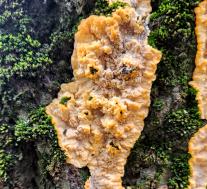
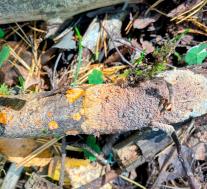
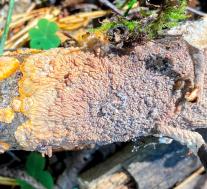
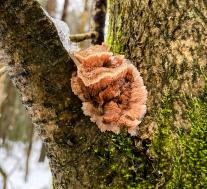
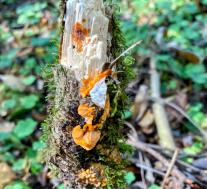
Annual, resupinate, effused, appearing on the substrate in small, scattered groups; in youth as small rounded formations from one to several centimeters in diameter, which over time fuse together to form an irregularly shaped conglomerate covering an area of up to several tens of centimeters. Surface uneven, bumpy, radially folded, yellow-orange to orange or orange-red, becoming grayish-blue with age. Margin uneven, fringed, sometimes free.
Flesh
Gelatinous, fairly dense, elastic, externally resembling wax; becomes hard and crust-like when dry. Taste weak, mushroom-like.
Odor
Very weak.
Microscopy
Spore print white. Spores nearly allantoid, thin-walled, smooth, often with 1–2 oil droplets.
Ecology and distribution
Widely distributed in the Northern Hemisphere, growing in groups or singly on decaying wood of deciduous and coniferous trees. Prefers moist habitats. Causes white rot.
Similar species
Red Phlebia (Phlebia rufa) — hymenophore not folded, but rather pseudo-porous, as for example in Trembling Phlebia (Phlebia tremellosa).
Related resources
Eriksson J., Hjortstam K., Ryvarden L. The Corticiaceae of North Europe. Volume 6. Phlebia — Sarcodontia. — Oslo: Fungiflora, 1981. — P. 1051–1276. — P. 1153.
Breitenbach J, Kränzlin F. Fungi of Switzerland. A contribution to the knowledge of the fungal flora of Switzerland. Vol 2. Heterobasidiomycetes, Aphyllophorales, Gasteromycetes. — Lucerne: Verlag Mykologia, 1986. — 412 p. — P. 166.
Bernicchia A., Gorjón S. P. Fungi Europaei. Vol. 12. Corticiaceae s.l. — Italia: Massimo Candusso, 2010. — 1008 p. — P. 530.

Add new comment