Shaggy Ink Cap (Coprinus comatus)
Index Fungorum Coprinus comatus (O.F. Müll.) Pers.
MycoBank Coprinus comatus (O.F. Müll.) Pers.
Shaggy Ink Cap, inky mushroom. It has the evocative English name "Lawyer's Wig."
From coma, ae f. — 1) hair on the head, curls; 2) (in animals) mane; wool, fleece; + -ātus, a, um — suffix denoting possession or quality. Thus, comatus means "hairy," "shaggy," or "with long flowing hair," referring to the distinctive shaggy, fibrous scales on the mushroom's cap.
Agaricus comatus O.F. Müll., Fl. Danic. 5: tab. 834 (1780)
Agaricus comatus var. campanulatus Alb. & Schwein., Consp. fung. (Leipzig): 199 (1805)
Agaricus comatus var. ovatus Pers., Syn. meth. fung. (Göttingen) 2: 396 (1801)
Agaricus comatus var. ovatus (Schaeff.) Fr., Syst. mycol. (Lundae) 1: 307 (1821)
Agaricus cylindricus Sowerby, Col. fig. Engl. Fung. Mushr. (London) 2(no. 16): tab. 189 (1799)
Agaricus fimetarius Bolton, Hist. fung. Halifax (Huddersfield) 1: 44 (1788)
Agaricus ovatus Scop., Fl. carniol., Edn 2 (Wien) 2: 425 (1772)
Agaricus ovatus Schaeff., Fung. bavar. palat. nasc. (Ratisbonae) 4: 5 (1774)
Coprinus comatus f. sphaerocephalus J.E. Lange [as 'sphaerocephala'], Dansk bot. Ark. 9(no. 6): 93 (1938)
Coprinus comatus var. breviceps Peck, Ann. Rep. Reg. N.Y. St. Mus. 49: 43 (1897) [1896]
Coprinus comatus var. caprimammillatus Bogart, The Genus Coprinus in Washington and Adjacent Western States [Ph.D. dissertation] (Seattle): 55 (1975)
Coprinus comatus var. caprimammillatus Bogart, Mycotaxon 4(1): 276 (1976)
Coprinus comatus var. columellifer Speg., Anal. Mus. nac. Hist. nat. B. Aires 6: 155 (1898) [1899]
Coprinus comatus var. excentricus Bogart, The Genus Coprinus in Washington and Adjacent Western States [Ph.D. dissertation] (Seattle): 55 (1975)
Coprinus comatus var. excentricus Bogart, Mycotaxon 4(1): 274 (1976)
Coprinus comatus var. ovatus (Schaeff.) Quél., Enchir. fung. (Paris): 121 (1886)
Coprinus comatus var. parvus Bogart, Mycotaxon 4(1): 272 (1976)
Coprinus comatus var. parvus Bogart, The Genus Coprinus in Washington and Adjacent Western States [Ph.D. dissertation] (Seattle): 54 (1975)
Coprinus comatus var. stellatolaciniatus Wichanský, C.C.H. 43: 143 (1966)
Coprinus comatus var. stellatus Šebek, C.C.H. 39: 72 (1962)
Coprinus comatus var. texensis Thiers, Mycologia 51(4): 535 (1960) [1959]
Coprinus ovatus (Schaeff.) Fr., Epicr. syst. mycol. (Upsaliae): 242 (1838) [1836-1838]
Pselliophora comata (O.F. Müll.) P. Karst., Bidr. Känn. Finl. Nat. Folk 32: 528 (1879)
Pselliophora ovata (Schaeff.) P. Karst., Bidr. Känn. Finl. Nat. Folk 32: 528 (1879)
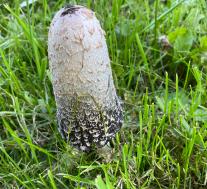
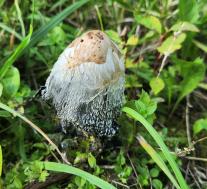
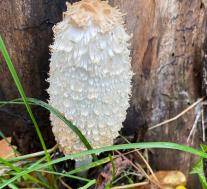
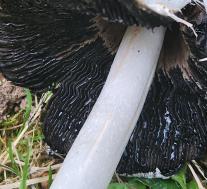
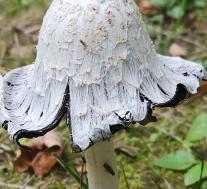
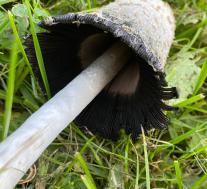
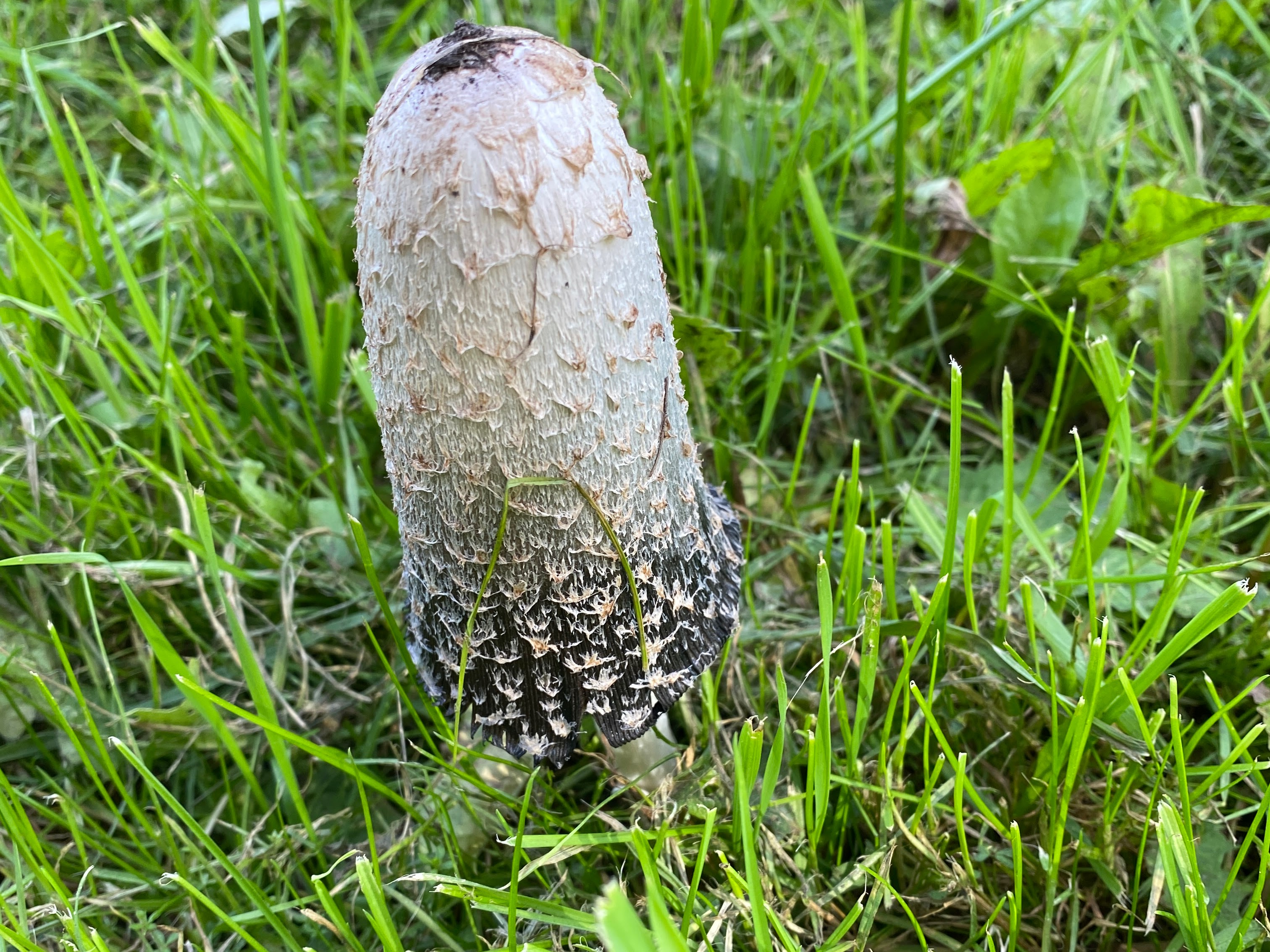
In youth, 2.5–20 cm high and 2–7.5 cm in diameter. Cylindrical or spindle-shaped with an incurved margin. As it matures, the cap expands and becomes conical to bell-shaped. Cap surface white to light beige, fibrous, covered with appressed scales that increase in size with age and curl upward at the edges, giving the cap a shaggy appearance. Hymenophore lamellate. Gills crowded, free; white when young, gradually turning pinkish, then black.
5–20 cm long, 1–2.5 cm in diameter; hollow in the lower part, with a movable ring (not always distinct). The base of the stipe is bulbous. Surface white, smooth, sometimes with a faint pattern.
White, fibrous, turning red where damaged. Odor strong, mushroom-like.
Spore print dark brown (visually black). Spores broadly ellipsoid, ovoid, smooth.
A litter saprotroph. Grows on soil in urban environments, on lawns and flower beds. Nematophagous (immobilizes and digests microscopic nematode worms). A ruderal, synanthropic species, very rarely found in undisturbed biotopes. Fruits abundantly and is frequently encountered.
Dung-loving Ink Cap (Coprinus sterquilinus) grows on dung and is microscopically distinguished by significantly larger spores.
Chestnut-spored Ink Cap (Coprinus spadiceisporus), like C. sterquilinus, grows on dung and is microscopically distinguished by smaller spores.
Veiled Ink Cap (Coprinus calyptratus) is distinguished by the characteristic structure of the velum, remnants of which remain on the upper part of the cap at maturity as a cap or disc with star-shaped torn edges.
Coprinus comatus is a nematophagous fungus capable of killing and digesting nematodes of the species Panagrellus redivivus and Meloidogyne arenaria.
Add new comment