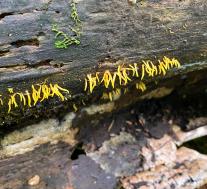
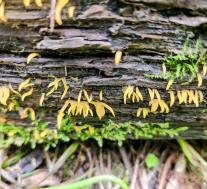
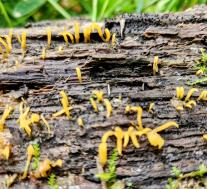
of highly variable shape: simple, awl-shaped, cylindrical, lanceolate, sometimes with a short stipe, usually with a slightly bulbous base, sometimes branched at the apex, 1.5–2 cm high and 0.5–1 mm in diameter. Growing singly or in groups, yellow or orange-yellow, amber when dry. The hymenium covers the lateral surfaces of the basidiocarps.
Small Stagshorn (Calocera cornea)
Index Fungorum Calocera cornea (Batsch) Fr
MycoBank Calocera cornea (Batsch) Fr
Corneus, ae, um — horny, made of horn; horn-like, resembling a horn.
Clavaria cornea Batsch, Elench. fung. (Halle): 139 (1783)
Corynoides cornea (Batsch) Gray, Nat. Arr. Brit. Pl. (London) 1: 654 (1821)
Calocera cornes (Batsch) Fr., Stirp. Agri. Femison. 5: 67 (1827)
Clavaria major Justus Müll., Schr. Ges. naturf. Freunde, Berlin 3: 351 (1777)
Clavaria aculeiformis Bull., Hist. Champ. Fr. (Paris) 10: 463 (1785)
Tremella aculeiformis (Bull.) Pers., Mycol. eur. (Erlanga) 1: 106 (1822)
Calocera aculeiforme (Bull.) Wallr., Fl. crypt. Germ. (Norimbergae) 2: 534 (1833)
Clavaria medullaris Holmsk., Beata Ruris Otia FUNGIS DANICIS 1: 80 (1790)
Clavaria striata Hoffm., Deutschl. Fl., Zweiter Theil (Erlangen): tab. 7, fig. 1 (1796)
Calocera striata (Hoffm.) Fr., Epicr. syst. mycol. (Upsaliae): 582 (1838)
Tremella palmata Schumach., Enum. pl. (Kjbenhavn) 2: 442 (1803)
Calocera palmata (Schumach.) Fr., Epicr. syst. mycol. (Upsaliae): 581 (1838)
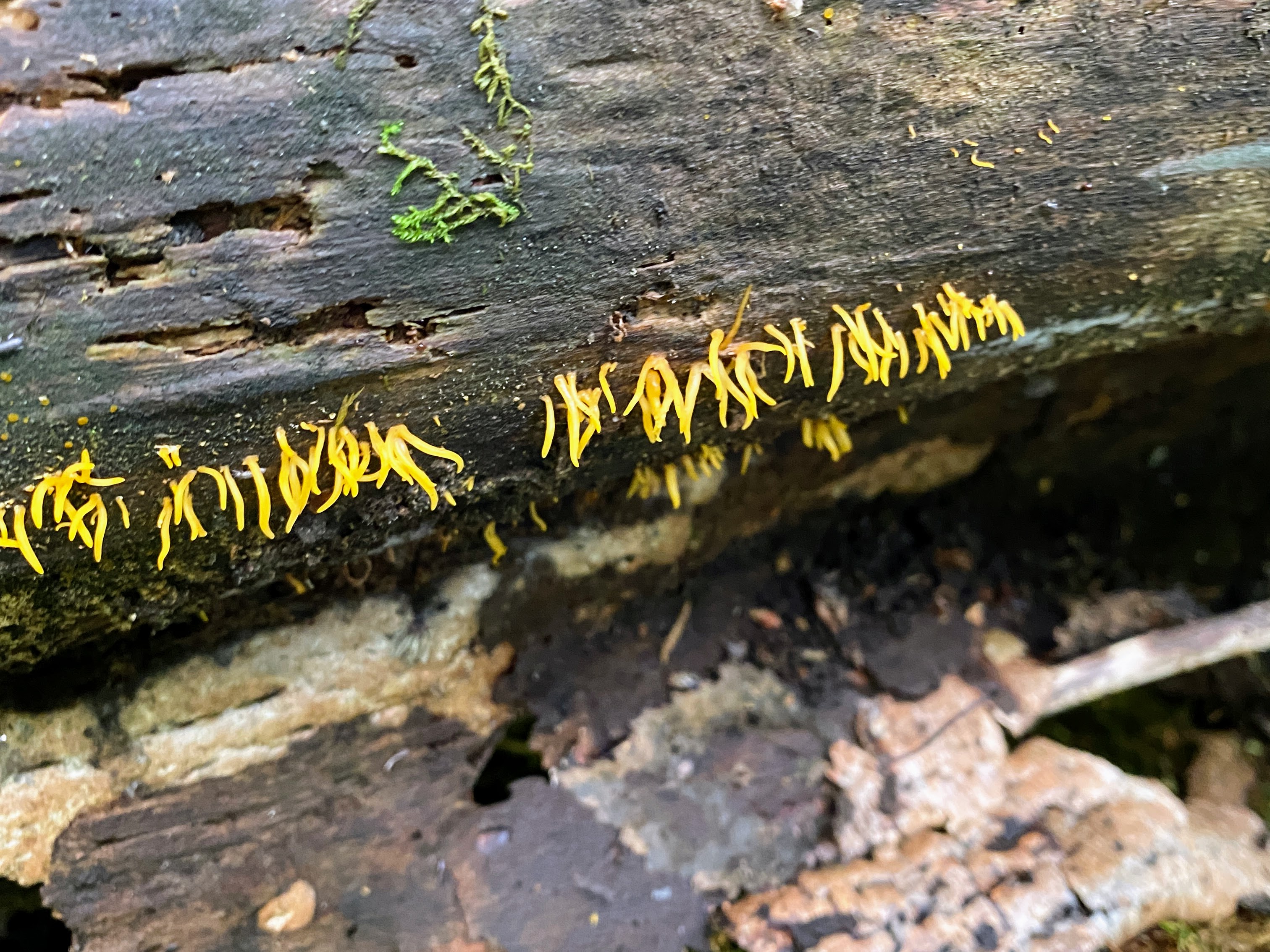
Gelatinous, jelly-like, rubbery. Odor weak, pleasant, mushroom-like.
Spore print yellowish in mass. Spores curved-ellipsoid to allantoid, with a distinct apex, thin-walled, unicellular or with one septum.
On decaying hardwood, preferring barkless oak wood. Frequent. Very widely distributed.
Forked Stagshorn (Calocera furcata) — grows on coniferous wood, has a white tomentose base at the fruiting bodies, and larger spores that often have more than one septum.
Add new comment