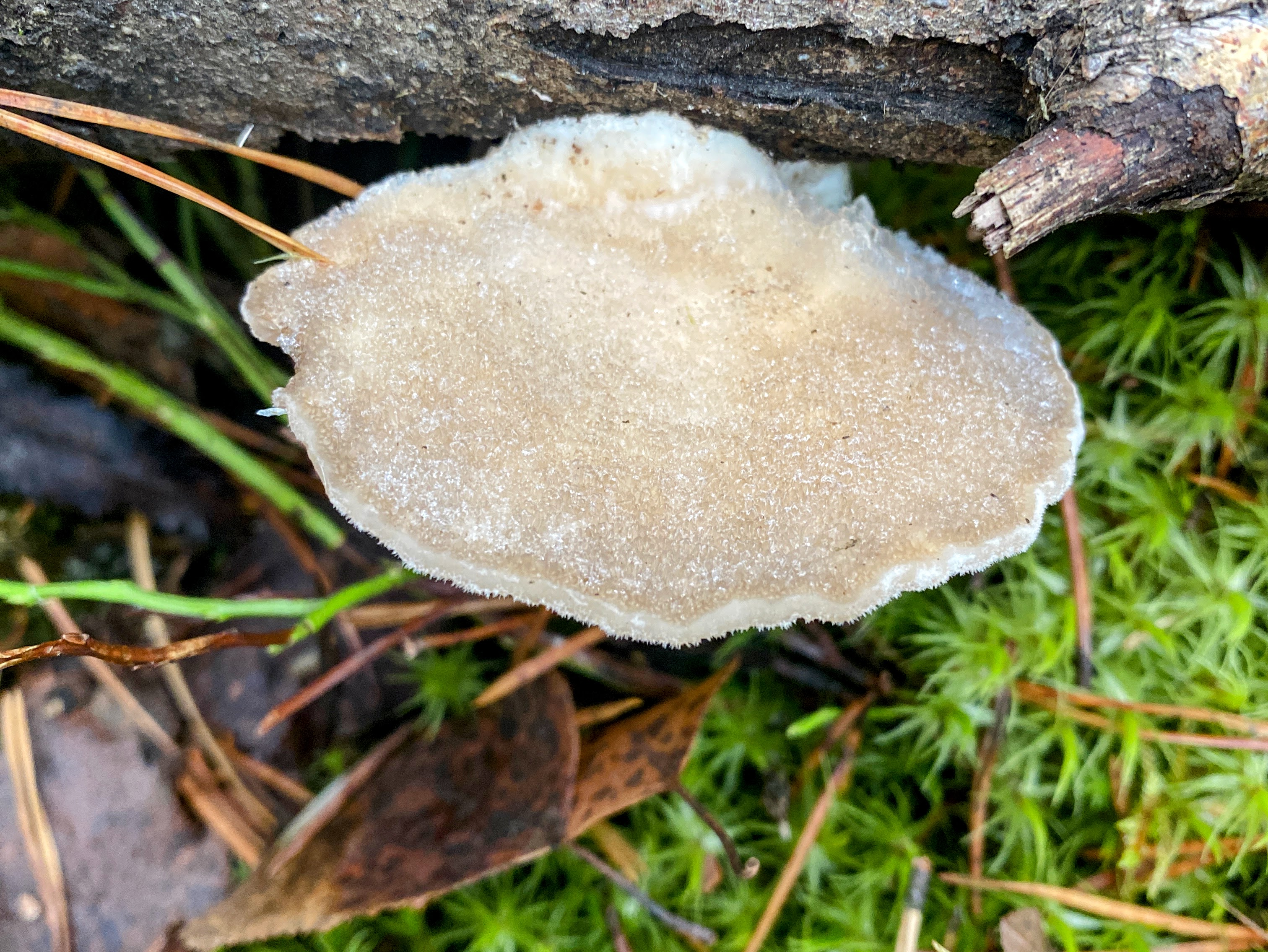
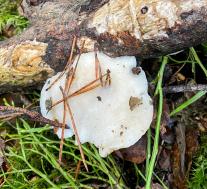
Snowy Tyromyces (Tyromyces chioneus)

Тиромицес белоснежный
Current name

Index Fungorum Tyromyces chioneus (Fr.) P. Karst.

MycoBank Tyromyces chioneus (Fr.) P. Karst.

Other names

Snowy polypore, snowy-white Skeletocutis.

In English, it's known as the white cheese polypore.

Systematic position
Specific epithet etymology

Lat. Chionea — a genus of insects in the family Limoniidae, commonly known as winter crane flies, active at subzero temperatures.

Synonyms

Ungularia chionea (Fr.) Lázaro Ibiza, Revista Real Acad. Ci. Madrid 14: 670 (1916) 

Polystictus chioneus (Fr.) Gillot & Lucand, Bull. Soc. Hist. nat. Autun: 172 (1890) 

Bjerkandera chionea (Fr.) P. Karst., Acta Soc. Fauna Fl. Fenn. 2 (1): 29 (1881) [MB#468215]
Leptoporus albellus subsp. chioneus (Fr.) Bourdot & Galzin, Bull. Soc. Mycol. France 41 (1-2): 125 (1925) 

Leptoporus chioneus (Fr.) Quél., Enchiridion Fungorum in Europa media et praesertim in Gallia Vigentium: 177 (1886)


General description

Tyromyces chioneus is a common species in our region — and indeed worldwide: findings in various types of forest plantations are relatively frequent.

Habit
Fruiting body
Sessile, bracket-shaped, hoof-shaped, or as an irregular crust/rosette
Hymenophore
Tubulate, poroid
Fruiting period (list)
MayMay (1st–10th)May (11th–20th)May (21st–31st)JunJune (1st–10th)June (11th–20th)June (21st–30th)JulJuly (1st–10th)July (11th–20th)July (21st–31st)AugAugust (1st–10th)August (11th–20th)August (21st–31st)SepSeptember (1st–10th)September (11th–20th)September (21st–30th)OctOctober (1st–10th)October (11th–20th)October (21st–31st)NovNovember (1st–10th)November (11th–20th)
Fruit body

Basidiomes are annual, appearing as convex, sessile caps with a triangular cross-section, growing singly or fused together, semi-circular or kidney-shaped, up to 12 cm long and 8 cm wide, with a sharp, sometimes slightly wavy margin. Initially white or whitish, later turning yellowish or brownish, often with dark speckles. The surface is finely velvety at first, becoming bare with age, and in old specimens covered with a wrinkled cuticle. Fully resupinate (crust-like) forms occasionally occur.

Due to agglutination of hyphae, a smooth, film-like surface forms; as it dries, it develops irregular radial zoning. In older specimens, this surface becomes wrinkled and ranges from dirty yellowish to pale gray.

The spore-bearing layer is white, turning slightly yellow with age or upon drying, and shows almost no color change when damaged. Tubes are up to 8 mm long; pores range from round or angular to elongated or even labyrinthine, thin-walled, with 3–5 pores per mm.

Flesh

Свежая, сочная. При высыхании становится хрупкой и пробковой. Вкус легкий, грибной.

Odor

Weak, mushroomy, pleasant.

Microscopy

Spore print: white. Spores are smooth, cylindrical, and hyaline.

Ecology and distribution

Causes white rot in dead wood of Carpinus, Castanea, Corylus, Crataegus, Fagus, Fraxinus, Populus, Prunus, Quercus, Salix, Sorbus, Tilia, and Ulmus; extremely rarely found on Picea or Pinus. A cosmopolitan species, most common in the temperate zone.

Fruiting

May–November.

Nutritional properties
Edibility unknown

Technically, the mushroom is edible when fresh, but little is known about its culinary qualities.

Similar species

The genus most closely related morphologically is Oligoporus, from which it differs by the type of rot: species of the latter cause brown rot in both coniferous and deciduous wood, whereas species of the genus Tyromyces are characterized by producing white rot on wood.

Notes

In laboratory experiments, cultures of this mushroom have been shown to contain a sesquiterpene with anti-HIV activity.

Link to this page for printed editions
Shipovalov A.G. Snowy Tyromyces (Tyromyces chioneus) - Mushrooms of Vologda Region [Electronic resource] URL: https://xn----7sbancweblffgklubds60aja.xn--p1ai/en/snowy-tyromyces-tyromyces-chioneus (accessed: 13.04.2026).
Share link

Add new comment

One file only.
2 MB limit.
Allowed types: png jpeg jpg jpe gif webp svg.
Allowed types: png gif jpg jpeg webp svg.

Plain text

  • No HTML tags allowed.
  • Lines and paragraphs break automatically.
  • Web page addresses and email addresses turn into links automatically.
Add image
Maximum 8 files.
2 MB limit.
Allowed types: png jpeg jpg jpe gif webp svg.
Allowed types: png gif jpg jpeg webp.
January (1st–10th)
January (1st–10th)
January (11th–20th)
January (11th–20th)
January (21st–31st)
January (21st–31st)
February (1st–10th)
February (1st–10th)
February (11th–20th)
February (21st–28th/29th)
March (1st–10th)
March (1st–10th)
March (11th–20th)
March (11th–20th)
March (21st–31st)
March (21st–31st)
April (1st–10th)
April (1st–10th)
April (11th–20th)
April (11th–20th)
April (21st–30th)
April (21st–30th)
May (1st–10th)
May (1st–10th)
May (11th–20th)
May (11th–20th)
May (21st–31st)
May (21st–31st)
June (1st–10th)
June (1st–10th)
June (11th–20th)
June (11th–20th)
June (21st–30th)
June (21st–30th)
July (1st–10th)
July (1st–10th)
July (11th–20th)
July (11th–20th)
July (21st–31st)
July (21st–31st)
August (1st–10th)
August (1st–10th)
August (11th–20th)
August (11th–20th)
August (21st–31st)
August (21st–31st)
September (1st–10th)
September (11th–20th)
September (21st–30th)
October (1st–10th)
October (1st–10th)
October (11th–20th)
October (11th–20th)
October (21st–31st)
October (21st–31st)
November (1st–10th)
November (1st–10th)
November (11th–20th)
November (21st–30th)
December (1st–10th)
December (1st–10th)
December (11th–20th)
December (21st–31st)