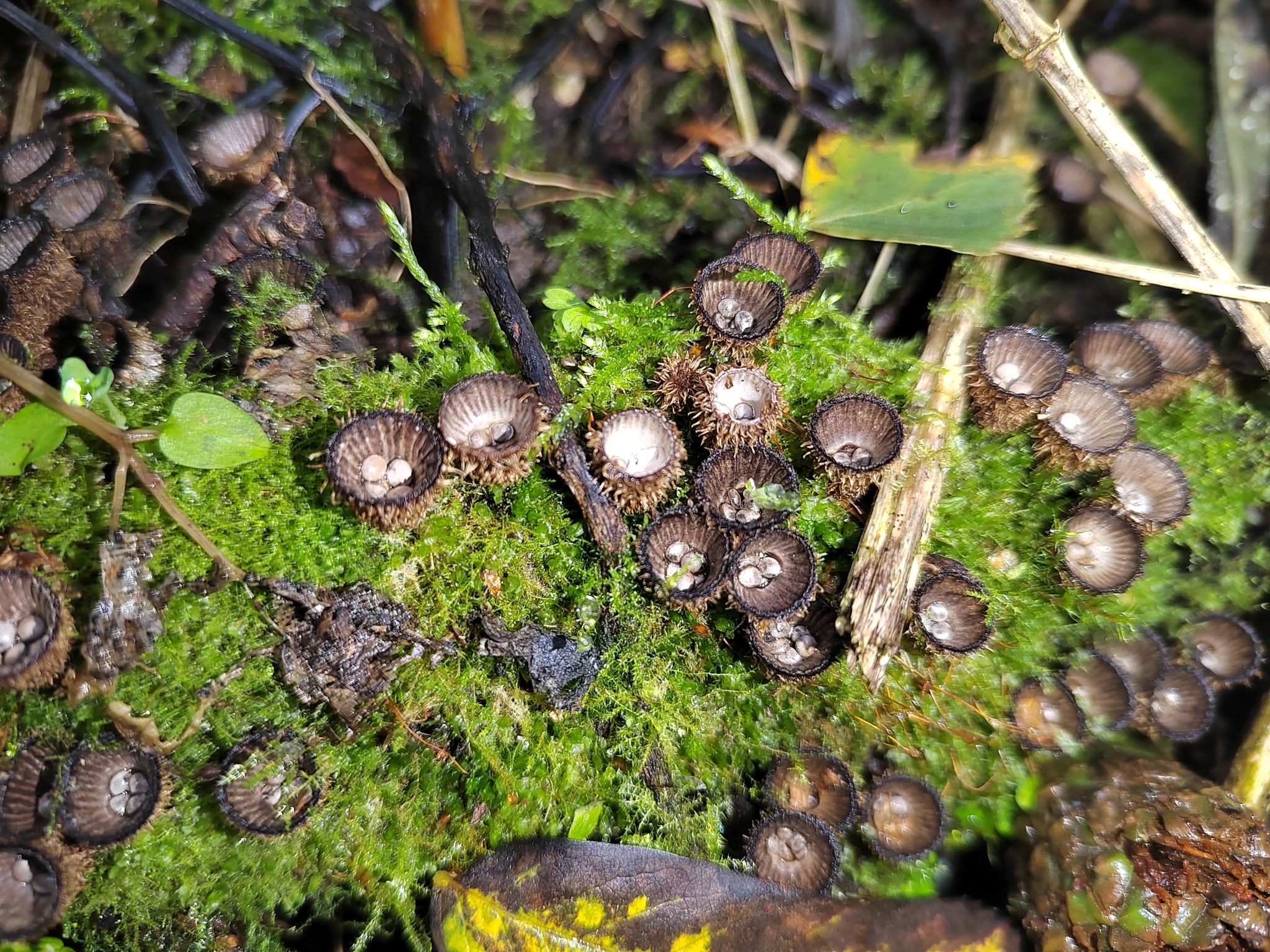
The English common name for this species is "fluted bird's nest." The resemblance to a nest is enhanced by the "eggs" lying at the bottom, which of course are not eggs at all, but specialized spore-bearing structures called peridioles. Another interesting name is "splash cups," which reflects one of the spore dispersal mechanisms: water droplets falling into the fruiting body wash out and "splash" the peridioles from the cup.
Specific epithet etymology
Striatus (Latin) — folded, wrinkled, shriveled.
Synonyms
Cyathella striata (Willd.) Brot., Fl. lusit. 2: 474 (1804)
Fruiting bodies annual. Cup-shaped, nest-like. Initially spherical or ovoid, becoming bell-shaped or elongated-funnel-shaped at maturity, 0.5–1.8 cm in height, 0.5–1 cm in diameter, with woolly root-like mycelial threads at the base. In young stage completely covered by an exoperidium; at maturity the upper part becomes flat and closed by a thin whitish film (epiphragm), which tears and disappears with age. Exoperidium (outer surface) rusty or dark brown, woolly; endoperidium (inner surface) lead-gray, may darken to black, longitudinally striate, fluted.
Xylotroph. Grows widely in deciduous, coniferous, and mixed forests. In groups on decaying wood and plant debris.
Conservation status
Not listed in the Red Data Book of the Russian Federation or regional Red Lists.
Similar species
All representatives of the genus Cyathus are very similar to one another.
Notes
C. striatus is extremely rich in bioactive components. As early as 1971, it was proven that the mushroom produces certain "indole" substances (multicomponent bioorganic molecules with an indole ring), as well as a complex of diterpenoid antibiotics. All these complexes together are called cyathins. A few years later, research showed that the indole substances are the so-called striatins. Striatins (A, B, and C) exhibit pronounced antifungal activity and also suppress both gram-positive and gram-negative bacteria. The Striated Bird's Nest also produces sesquiterpenes known as schizandronols. In addition, it contains the triterpenoids glochidone, glochidonol, glochidiol, and glochidiol diacetate, as well as cyathic acid, striatic acid, cyathadonic acid, and epistriatic acid. The last four of these components were unknown until their isolation from C. striatus. Extracts from the mycelium and culture fluid of C. striatus have shown antibacterial activity against Bacillus cereus and B. subtilis. After isolation of pure striatins (striatins A, B, and C), the latter demonstrated antibacterial activity against a large number of gram-positive and gram-negative bacterial species, as well as activity against imperfect fungi.
Related resources
Pegler D. N., Læssøe T., Spooner B. M. British puffballs, earthstars and stinkhorns. An Account of the British Gasteroid Fungi. — Royal Botanic Gardens, Kew, 1995. — 255 p. — P. 58.
Garibova L. V., Sidorova I. I. Mushrooms. Encyclopedia of Nature of Russia. — M.: "ABF", 1997. — 352 p. — P. 310.
Breitenbach J, Kränzlin F. Fungi of Switzerland. A contribution to the knowledge of the fungal flora of Switzerland. Vol. 2. Heterobasidiomycetes, Aphyllophorales, Gasteromycetes. — Lucerne: Verlag Mykologia, 1986. — 412 p. — P. 380.
Perova N. V., Gorbunova I. A. Macromycetes of the south of Western Siberia. — Novosibirsk: Publishing House of the Siberian Branch of the Russian Academy of Sciences, 2001. — 158 p. — P. 115.
Add new comment