Tuberaster — from Latin tuber ("tuber, swelling, knob") + diminutive suffix -aster + Greek astēr ("star"), referring to the distinctive star-shaped tuberous base of the stipe.
Synonyms
Boletus tuberaster Jacq. ex Pers., Synopsis methodica fungorum: 514 (1801)]
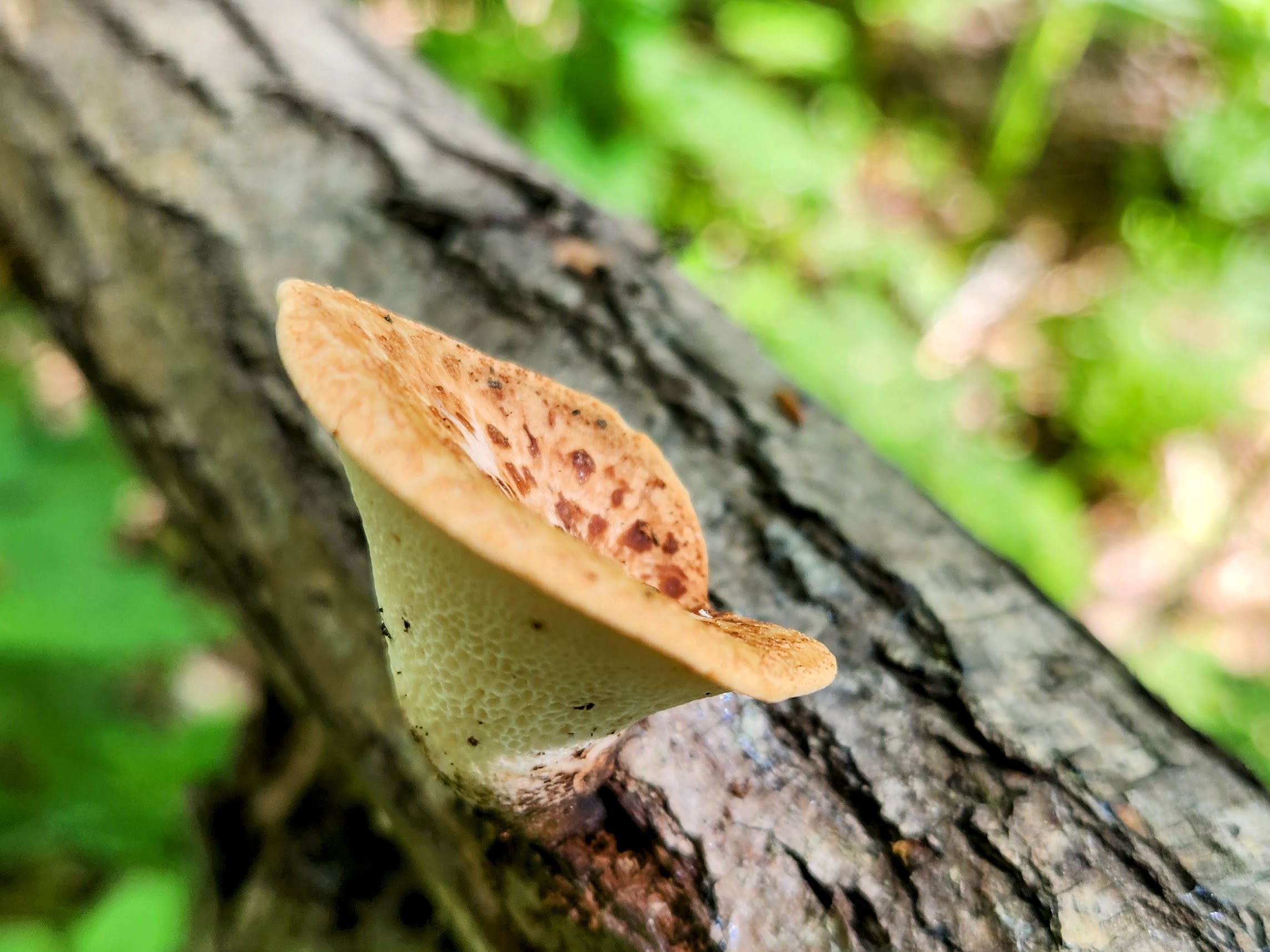
Cap: Rounded to semi-circular, centrally depressed, up to 15 cm across, 0.5–1.5 cm thick. Surface whitish, becoming yellowish to yellowish-brown, covered with small, appressed brownish to dark brown scales.
Pores: Medium-sized, yellowish, 1–3 mm, round to elongated, with uneven thick margins; sometimes becoming gill-like, slightly decurrent on the stipe.
Stem
Usually central, hollow, cream-colored, pubescent and darkening towards the base, 1–3 × 4–7 cm. A dark pseudosclerotium is present deep in the substrate.
Flesh
Whitish, rubbery, very elastic; becoming very succulent in wet weather; taste indistinct.
Odor
Weak, pleasant, fungoid, with slight floral notes.
Microscopy
Spore print white. Spores predominantly cylindrical, occasionally oblong, hyaline, smooth, thin-walled, usually with one or more guttules, (9.4–)10–16.3(–17) × (4.1–)4.5–7.2(–7.7) µm; inamyloid and non-dextrinoid (IKI−), acyanophilous (CB−).
Conservation status
Red Data Book of the Republic of Buryatia (2023)
Status 3. Rare species.
Red Data Book of Orenburg Oblast (2019)
Status 3. Rare species.
Similar species
Polyporus squamosus (Dryad's Saddle) differs by larger, somewhat denser fruiting bodies; dark appressed scales on the cap arranged concentrically; and a dark brown to blackish stipe base.
Coordinates
Related resources
Bondartseva M.A.Keys to Fungi of Russia. Order Aphyllophorales. Issue 2. 1998.
Storozhenko V.G., Krutov V.I., Ruokolainen A.V., Kotkova V.M., Bondartseva M.A.Atlas-Keys of Wood-Decaying Fungi of the Forests of the Russian Plain. Moscow: KMK Scientific Press, 2014, p. 110.
Lyubarsky L.V., Vasilyeva L.N.Wood-Decaying Fungi of the Far East. Novosibirsk: Nauka, 1975, p. 73, 163 pp.
Species diversity, taxonomy and phylogeny of Polyporaceae (Basidiomycota) in China / B.-K. Cui, H.-J. Li, X. Ji [et al.] // Fungal Diversity. — 2019. — Vol. 97, № 1. — P. 137–392.
Link to this page for printed editions
A. G. Shipovalov Tuberous Polypore (Polyporus tuberaster) - Прикладная микология [Электронный ресурс]
URL: https://xn----7sbancweblffgklubds60aja.xn--p1ai/en/tuberous-polypore-polyporus-tuberaster (дата обращения: 09.10.2026).


Add new comment