Viscid Limacella (Limacella delicata var. glioderma)
Index Fungorum Limacella delicata (Fr.) Earle ex Konrad & Maubl
MycoBank Limacella delicata var. glioderma (Fr.) Gminder
Tender Limacella, Slimy-skinned Limacella.
The Viscid Limacella is a very distinctive mushroom. Identification of an unfamiliar specimen, even to the genus level, is usually challenging because this mushroom combines features of different genera and families—Cortinarius, Lepiota, Tricholoma, and even Hygrophorus—and from above, specimens of this group can also be confused with boletes of the genus Suillus. The literature describes several closely related Limacella species of similar appearance, but none of these have been recorded so far in the Vologda Region.
Dēlicātus, a, um — delicate, fine, exquisite; elegant; effeminate; spoiled, capricious, fastidious.
Agaricus delicatus Fr., Syst. mycol. (Lundae) 1: 23 (1821)
Agaricus gliodermus Fr., Monogr. Hymenomyc. Suec. (Upsaliae) 1: 31 (1857)
Amanita delicata (Fr.) E.-J. Gilbert, Le Genre Amanita Persoon (Lons-le-Saunier): 168 (1918)
Amanitella glioderma (Fr.) Maire, Annls mycol. 11(4): 337 (1913)
Armillaria glioderma (Fr.) J.E. Lange, Fl. Agaric. Danic. 1: 41 (1935)
Gyrophila glioderma (Fr.) Quél., Enchir. fung. (Paris): 9 (1886)
Lepiota delicata (Fr.) P. Kumm., Führ. Pilzk. (Zerbst): 136 (1871)
Lepiota glioderma (Fr.) Gillet, Hyménomycètes (Alençon): 73 (1874) [1878]
Limacella delicata var. glioderma (Fr.) Gminder, Z. Mykol. 60(2): 386 (1994)
Limacella delicata var. vinosorubescens (Furrer-Ziogas) Gminder, Z. Mykol. 60(2): 386 (1994)
Limacella delicata var. vinosorubescens (Furrer-Ziogas) Gminder, in Gminder, Z. Mykol. 80(2): 647 (2014)
Limacella delicata var. vinosorubescens (Furrer-Ziogas) Gminder, Z. Mykol. 60(2): 386 (1994)
Limacella glioderma (Fr.) Maire, Bull. trimest. Soc. mycol. Fr. 40(4): 294 (1926) [1924]
Limacella glioderma f. brunnea (Killerm.) Neville & Poumarat, Fungi europ. (Alassio) 9: 217 (2004)
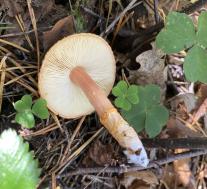
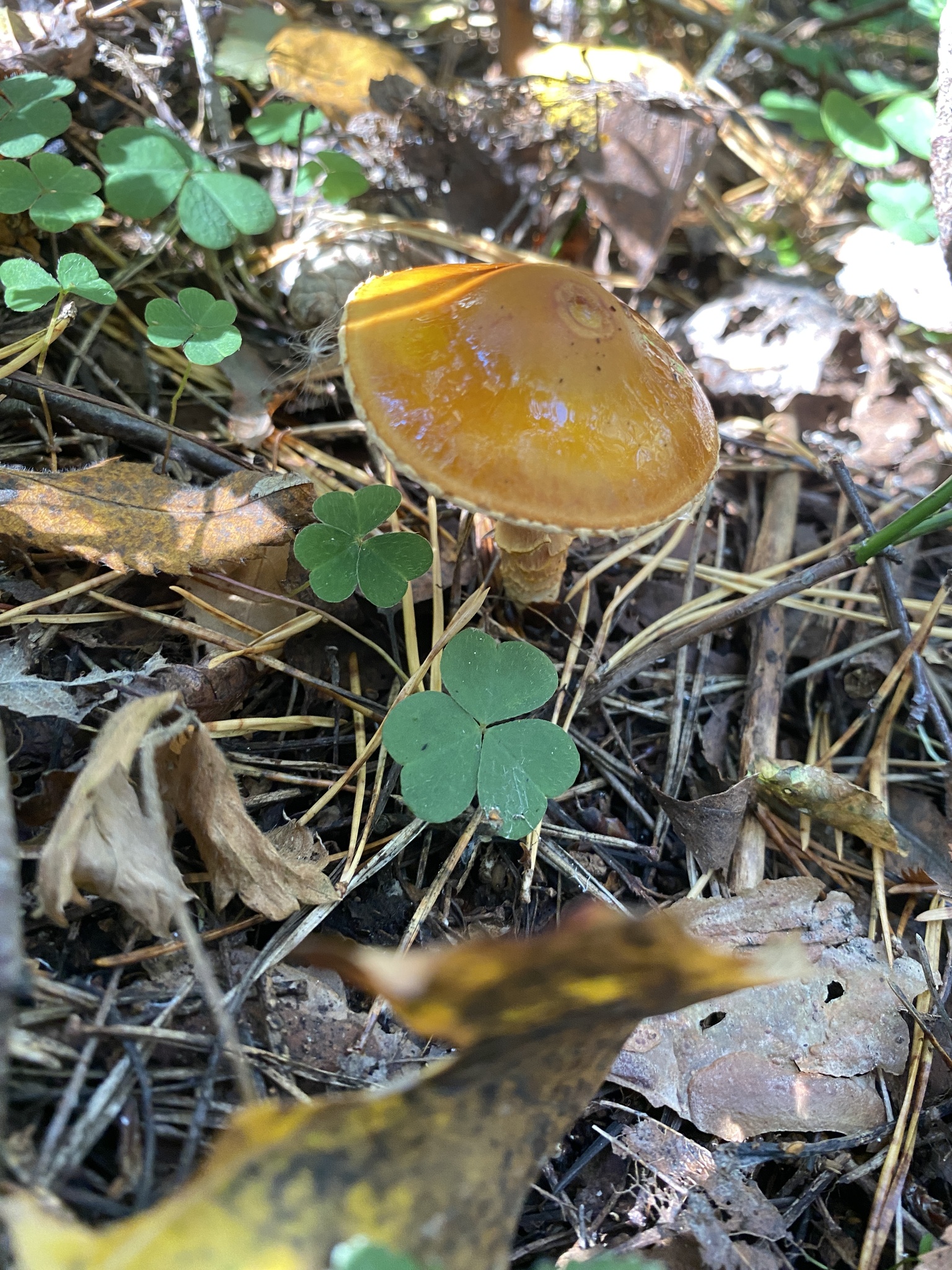
Cap 3–7 cm in diameter; initially spherical, becoming convex with age and eventually expanded-depressed, sometimes with an uneven, wavy margin, often bearing separate floccose or slimy veil fragments; cinnabar-red, brick-red, or reddish-brown, with a whitish or golden margin in young specimens; in older fruiting bodies sometimes fading to pale brick or beige, usually with a darker center.
Hymenophore: lamellate. Gills crowded, free, white, with a yellowish tint in older mushrooms.
4–8 cm long, 0.7–1.2 cm in diameter; cylindrical, sometimes with a slightly thickened base, solid. Surface pinkish or beige; smooth above the ring, while below the ring it is covered with felty or floccose fragments of the partial veil—which in young specimens and in wet weather may appear membranous or slimy. The veil remnants are ochre or brick-colored, forming a contrasting moiré pattern or almost completely covering the stem surface, especially toward the base. The ring is the same color as the stem surface, floccose-membranous, and may disappear or slide down the stem.
White, with a reddish-brown tint beneath the cuticle, fragile. Odor: mushroom-like, pleasant. Taste: faintly mealy.
Spore print: white. Spores round, smooth, hyaline, colorless.
Grows on soil and leaf litter, singly and in groups, in coniferous and deciduous forests. Probably forms mycorrhiza with Scots pine (Pinus sylvestris), although some sources suggest that the symbiosis with pine is facultative and that the species may be a saprotroph on litter. Like other Limacella species, it is a rare mushroom.
Status 3. Rare species.
Status 3. Vulnerable species
Status 3. Rare species.
Girded tricholoma (Tricholoma focale) – a species strictly tied to pine forests; it resembles gluey limacella in the coloration of the cap with orange-red, brick shades, white color of gills and flesh, and the scales on the surface of the stem of this tricholoma somewhat resemble the mottled remnants of a partial veil on gluey limacella. Girded tricholoma differs in larger size and massive, squat habit; cap surface often covered with large, closely pressed membranous scales and never slimy; denser, elastic flesh and absence of golden-orange tones in stem coloration. In addition, Tricholoma focale, like many other tricholomas, often grows in large groups and rings; typically fruits later than limacellas, at the very end of the season, usually in mid-September.
Slimy cortinarius (Cortinarius mucosus) – yet another common and widespread inhabitant of pine forests that can be confused with gluey limacella, although it belongs to a different family. The mushrooms are similar in size, red-orange color and slimy cap surface. The cap margin of young slimy cortinarius, like gluey limacella, is connected to the stem by a slimy cobweb-like veil. Unlike gluey limacella, the stem surface of C. mucosus is white or grayish-yellow, without distinct rust-colored bands, and gills noticeably darken with age, acquiring rusty-brown color from mature spores, as is characteristic of virtually all species of the genus Cortinarius. Yet another "twin species" from the cortinarius group is Ringed cortinarius (C. collinitus) – differs from the above-described species by lilac shade of the slimy veil on the stem surface.
Limiting factors: sensitivity to soil fertility, high recreational load, logging in coniferous-broadleaf areas.
Add new comment