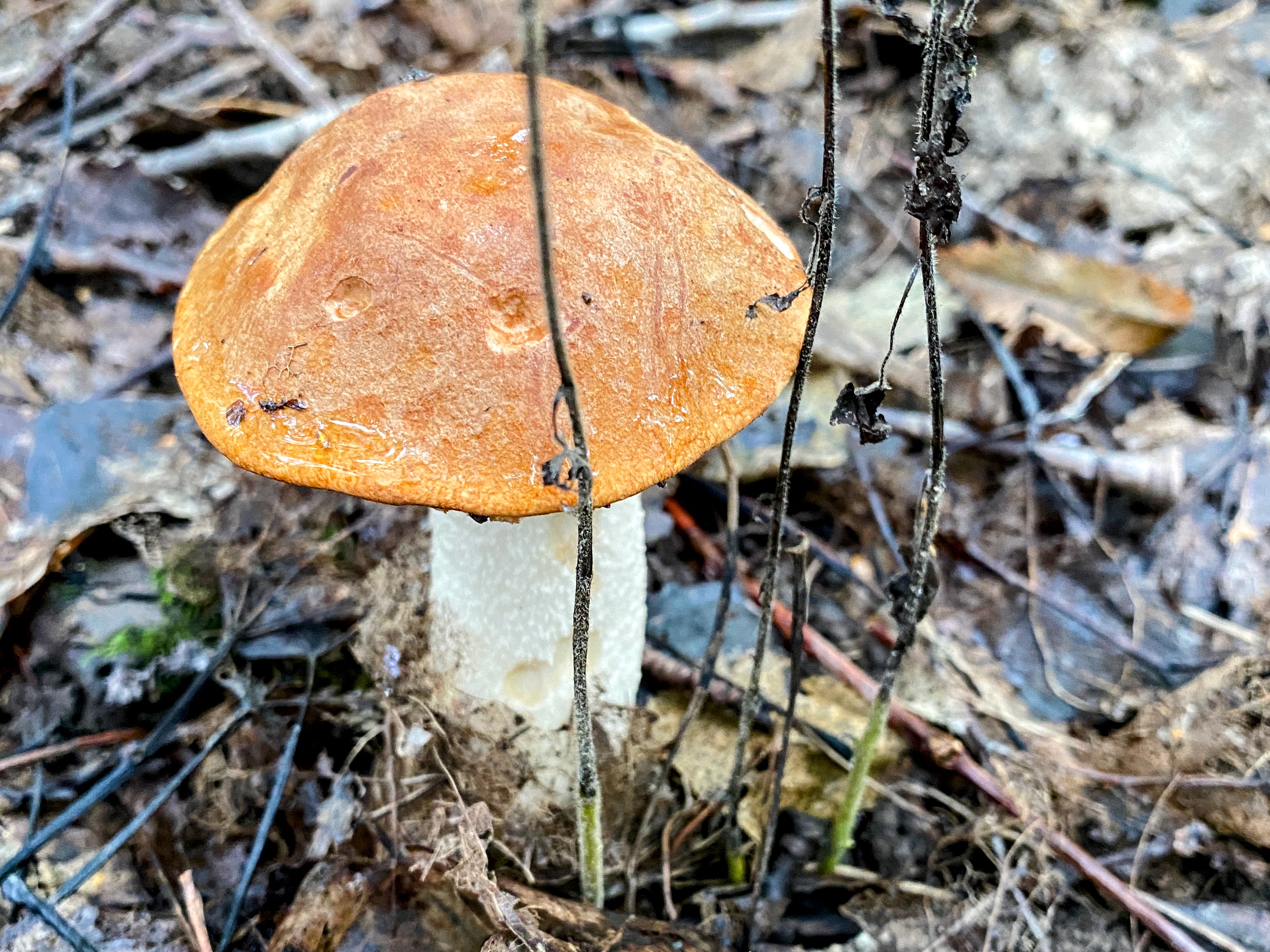
White-stemmed bolete (Leccinum albostipitatum)
Index Fungorum Leccinum albostipitatum den Bakker & Noordel
MycoBank Leccinum albostipitatum den Bakker & Noordel
Albostipitatus, white-stemmed. From albus (white) + stipes (stem, stipe).
Leccinum rufum (Pers.) Kreisel, Handbuch für Pilzfreunde. Die wichtigsten und häufigsten Pilze 1: 346 (1983)
Boletopsis rufa (Pers.) Henn., Die natürlichen Pflanzenfamilien nebst ihren Gattungen und wichtigeren Arten insbesondere den Nutzpflanzen : I. Tl., 1. Abt.: Fungi (Eumycetes): 194 (1900)
Boletus aurantiacus var. rufus (Pers.) Mérat, Nouvelle flore des environs de Paris. Ed. 2 1: 46 (1821)
Leccinum albostipitatum was scientifically described by mycologists Hendrik den Bakker and Machiel Noordeloos in 2005 following comparison of Populus-associated collections previously identified as Leccinum aurantiacum or Leccinum leucopodium.
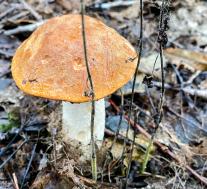
5–25 cm in diameter; hemispherical in young mushrooms, then expanding to become convex and cushion-shaped. The cap surface is velvety; in young specimens it curves down over the tubular layer. Coloration is bright or dark orange, becoming dull light brown when dry.
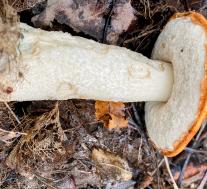
Hymenophore tubular, initially dense, then porous; yellowish-white with brown dots, becoming grayish-brown as spores mature; pores 0.5 mm in diameter.
5–27 cm long, 1.5–5 cm in diameter, cylindrical, sometimes thickened towards the base, white; surface densely covered with white scales (often with a bluish tint at the base); in old fruiting bodies, the scales become reddish-brown.
Firm, becoming tough in the stipe with age; white, turning lilac-pink when damaged, then grayish and finally blackening. At the base of the stipe, the cut flesh may show a bluish tint.
Mushroom-like, pleasant.
Spore print yellowish-brown. Spores (9.5) 11.0–17.0 × 4.0–5.0 (5.5) μm, fusiform with a conical apex. Basidia 25–35 × 7.5–11.0 μm, clavate, 2- or 4-spored.
Distributed in the forest zone of Europe and Russia. Grows in deciduous or mixed open forests, at forest edges, in clearings overgrown with young trees, and in meadows. Forms mycorrhiza with trees of the genus Populus, preferring aspen (Populus tremula) or trembling poplar.
Several species of orange-cap boletes occur in our forests. For more or less accurate species identification in the field, it is important to carefully note the forest type (i.e., which trees grow nearby) and a number of external characteristics: the colour and structure of scales on the stipe, the structure of the cap surface (smooth or velvety, with an even or overhanging margin), and colour changes upon damage (for this, the mushroom should be cut lengthwise and colour changes observed over several minutes, then again after a couple of hours). The same applies to birch boletes (common, bog, and others), which also belong to the genus Leccinum.
Orange-cap bolete (Leccinum aurantiacum) — grows in deciduous forests dominated by aspen; cap brick-red or orange, scales on the stipe reddish-brown and bright.
Yellow-brown bolete (Leccinum versipelle) — grows in deciduous forests dominated by birch; cap yellowish-ochre, scales on the stipe gray, hymenophore grayish.
Pine bolete (Leccinum vulpinum) — grows in pine forests; cap dark brick-red, scales black with a wine tint, hymenophore grayish-brown.
Add new comment