Orange Birch Bolete, Red-capped Scaber Stalk (Leccinum aurantiacum)
Index Fungorum Leccinum aurantiacum (Bull.) Gray
MycoBank Leccinum aurantiacum (Bull.) Gray
Common Bolete, red-cap, aspen bolete, red-head.
Aurantiacus (= aurantius), a, um, mycol. 1) orange; 2) orange-colored (relating to the fruit); 3) bitter-orange (Seville orange). From aurantium (orange tree/fruit) + -acus, a, um (suffix denoting quality or relation).
Krombholziella aurantiaca (Bull.) Maire, Publ. Inst. Bot., Barcelona 3 (4): 46 (1937)
Boletus scaber var. aurantiacus (Bull.) Opat., Commentatio historico-naturalis de familia fungorum Boletoideorum: 34 (1836)
Trachypus aurantiacus (Bull.) Romagn., Rev. Mycol. (Paris): 141 (1939)
Boletus versipellis var. aurantiacus (Bull.) Vassilkov, Edible and poisonous fungi of the medium belt of the European part of the USSR: 38 (1948)
Krombholzia aurantiaca (Roques ex Bull.) E.J. Gilbert, Les Bolets: 182 (1931)
Leccinum aurantiacum is characterized by fruiting in three distinct waves. The first wave ("kolosoviki" or "spike-mushrooms") occurs from late June to early July and is relatively sparse. The second wave ("zhnivniki" or "harvest-mushrooms") appears in mid-July, with more abundant fruiting. The third wave ("listopadniki" or "leaf-fall mushrooms") runs from mid-August to mid-September and represents the longest and most massive period of fruiting.
Between these waves and afterward, until mid-October, rare solitary fruiting may be observed—especially during wet summers, when the waves are less distinctly separated. In fact, this pattern holds true for most boletes: Leccinum species, Boletus edulis, and others.
Several species of Leccinum occur in our forests. For more or less accurate field identification, one should carefully note the forest type (i.e., which trees are growing nearby) and a series of external features: the color and structure of the scales on the stipe, the texture of the cap cuticle (smooth or velvety, with an even or overhanging margin), and color changes upon damage (for this, the mushroom should be cut lengthwise and color changes observed over several minutes, then again after a couple of hours). The same approach applies to birch boletes (Leccinum scabrum, L. uliginosum, and others), which also belong to the genus Leccinum.
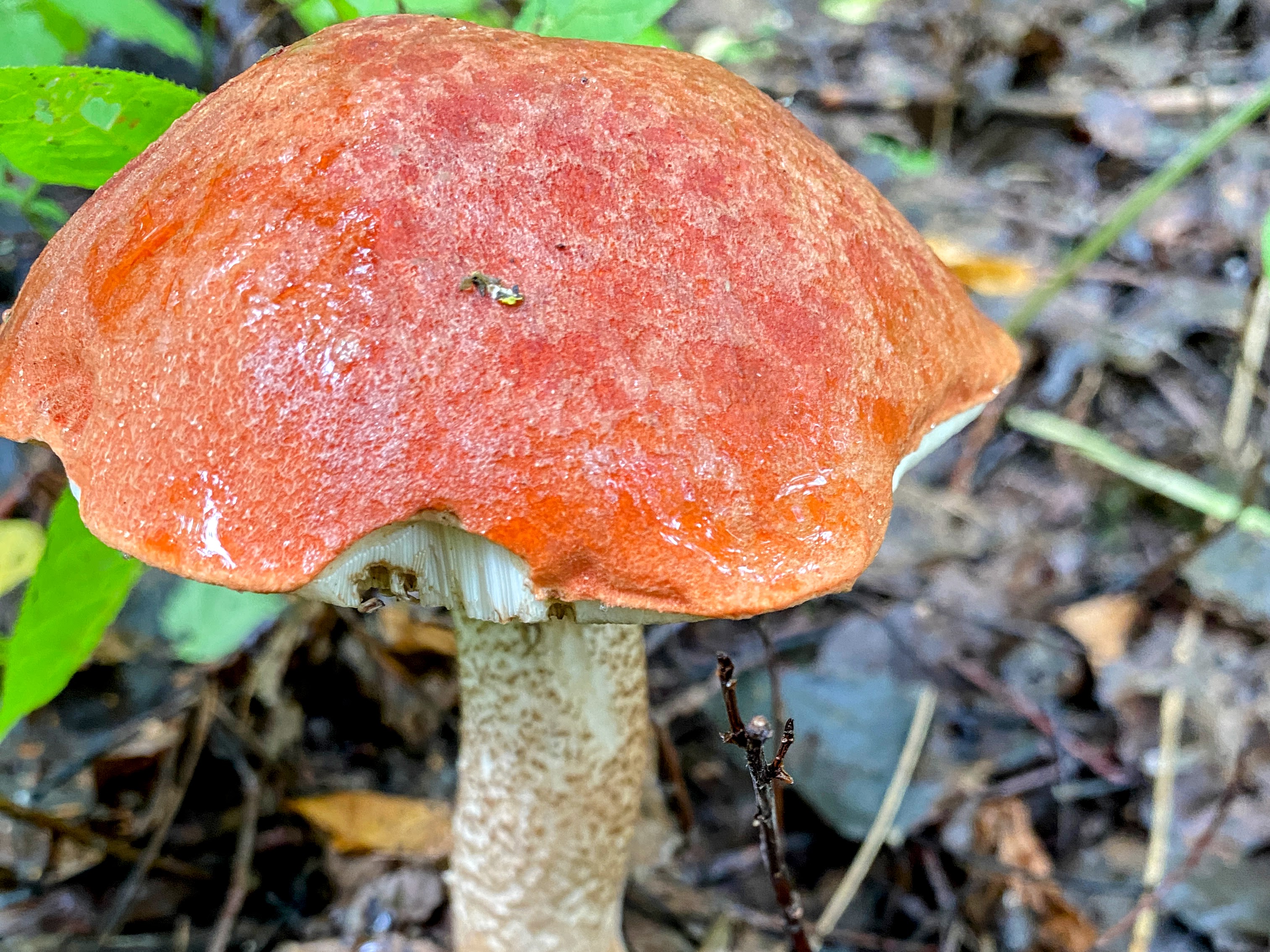
3–15 (25) cm in diameter, initially hemispherical, becoming plano-convex at maturity. In young fruiting bodies, the margin is initially pressed tightly against the stipe; as it matures, the cuticle forms hanging lobes along the edge, approximately 6 mm long. The surface is slightly, faintly velvety, bright red, reddish-brown, or orange, slightly darker at the center than toward the margin.
The hymenophore is tubular and adnate; pores are 0.2–0.5 mm in diameter, pale or creamy, turning brownish where damaged.
5–25 cm long, 1.5–4.5 cm in diameter, cylindrical, sometimes expanding toward the base, whitish or gray, often with a bluish tint at the base; covered along its entire length with scales that are initially red, darkening over time to reddish-brown or red-black.
White, turning purple when damaged, then grayish, eventually blackening; often becoming blue-green at the base of the stipe.
Mushroom-like, pleasant.
Spore print olive-brown. Spores smooth, fusiform.
Grows singly and in groups; forms mycorrhiza with various deciduous tree species (aspen, poplar, oak, beech, birch). It occurs in deciduous and mixed forests under young trees, in sparse deciduous woodlands, and can be abundant in aspen thickets. During dry summers, it appears in moist, mature aspen stands. Most often, it fruits in sparse groups or singly in clearings and along forest roads, among grass.
White-stemmed Bolete (Leccinum albostipitatum) — grows in deciduous forests dominated by aspen; cap bright orange, scales on the stipe white.
Yellow-Brown Bolete (Leccinum versipelle) — grows in deciduous forests dominated by birch; cap yellowish-ochre, scales on the stipe gray, hymenophore grayish.
Pine Bolete (Leccinum vulpinum) — grows in pine forests; cap dark brick-red, scales black with a wine-colored tint, hymenophore grayish-brown.
In fact, this distinction is not particularly important, as all Leccinum species are edible and possess excellent taste qualities.
From a taxonomic perspective, there is still no complete clarity regarding the genus Leccinum (Obabok), which is precisely why names such as "Pine Bolete" (Leccinum vulpinum, literally "pine aspen-bolete") exist—a designation that sounds somewhat odd to the Russian ear, since "podosinovik" etymologically means "under-aspen" (osina = aspen), implying an association with aspen trees rather than pines. This linguistic tension reflects the ongoing scientific debate about species delimitation and host specificity within the genus.
Add new comment