Winter Lentinus, Winter Polypore (Lentinus brumalis)
Index Fungorum Lentinus brumalis (Pers.) Zmitr.
MycoBank Lentinus brumalis (Pers.) Zmitr.
Winter Polyporus
Brumalis, e, mycol. winter. From bruma, ae f. 1) the period of the shortest days of the year, winter solstice; 2) winter season, winter cold, frost + -alis, e, suffix denoting relation or belonging.
Polyporus brumalis (Pers.) Fr., Observationes Mycologicae 2: 255 (1818)
Polystictus brumalis (Pers.) Fr. (?)
Polyporellus brumalis (Pers.) P. Karst., Meddeland. Soc. Fauna Fl. Fenn. 5: 37 (1879)
Leucoporus brumalis (Pers.) Speg., Bol. Acad. Nac. Ci. 28: 367 (1926)
Leucoporus brumalis (Pers.) Quél., Enchiridion Fungorum in Europa media et praesertim in Gallia Vigentium: 165 (1886) [MB#215815]
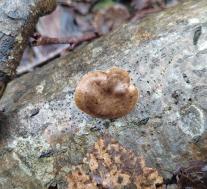
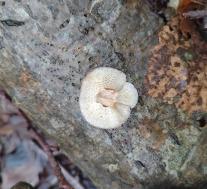
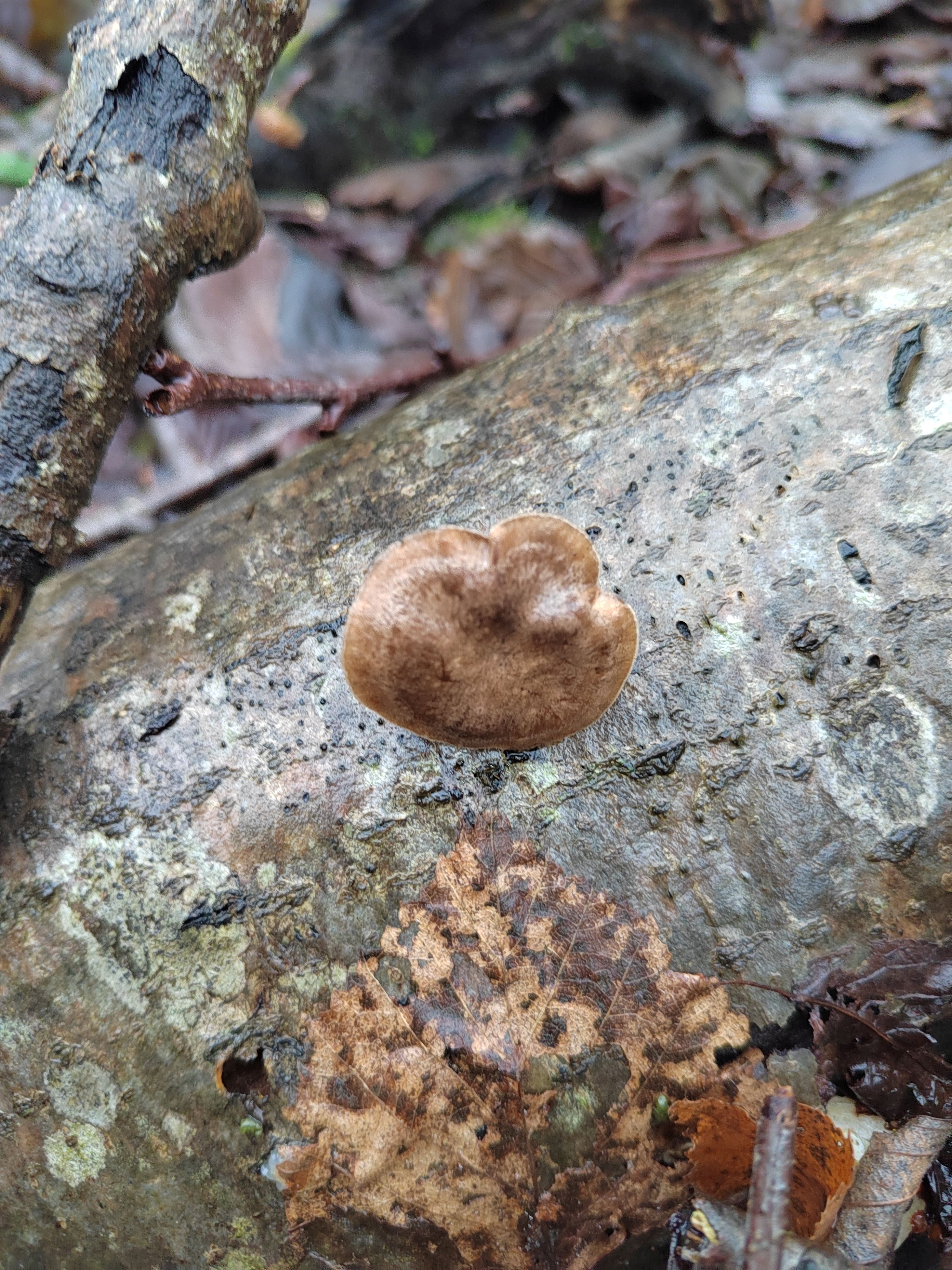
(1) 1.5–5 (6) cm in diameter, up to 0.5 cm thick, convex, rounded, slightly depressed at the center. The cap surface is covered with tufts of short conical hairs, giving it a granular or tufted appearance; later becoming glabrous, more or less rough, sometimes with indistinct appressed scales, brownish or bistre-colored, often with a reddish or even yellowish tint. The margin is sharp, fringed, sometimes with noticeable short hairs, becoming glabrous with age.
Tubes short, up to 1–2 mm long, sometimes decurrent, almost pale ochre with a whitish-mealy bloom. Pores rounded-angular or radially elongated, 0.3–1 × 0.2–0.6 mm, averaging 3 (4) per mm.
Stipe shape: cylindrical, smoothly expanded at the top where it meets the cap, straight or curved.
Cavity in the stipe: absent.
Stipe color: same as the cap, sometimes slightly darker or lighter; coloration may vary in intensity, lighter near the tubes at the top.
Thin, leathery, very tough, quickly hardening with age, white. Color change of flesh when cut: not observed. Taste indistinct.
Very weak.
Spore print white. Spores short-cylindrical, sometimes somewhat fusiform, flat or slightly curved on one side, weakly pointed at the base, often with two droplets at the poles, 5–7 × (1.5) 2–3 μm. Hyphal pegs present.
Singly, occasionally in pairs of fruiting bodies, in forests of various types on fallen branches, deadwood, and old rotten stumps of various deciduous trees, rarely conifers. Habitat: anywhere where the necessary substrate is present, but generally encountered in forests.
Distribution: widespread but not frequently encountered. Widely distributed throughout the temperate zone of the Northern Hemisphere.
Other small polypores, from which brumalis is distinguished by its characteristic reddish tint in coloration, or—in the absence of this feature in specific specimens—by its growing season. Without practical familiarity with the mushroom, one might confuse it with May Lentinus (Lentinus substrictus), but that species is larger, sturdier, and has very small pores.
Cultures of L. brumalis were delivered to three different satellites (the Salyut-5 space station, the Salyut-6 space station, and Kosmos-690) to study the effects of weightlessness, spatial orientation, and lighting on geotropism and fruiting body formation. Under conditions of zero gravity and darkness, the stipe became strongly twisted, forming a spiral or sphere, and caps failed to develop; however, when light was present, anatomical differences from control specimens were minor. On Salyut-6, where samples were kept in darkness, fruiting bodies did not form at all.
L. brumalis has been studied for its potential ability to degrade dibutyl phthalate. A 2007 study reported that dibutyl phthalate virtually disappeared from the nutrient medium of L. brumalis within 12 days, possibly as a result of transesterification and de-esterification processes.
Add new comment