Wood Blewit (Lepista nuda)
IndexFungorum Lepista nuda (Bull.) Cooke 1871
MycoBank Lepista nuda (Bull.) Cooke
Purple Lepista, Naked Lepista, Lilac Row, Bluecap. The colloquial English name "blewit" is most likely a corrupted spelling of the word "bluet," analogous to the Russian "sinyukha" (little blue one), and is associated with the blue and lilac tones in its coloration.
Nūdus, a, um — bare, naked, uncovered, lightly clothed, half-dressed, stripped of branches, leafless, shed of foliage, devoid of vegetation.
Rhodopaxillus nudus (Bull.) Maire
Tricholoma nudum (Bull.) P. Kumm., Der Führer in die Pilzkunde
Clitocybe nuda (Bull.) H.E. Bigelow & A.H. Sm., Brittonia
Tricholoma personatum var. nudum (Bull.) Rick
Gyrophila nuda (Fr.) Quél
Cortinarius nudus (Bull.) Gray
Agaricus nudus var. nudus
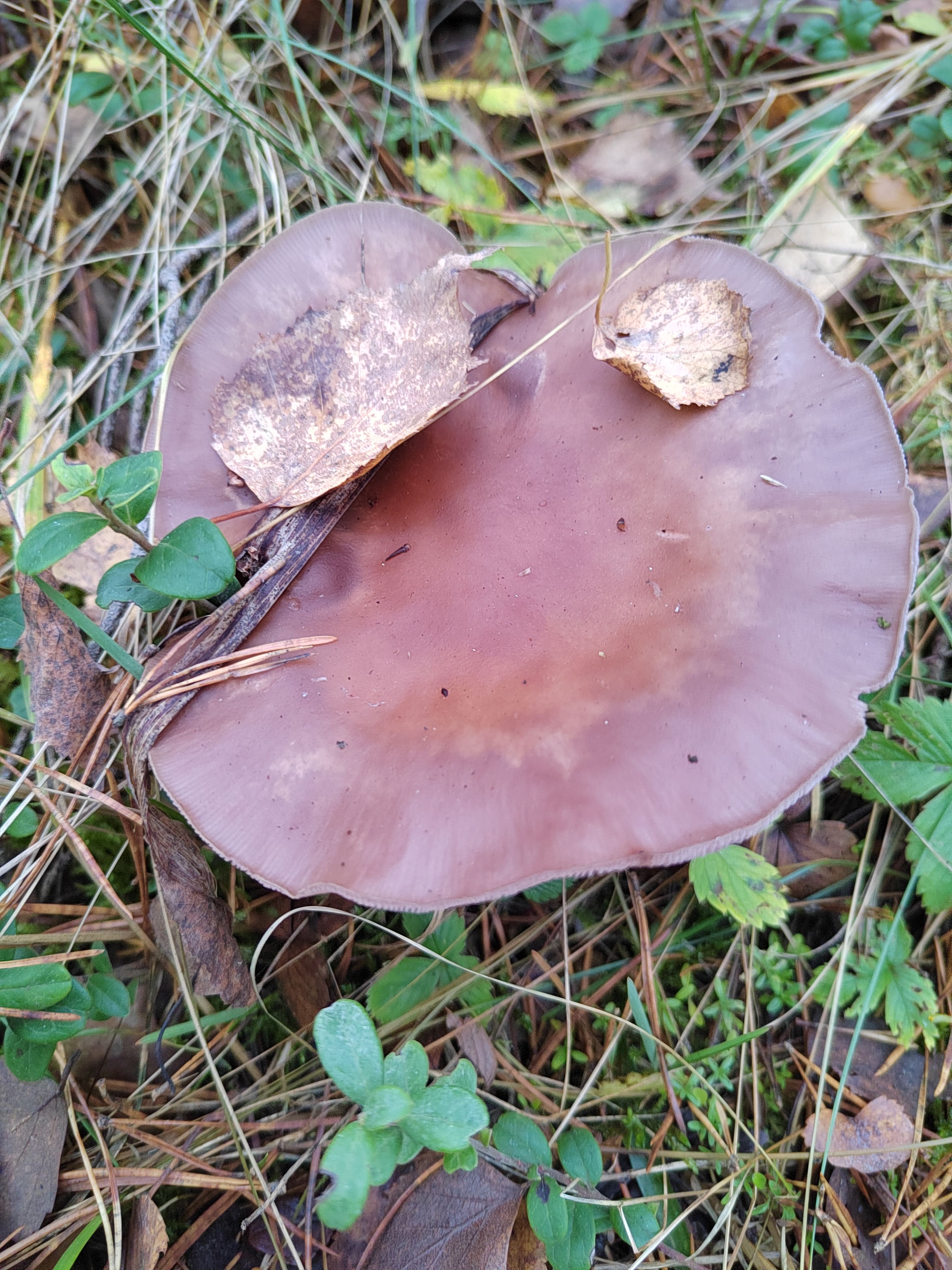
25–200 mm in diameter; initially convex with an incurved margin, becoming spread-out with a broad umbo in the center or slightly depressed at maturity. The margin remains incurved for a long time, becoming wavy with age. Surface smooth, matte, hygrophanous, slightly sticky in wet weather. Color is variable and depends on age, habitat, and weather conditions: in young mushrooms the cap is purple, violet-blue, or lilac; brownish tones gradually appear from the edges with time; it progressively becomes paler, brownish-lilac, and may eventually lose almost all purple tones in its coloration. This color change is accelerated by frost.
50–110 mm long, 10–30 mm in diameter, expanding toward the base, clavate or with a bulbous thickening; solid or fibrous-floccose, with cavities, especially in old specimens and during dry weather. The base of the stipe deeply penetrates the substrate, enveloping fragments of litter. Surface longitudinally fibrous, with fine scales in the upper part, often forming a zigzag pattern. Color of the stipe — both surface and flesh — ranging from dirty white to purple.
Lilac or whitish. Taste mild, pleasant, mushroom-like or nutty.
Spores 5.5–9.0 × 4.0–5.5 µm, Q = 1.2–1.9, ellipsoid [1].
Basidia 15–26 × 5–8 µm, 4-spored [1].
Cystidia absent [1].
Pileipellis — a cutis composed of more or less radially arranged hyphae 2–8 µm in diameter [1].
Clamp connections frequently present [1].
A humus saprotroph, growing in large groups on litter. According to literature, it occurs in both coniferous and deciduous forests. In the Vologda Region, it has been recorded in pine forests or mixed forests with birch, pine, and spruce, and is often found in ruderal biotopes. Fairly common within the Cherepovets District. Forms fairy rings, sometimes of very large size.
The species is assigned category 3 — "Potentially vulnerable" (NT). Conservation measures: preservation of the natural state of its habitats is required.
Greyish-lilac Row (Lepista glaucocana) is a very similar, closely related mushroom. It sometimes differs by even larger size and lighter, lilac-grey or bluish-grey, sometimes dirty-white coloration of the fruiting bodies, although some specimens can be quite vividly colored. It can also grow in large rows and rings. In Western Siberia, it prefers subory forests on rich, non-acidic soils. It is one of the typical species of old-growth sedge-bracken Ob River subory forests.
Blue-leg (Lepista personata) resembles L. nuda in all respects, but only the stipe is colored in bright blue or purple. It is common in many regions of the country, in some places preferring meadows and pastures. It fruits, as a rule, late, in September–October. A good edible mushroom.
Dirty Row (Lepista sordida) is generally a very similar, closely related mushroom. It differs by significantly smaller and more delicate fruiting bodies, and typically grows singly or in small groups. Edible.
It can also be confused with some webcaps colored in purple tones, for example the Violet Webcap (Cortinarius violaceus) or the Pale Violet Webcap (Cortinarius alboviolaceus).
Wood Blewit is cultivated in some countries. It is less demanding regarding substrate — part of the substrate used for growing button mushrooms can be reused, it is almost not susceptible to bacterial and fungal contamination, but it is highly dependent on temperature and humidity conditions.
Add new comment