Bovine Bolete, Cow Bolete (Suillus bovinus)
Index Fungorum Suillus bovinus (L.) Roussel
MycoBank Suillus bovinus (L.) Roussel
Lattice bolete, cow mushroom, dry bolete, shitik (little awl).
It is difficult to say why this fungus received such an unappetizing name. Several versions exist: that it has a smell like a goat—i.e., very unpleasant; that it grows in areas used for cattle grazing; that it is readily eaten by cattle; or that the shape of the fruiting bodies resembles goat horns. Honestly, in both young and mature specimens, the odor is faint but pleasantly mushroom-like. The argument about grazing areas is also not very convincing, given that this is a mycorrhiza-forming fungus. The shape does not differ significantly from other Suillus species. Let us settle on the fact that the mushroom is eaten by cattle. There is nothing alarming in this—the common chanterelle, for example, is part of the autumn diet of moose, and there is nothing particularly frightening or threatening about that. The version that Kozlyak was used as fodder for livestock seems highly doubtful to us. Meanwhile, Kozlyak belongs to the genus Suillus, which makes it at least worthy of attention. One of its names, "reshetochnik" (lattice bolete), reflects the large pores of the hymenophore, which are somewhat lattice-like in structure.
Bovinus, a, um — bovine, relating to cattle. From bos, bovis (m.), bull/ox + -inus, a, um (suffix denoting quality or relation).
Mariaella bovina (L.) Šutara, Česká Mykol. 41 (2): 76 (1987)
Ixocomus bovinus (L.) Quél., Flore mycologique de la France et des pays limitrophes: 413 (1888)
Agaricus bovinus (L.) Lam., Encyclopédie Méthodique, Botanique 1-1: 52 (1783)
Viscipellis bovina (L.) Quél., Enchiridion Fungorum in Europa media et praesertim in Gallia Vigentium: 157 (1886)
Viscipellis bovina (L.) Quél.: 157 (1886)
Suillus bovinus (L.) Kuntze, Revisio generum plantarum 3 (3): 535 (1898)
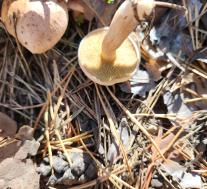
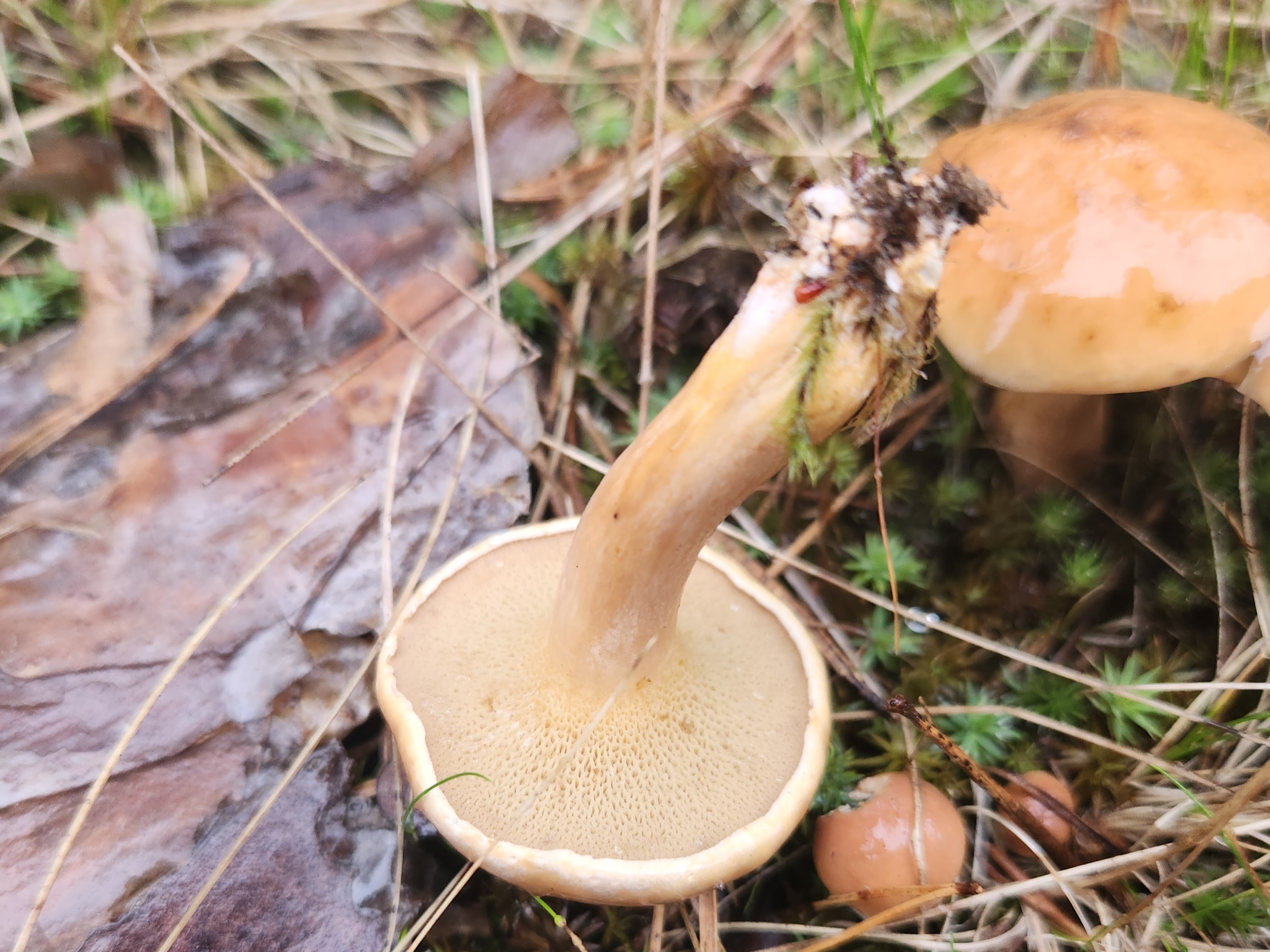
3–12 cm in diameter, initially hemispherical to convex with an inrolled margin; as it matures, it expands to become spread-out, and in old age flat, sometimes uneven or tuberculate. The surface is smooth, slightly sticky in wet weather, orange-brown, pinkish-brown, or yellowish-brown, with lighter shades toward the margin.
The hymenophore is tubular and slightly decurrent; in young specimens it has a characteristic gray-olive color, later becoming dirty yellow. The pores are angular, elongated, and darken very little when damaged.
4–10 cm long, 1–2 cm in diameter, cylindrical, often curved, longitudinally fibrous, concolorous with the cap, with pink or yellowish mycelium at the base.
In young specimens, the flesh is dense and elastic; later it becomes loose and easily bruised, pale yellow with a brownish or reddish tint, and may turn slightly red or pinkish when cut. The taste has a slight sourness.
Weak, slightly resinous.
Spore print yellow-olive or light brown. Spores ellipsoid-fusiform, light yellow, smooth.
Forms mycorrhiza primarily with pine. It occurs in coniferous forests with pine on acidic, nutrient-rich soils in moist places, near roads, and on sphagnum bogs. It grows singly and in large groups. The mycelium of S. bovinus is parasitized by the Rosy Spike (Gomphidius roseus); they are often found together, as they fruit at the same time.
A widely distributed species throughout the northern temperate zone: Europe, including the European part of Russia and the North Caucasus, the Urals, Siberia, and the Far East. The Bovine Bolete is a species that favors disturbed habitats. In typical years, it is most commonly found along forest roads and trails, on sandy verges, and on man-made wastelands with sandy soil that are becoming overgrown with pine.
It is not listed in the Red Data Book of the Russian Federation or in regional Red Data Books.
Alder Bolete (Gyrodon lividus) — associated with alder (Alnus).
Peppery Bolete (Chalciporus piperatus) — usually smaller in size, with very fragile flesh and a distinctly bright yellow stipe base, reddish hymenophore, and does not grow in large groups.
Yellowish Bolete (Suillus flavidus) — stipe with a ring.
An experimental study in Portugal showed that Pinus pinaster trees grew better after inoculation with mycelium of S. bovinus, Laccaria laccata, and Lactarius deterrimus, and with spores of Pisolithus tinctorius and Scleroderma citrinum. These fungi have been proposed as alternatives to chemical fertilizers in pine horticulture.
The fruiting bodies form part of the late-summer diet of the Eurasian red squirrel, which collects mushrooms and stores them in tree forks as a ready food supply after the onset of frost. Several species of flies often use the fruiting bodies of S. bovinus to rear their offspring, including Bolitophila rossica, Exechia separata, Exechiopsis indecisa, Pegomya deprimata, and Pegohylemyia silvatica.
Add new comment