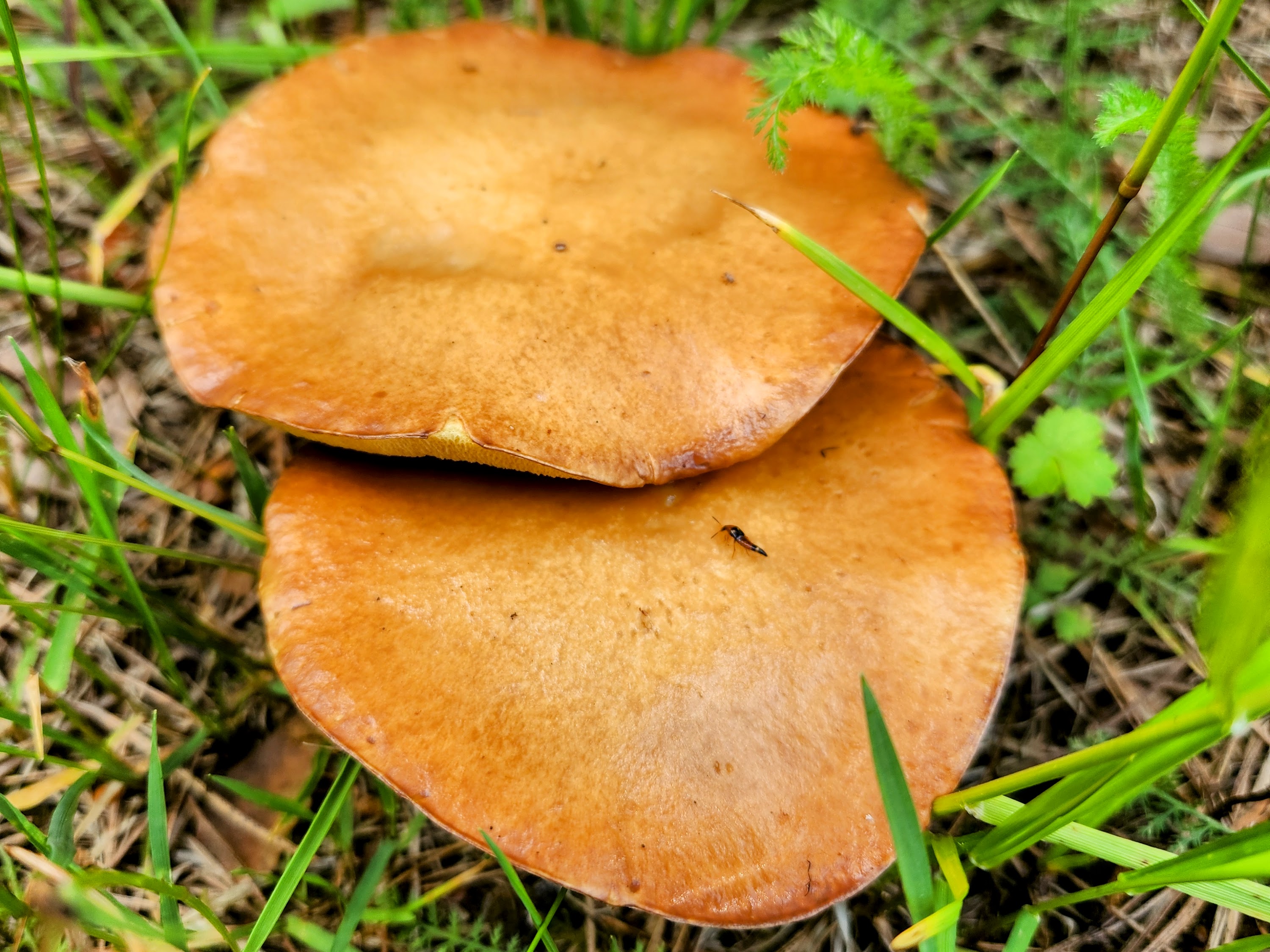
Weeping Bolete, Granulated Bolete (Suillus granulatus)
Index Fungorum Suillus granulatus (L.) Roussel
MycoBank Suillus granulatus (L.) Roussel
Summer Bolete, Early Bolete.
Granulātus, a, um, mycol. 1) granulated; 2) granular. From grānulum, i + -ātus, a, um (denoting quality).
Ixocomus granulatus (L.) Quél., Flore mycologique de la France et des pays limitrophes: 412 (1888)
Rostkovites granulatus (L.) P. Karst., Rev. Mycol. (Toulouse) 3 (9): 16 (1881)
Agaricus granulatus (L.) Lam., Encyclopédie Méthodique, Botanique 1-1: 51 (1783)
Viscipellis granulata (L.) Quél., Enchiridion Fungorum in Europa media et praesertim in Gallia Vigentium: 156 (1886)
Suillus granulatus var. granulatus (L.) Roussel, Flore du Calvados et terreins adjacents, composée suivant la méthode de Jussieu: 34 (1806)
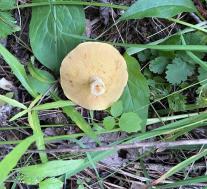
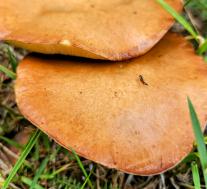
The purple spike (Chroogomphus rutilus s.l.) often parasitizes the Weeping Bolete; the fruiting bodies of these two species can be collected together.
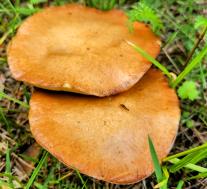
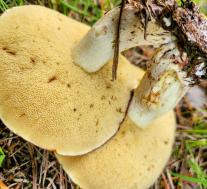
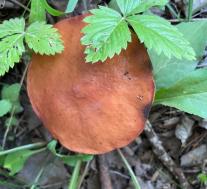
2–12 cm, hemispherical when young, then plano-convex, covered with a glossy, slimy pellicle that peels off easily. The pellicle coloration is yellowish- or ochre-brown, grayish-yellow, or reddish-brown. The lower surface of the cap (hymenophore) is tubular; the tubes are light yellow, becoming brownish-yellow or greenish as the spores mature. In young specimens, small milky-white droplets form on the tubular layer, leaving brownish spots upon drying.
4–8 cm high, 1–2 cm in diameter, solid, appearing rather short compared to the cap. The stipe surface is yellowish, speckled with darker spots from dried milky exudate. No ring present.
Flesh yellowish, soft, with a pleasant mushroom flavor.
Mushroom-like, pleasant.
Spore print yellow-brown. Spores 7.1–10.1 × 3.2–4.3 μm, Q = 1.7–2.8, ellipsoid, smooth.
Растёт в сосновых борах, в молодых и светлых хвойных лесах с сосной, в сосновых посадках, на полянах и опушках с сосновым подростом. Предпочитает песчаные почвы. Часто образует большие колонии, по несколько десятков штук на одном месте.
Status 3. Rare species.
Limiting factors: Disturbance of established ecological conditions in the species' habitats.
Almost all species resembling the Weeping Bolete are relatives and edible. The most well-known are the Common Bolete and the Larch Bolete (S. grevillei), which, unlike the granulated bolete, have a ring on the stipe. In addition, the Larch Bolete, as well as the Gray Bolete, grow in association with larch. Two species—the Yellow-Brown Bolete (also known as a type of mokhovik) and the Bovine Bolete (S. bovinus)—lack a ring, but the former has a dry, velvety cap, while the latter has a smooth but non-sticky pellicle. From the similar species, the True or Late Bolete (Suillus luteus), the Weeping Bolete is easily distinguished by the complete absence of a veil, which in young fruiting bodies of S. luteus covers the hymenophore and later remains as a membranous grayish-white ring on the stipe and as separate fragments along the cap margin. However, among boletes there is also a small, inedible look-alike—the Peppery Bolete (genus Chalciporus)—which differs by its reddish-brown tubes and sharply bitter taste.
Bioleaching is an industrial process for extracting metals from ores using living organisms, typically employed when the target metal is present only in trace amounts. It has been found that S. granulatus can extract trace elements (titanium, calcium, potassium, magnesium, and lead) from wood ash and apatite.
Add new comment