Common brittlestem (Candolleomyces candolleanus)
Index Fungorum Candolleomyces candolleanus (Fr.) D. Wächt. & A. Melzer
MycoBank Candolleomyces candolleanus (Fr.) D. Wächt. & A. Melzer
Psathyrella candolleana, Hypholoma candolleanum.
Candolleanus, a, um, dedicated to the French botanist and mycologist Augustin Pyramus de Candolle (1778 – 1841).
Agaricus candolleanus Fr., Observationes Mycologicae 2: 182 (1818)
Drosophila candolleana (Fr.) Quél., Enchiridion Fungorum in Europa media et praesertim in Gallia Vigentium: 115 (1886)
Hypholoma candolleanum (Fr.) Quél., Mém. Soc. Émul. Montbéliard Ser. 2, 5: 146 (1872)
Psathyra candolleana (Fr.) G. Bertrand, Bull. Soc. Mycol. France 17: 278 (1901)
Agaricus candollianus Fr. (1821)
Psathyrella candolleana (Fr.) Maire (1913)
Drosophila candolleana var. candolleana (Fr.) Quél.: 115 (1886)
Psathyrella candolleana (Fr.) Maire, Mém. Soc. Sci. Nat. Maroc 45: 112 (1937)
Agaricus violaceolamellatus DC., Flore française, Ed. 3 2: 143 (1805)
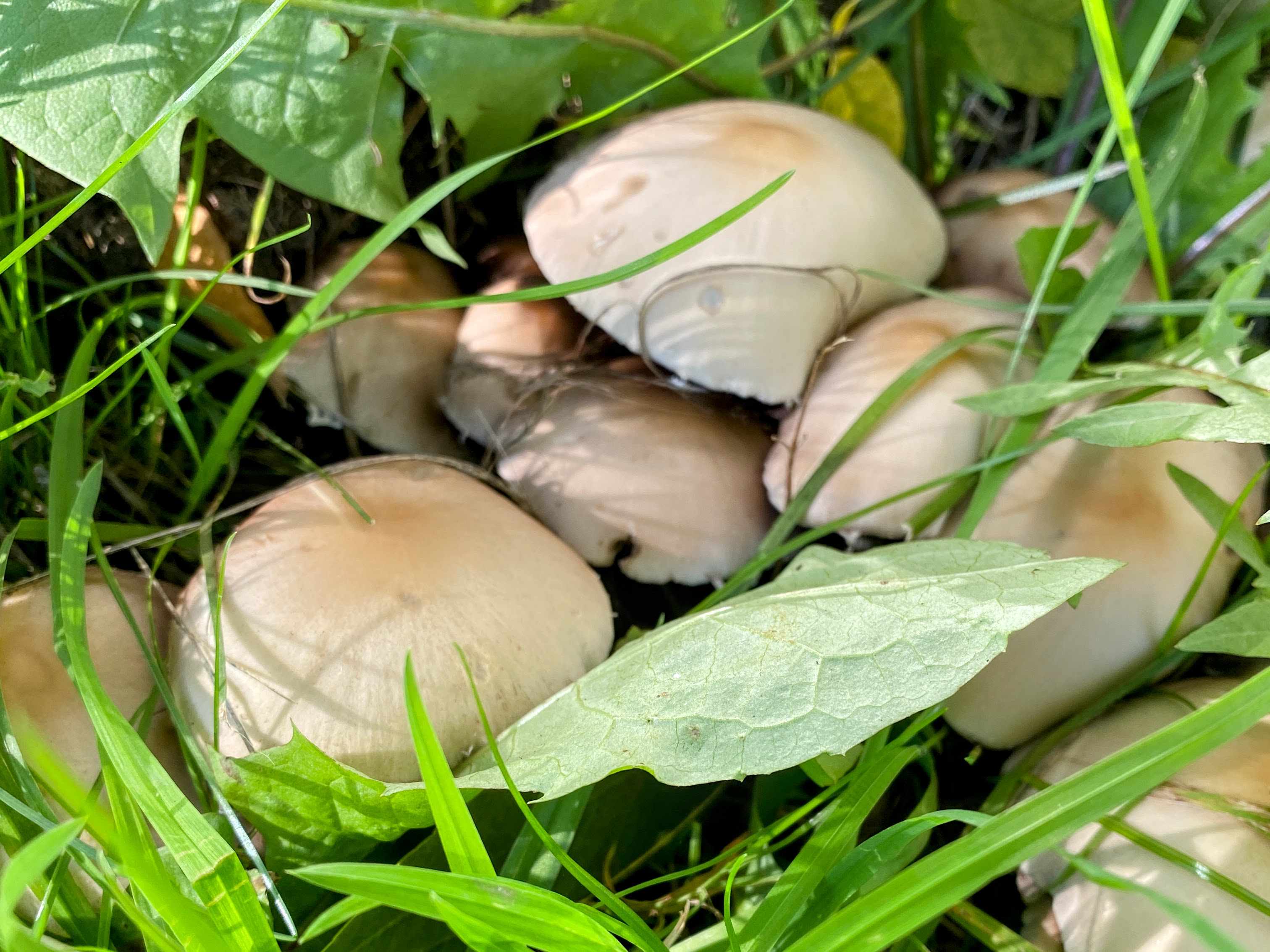
2-8 cm in diameter, hemispherical or bell-shaped in young mushrooms, flat-convex to flat in mature ones. Light yellow-brown in color, quickly fading to cream or grayish-cream; sometimes light gray in mature mushrooms, often with a noticeable yellowing in the center. Smooth, sometimes slightly radially wrinkled, often with a noticeable white fringe (remnants of the veil) along the edge. The edge is rolled, quickly straightening, thin, covered with flakes (remnants of the veil), often persisting into old age.
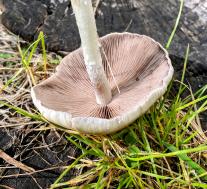
Gills: adnate, narrow, frequent, dirty white when young, later becoming a characteristic light gray with a distinct lilac or purple tint, gradually darkening, with a lighter edge.
Spore powder: violet-brown.
3-12 cm long and 3-7 mm in diameter. Cylindrical, slightly thickened at the base. White or off-white, grayish. No ring. The surface is smooth, silky, sometimes with light, flocculent remnants of a spathe at the top of the gills. The cavity in the stipe is wide and solid.
White or grayish-white, thin, and brittle. It doesn't change color when broken. The flavor is mild, mushroom-like, with a slight sweet note.
Weak, mushroomy.
The spore powder is violet-brown. Spores are 6.5–9 × (3.5) 4–5 µm, ellipsoid, slightly flattened on the adaxial side, with a distinct germinal pore and a small apiculus, transparent in aqueous solution, yellowish-brown in 5% KOH.
A saprotrophic insect that grows on deciduous wood debris, a facultative parasite. It is found in groups and clusters on and around stumps, fallen trunks, roots, buried fallen branches, and wood chips, often and abundantly, primarily in shaded areas. It is found in forests, parks, public gardens, lawns, garden plots, and even in drafty buildings. It sometimes parasitizes weakened deciduous trees.
Throughout the European part of the country, the Caucasus, Western Siberia, and Primorsky Krai; abroad, it is widespread in Europe and North America and has been recorded in Iraq.
A distinctive feature of Psathyrella candolii is the remnants of a partial veil on the cap margin. If these remnants are absent or unnoticed, it can be immediately distinguished from various species of small mushrooms by its location and growth habit (crowded on rotting wood), as well as the absence of any significant ring on the stem. It differs from members of the genus Agrocybe by the much darker color of its spore powder. Thus, identifying the mushroom as a Candolemycete is easy. However, distinguishing it from closely related species that smoothly merge into one another is not always possible. Psathyrella spadiceogrisea can be distinguished from Psathyrella gordonii by its dark coloration and denser habit. Psathyrella gordonii is very similar, only several times smaller.
Add new comment