Destroying Angel (Amanita virosa)
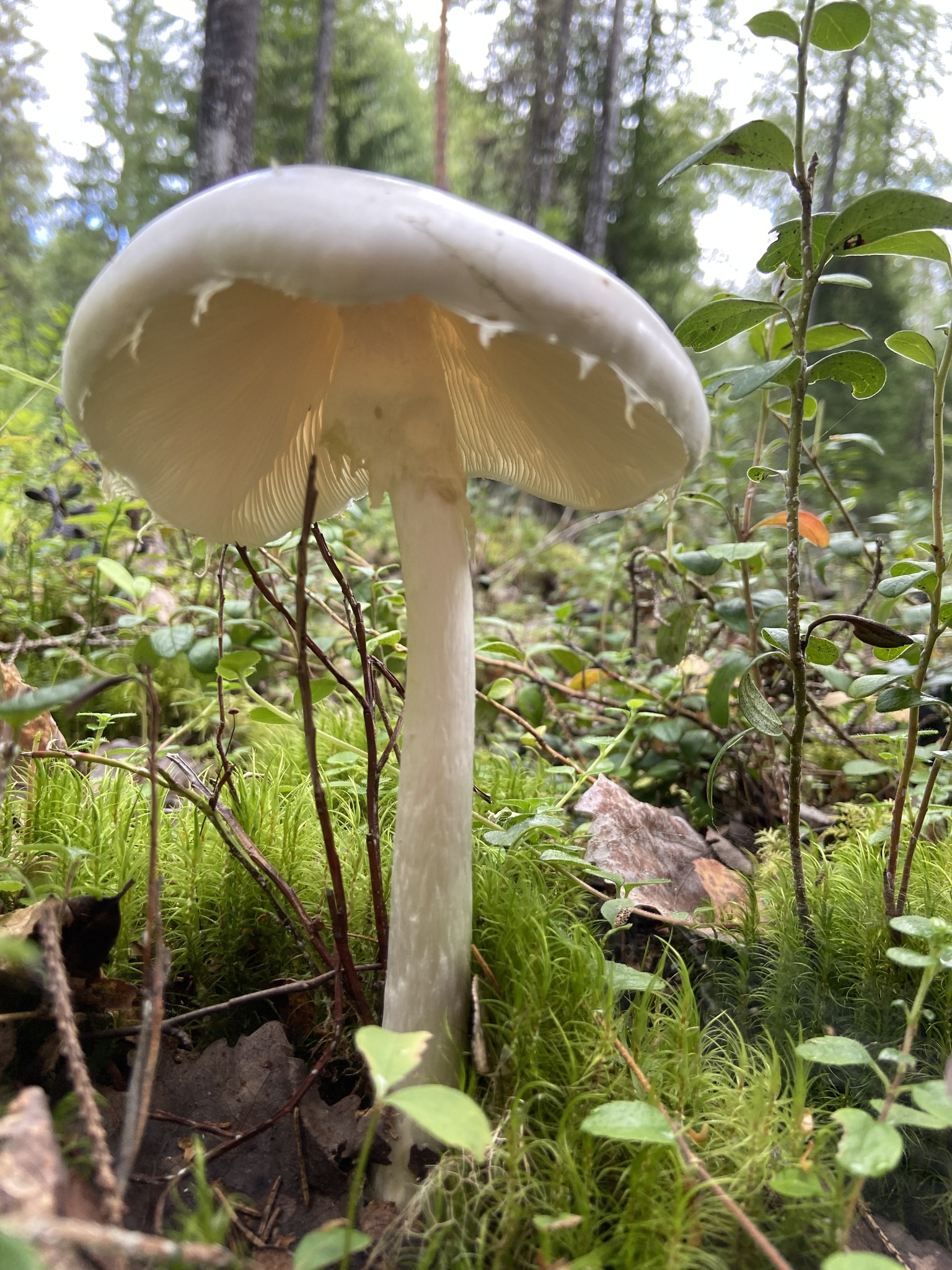
Мухомор вонючий
Current name

Index Fungorum   Amanita citrina Pers.

MycoBank  Amanita virosa Bertill

Other names

White poisonous mushroom, stinking Fly Agaric. Its resemblance to the Death Cap is also reflected in the English name of the mushroom — False death cap (false pale toadstool).

Systematic position
Specific epithet etymology

vīrōsus, a, um 1) covered with slime; 2) strongly smelling, 3) poisonous. From vīrus, i n 1) slime; mucous juice; animal seed; 2) poisonous secretion, poison; 3) poisonousness, acrimony, bitterness; pungency; 4) unpleasant odor, stench; 5) sharp taste, pungency; acrimony, bitterness + -ōsus.

Synonyms

Agaricus virosus Fr., Epicr. syst. mycol. (Upsaliae): 3 (1838) [1836-1838]

Amanita phalloides var. virosa (Bertill.) Sartory & L. Maire, Compendium Hymenomycetum, Amanita: 93 (1922)

Amanita virosa var. aculeata Voglino, Boll. Soc. bot. ital., 1894: 120 (1894)

Amanita virosa var. levipes Neville & Poumarat, Fungi europ. (Alassio) 9: 600 (2004)

Amanitina virosa (Bertill.) E.-J. Gilbert, in Bresadola, Iconogr. mycol., Suppl. I (Milan) 27: 78 (1940)
Habit
Fruiting body
Agaricoid (cap and stipe)
Hymenophore
Lamellate (gills present, including folded or rudimentary)
Fruiting period (list)
JunJune (21st–30th)JulJuly (1st–10th)July (11th–20th)July (21st–31st)AugAugust (1st–10th)August (11th–20th)August (21st–31st)SepSeptember (1st–10th)September (11th–20th)September (21st–30th)
Mushroom cap

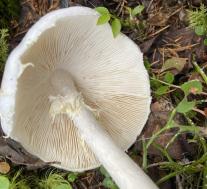
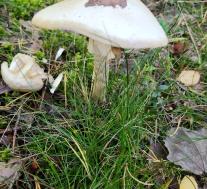
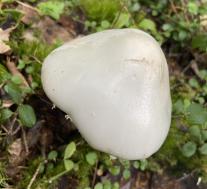
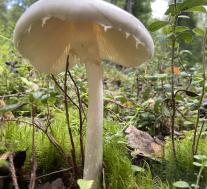
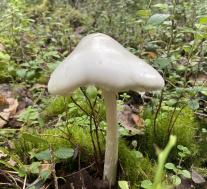
4–8 cm in diameter. Pure white; in young mushrooms egg-shaped, covered together with the rudimentary stipe by a white universal veil; with age it opens to bell-shaped with an inrolled margin and semi-expanded, often developing asymmetrically, which sometimes gives the impression of a "jauntily bent" appearance. Surface smooth, rarely covered with large flaky remnants of the universal veil, not very conspicuous against the white background. Cap margin dense, not striate. Hymenophore lamellate. Gills crowded, white, free, fairly broad, fragile. In young mushrooms covered by a white veil.

Stem

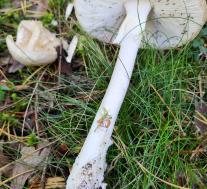
8–12 cm high and 0.5–1.5 cm thick, cylindrical, white, covered with white peeling scales in the form of "collars"; in the upper part of the stipe, noticeably higher than in other Amanita species, there is a white shaggy ring, a remnant of the partial veil. In the lower part — a tuberous thickening and a wide white volva, often hidden in the litter.

Flesh

Flesh white, yellowish, fragile.

Odor

Weak, reminiscent of rotting potatoes.

Microscopy

Spore print white. Spores nearly spherical, smooth.

Ecology and distribution

It grows ubiquitously; Amanita virosa is encountered infrequently but quite steadily in coniferous and mixed forests, forming mycorrhiza, apparently with spruce. The Destroying Angel typically grows singly. It prefers sandy soils.

Fruiting

July–September

Nutritional properties
Poisonous

Deadly poisonous mushroom. Fruiting bodies contain both amatoxins and phallotoxins. The most dangerous aspect of poisoning by this mushroom is the false sense of improvement, during which fatty degeneration of the liver occurs. The most reliable treatment is liver transplantation. Therefore, experimenting with the Destroying Angel is not advisable.

Similar species

Amanita virosa resembles the white form of the Death Cap, Amanita phalloides. Confusing these mushrooms is not particularly dangerous — both species are deadly poisonous. In terms of color similarity, the White Lepidella, Amanita alba, could be at risk of confusion — but it lacks a ring, has a relatively smooth stipe, and a cap margin that is striate due to the gills showing through. It is difficult to discuss the resemblance mentioned in literature to certain species of Agaricus and especially Macrolepiota.

Link to this page for printed editions
Shipovalov A.G. Destroying Angel (Amanita virosa) - Mushrooms of Vologda Region [Electronic resource] URL: https://xn----7sbancweblffgklubds60aja.xn--p1ai/en/destroying-angel-amanita-virosa (accessed: 13.04.2026).
Share link

Add new comment

One file only.
2 MB limit.
Allowed types: png jpeg jpg jpe gif webp svg.
Allowed types: png gif jpg jpeg webp svg.

Plain text

  • No HTML tags allowed.
  • Lines and paragraphs break automatically.
  • Web page addresses and email addresses turn into links automatically.
Add image
Maximum 8 files.
2 MB limit.
Allowed types: png jpeg jpg jpe gif webp svg.
Allowed types: png gif jpg jpeg webp.
January (1st–10th)
January (1st–10th)
January (11th–20th)
January (11th–20th)
January (21st–31st)
January (21st–31st)
February (1st–10th)
February (1st–10th)
February (11th–20th)
February (21st–28th/29th)
March (1st–10th)
March (1st–10th)
March (11th–20th)
March (11th–20th)
March (21st–31st)
March (21st–31st)
April (1st–10th)
April (1st–10th)
April (11th–20th)
April (11th–20th)
April (21st–30th)
April (21st–30th)
May (1st–10th)
May (1st–10th)
May (11th–20th)
May (11th–20th)
May (21st–31st)
May (21st–31st)
June (1st–10th)
June (1st–10th)
June (11th–20th)
June (11th–20th)
June (21st–30th)
June (21st–30th)
July (1st–10th)
July (1st–10th)
July (11th–20th)
July (11th–20th)
July (21st–31st)
July (21st–31st)
August (1st–10th)
August (1st–10th)
August (11th–20th)
August (11th–20th)
August (21st–31st)
August (21st–31st)
September (1st–10th)
September (11th–20th)
September (21st–30th)
October (1st–10th)
October (1st–10th)
October (11th–20th)
October (11th–20th)
October (21st–31st)
October (21st–31st)
November (1st–10th)
November (1st–10th)
November (11th–20th)
November (21st–30th)
December (1st–10th)
December (1st–10th)
December (11th–20th)
December (21st–31st)