Golden Bolbitius (Bolbitius titubans)
Index Fungorum Bolbitius titubans (Bull.) Fr
MycoBank Bolbitius titubans (Bull.) Fr.
Titubans — wavering, unsteady, tottering. Pres. act. participle of titubo, āvi, ātum, āre — to waver, to totter, to be unsteady.
Bolbitius vitellinus var. titubans (Bull.) M.M. Moser ex Bon & Courtec., Documents Mycologiques 18 (69): 37 (1987)
Prunulus titubans (Bull.) Gray, A natural arrangement of British plants 1: 632 (1821)
Pluteolus titubans (Bull.) Quél., Enchiridion Fungorum in Europa media et praesertim in Gallia Vigentium: 105 (1886)
Bolbitius vitellinus subsp. titubans (Bull.) Konrad & Maubl., Icones Selectae Fungorum Fasc. 4: pl. 171: 2, t. 171:2 (1928)
Pluteolus titubans var. titubans (Bull.) Quél.: 83 (1888)
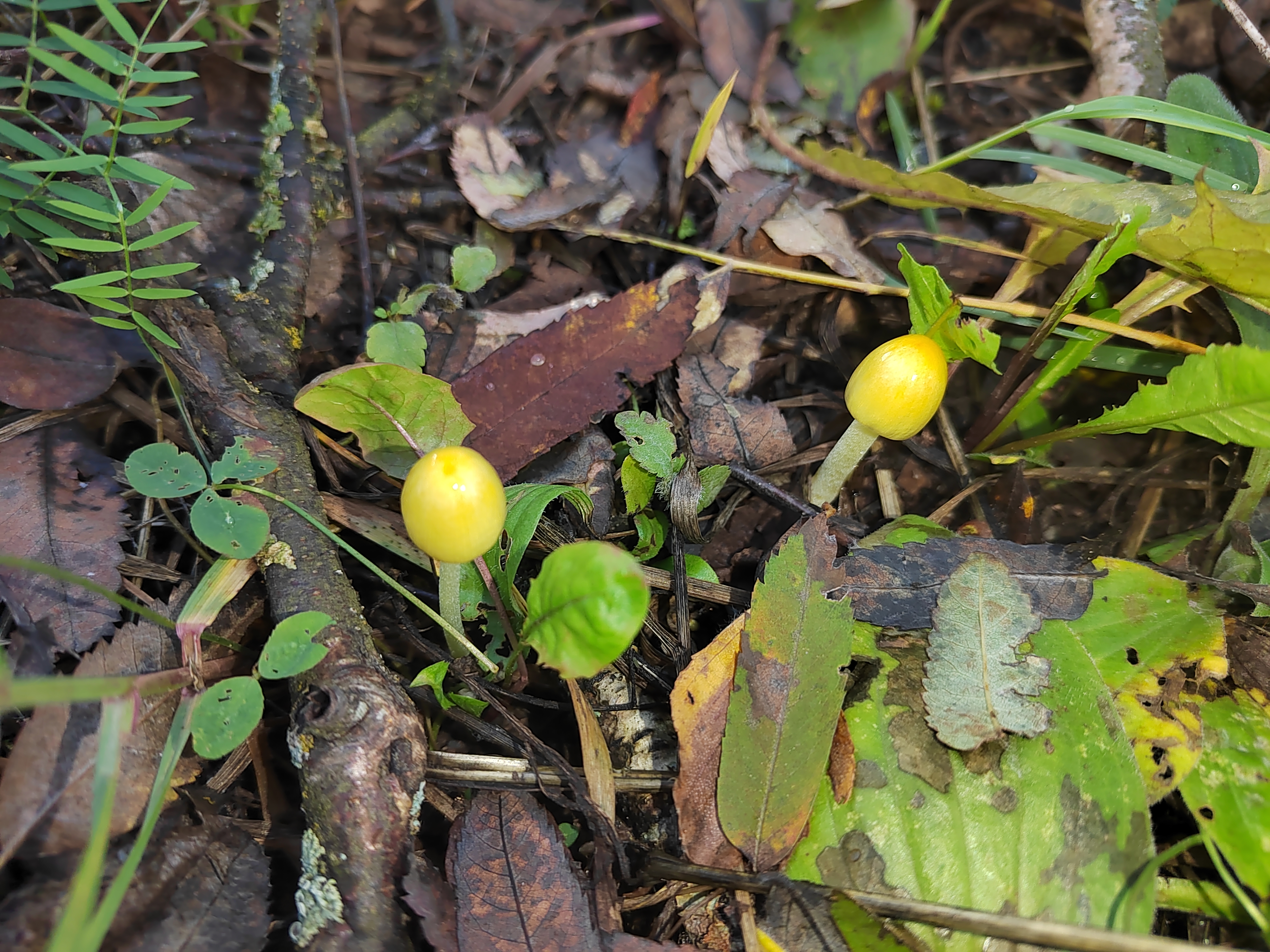
1.5–6 cm in diameter, 1.5–2.5 cm high; initially oval, egg-shaped, then bell-shaped or conical; in maturity becoming expanded, with a broad umbo or, conversely, depressed in the center. Surface usually slimy, with a sticky cuticle, sometimes dry, smooth, occasionally wrinkled at the center, not hygrophanous, with a ribbed-grooved margin. Coloration in young specimens bright yellow, golden, shining; later fading to olive-yellow, light brownish, yellowish-brown, pale at the margin with a yellow center. Occasionally, completely unpigmented fruiting bodies occur—white with a bluish tint.
Hymenophore lamellate (gilled). Gills free or nearly free, crowded, becoming slimy; in young specimens whitish, light yellow, or lemon-yellow; upon spore maturation they darken to grayish-brown or yellowish-brown.
4,5 – 10 см высотой, 0,2 – 0,8 см в диаметре, цилиндрическая или равномерно утолщённая к основанию, но без клубенька в основании, полая, хрупкая; белая, жёлтая, лимонно-жёлтая, покрыта беловатым мучнистым налётом по всей длине и более выраженными хлопьевидными чешуйками в основании.
Беловатая,ломкая, хрупкая. Запах слабый грибной.
Споровый порошок ржаво -бурый, желто - бурый. Споры широкоэллипсоидные, удлинённоэллипсоидные, яйцевидные, иногда слегка угловатые и уплощённые.
Подстилочный сапротроф. Растёт одиночно и небольшими группами на почве, растительных остатках, соломе, разрушенной древесине, или навозе.
Вид тяготеет к антропогенным местообитаниям — часто встречается в садах и огородах, в парках, на клумбах, повреждённой почве, вдоль дорожек и тропинок.
Not listed in the Red Data Book of the Russian Federation or regional Red Lists.
Bolbitius titubans is characterized by extreme variability in morphological features, ranging from the size and coloration of fruiting bodies to spore dimensions and substrate preferences. Consequently, it resembles many other mushroom species; however, the typical, reference form of this mushroom has no true look-alikes.
Recent studies (Malysheva et al., 2015), based on analysis of both phenotypic traits and molecular data (ITS, LSU, tef1, mtSSU), have shown that B. titubans evidently represents a complex of several morphotypes that are also phylogenetically distinct from one another (at least four well-supported clades are distinguished on the evolutionary tree). However, the question of the taxonomic status of these groups—whether they represent intraspecific taxa or separate species—remains open and requires further resolution through the inclusion of more material from various geographic regions and a thorough reevaluation of morphological and ecological criteria.
Add new comment