Gray Ink Cap (Coprinopsis atramentaria)
Index Fungorum Coprinopsis atramentaria (Bull.) Redhead, Vilgalys & Moncalvo
MycoBank Coprinopsis atramentaria (Bull.) Redhead, Vilgalys & Moncalvo
Ink Cap, inky mushroom. One of the English names for this fungus is "tippler's bane" — a curse for drunkards.
Atramentarius, a, um — ink-colored, inky. From atramentum, -i n — black liquid, black paint, ink + -ārius.
Agaricus atramentarius Bull., Herb. France 4 (40-48): t. 164 (1784) - Basionym
Coprinus atramentarius (Bull.) Fr., Epicrisis Systematis Mycologici: 243 (1838)
Pselliophora atramentaria (Bull.) Fr., Bidr. Känn. Finl. Nat. Folk: 528 (1879)
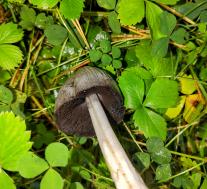
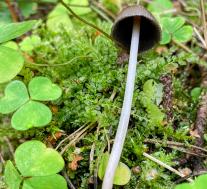
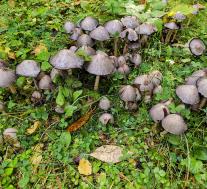
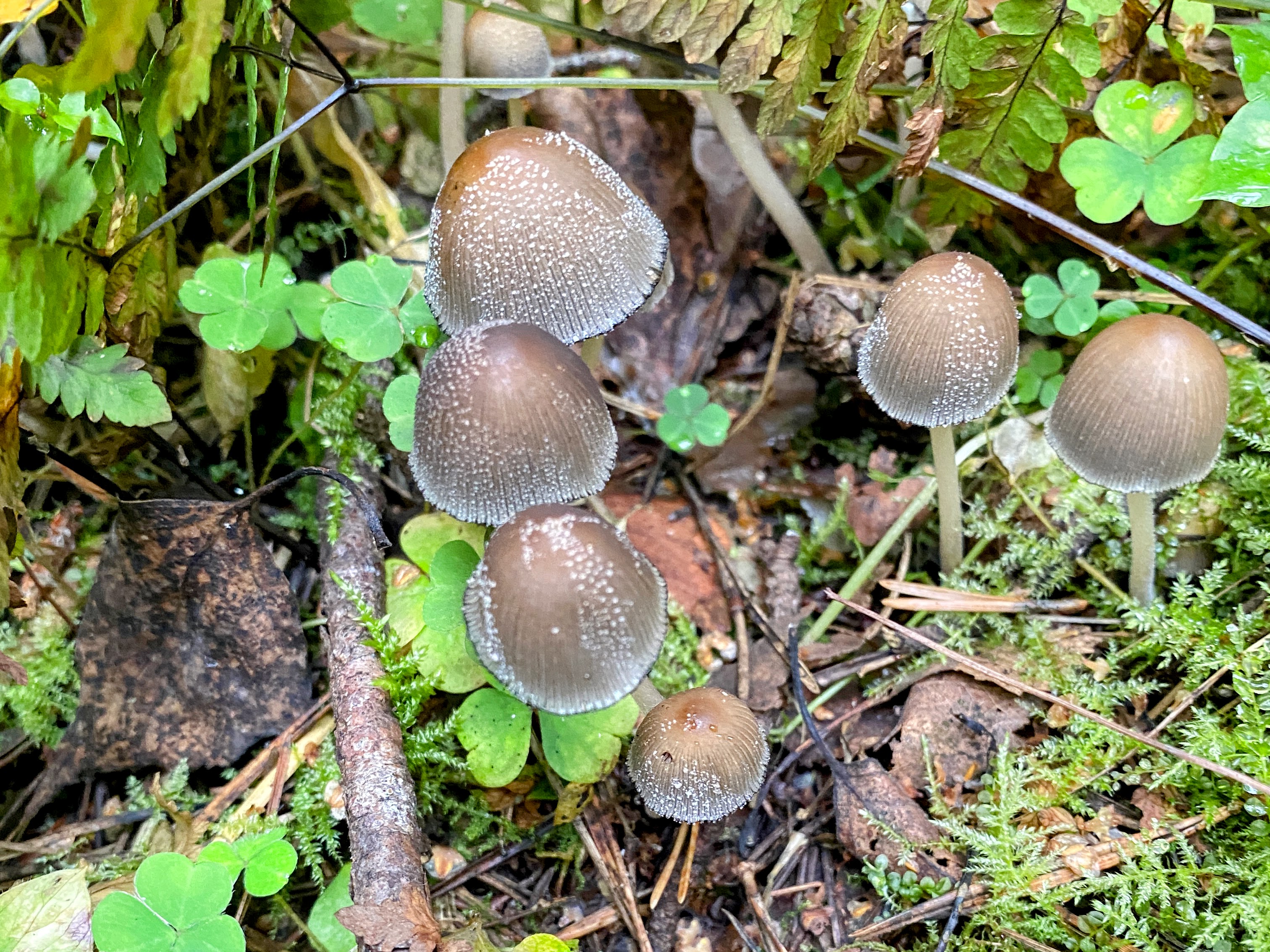
Cap height 3–7 cm, width 2–5 cm. Shape ovate, later becoming bell-shaped. Color grayish-brown, usually darker in the center, covered with small scales, often with noticeable radial striations.
Gills crowded, broad, free, initially whitish-gray, then darkening to black.
10–15 cm long, 1–2 cm in diameter, white, fibrous, hollow. Ring absent.
Thin, pale, brittle, taste weak, mushroom-like.
Weak, mushroom-like.
Spore print black. Spores ellipsoidal, with a germ pore.
A humus saprotroph, it grows in grass, on stumps of deciduous trees, on enriched soils, along roadsides, in vegetable gardens, refuse heaps, and similar habitats; it is common and grows in large clusters.
There are other similar ink caps, but the size of Coprinopsis atramentaria makes it unlikely to be confused with any other common species. All others, for example, Romagnesi's Ink Cap (Coprinopsis romagnesiana), are significantly smaller.
The Gray Ink Cap and the Shaggy Ink Cap were historically used to make ink. For this purpose, mature mushrooms were placed in a container and, after the autolysis process was complete, the resulting liquid was filtered and mixed with glue and a fragrance (clove oil). This ink was used as an additive to conventional inks as a security measure for protecting state documents of high importance and large financial instruments. The protection relied on the fact that, after drying, the mushroom spores formed a unique microscopic pattern, which could then be examined under a microscope and manually verified for authentication.
Add new comment