Lacrymaria pyrotricha
Index Fungorum Lacrymaria pyrotricha (Holmsk.) Konrad & Maubl.
MycoBank Psathyrella pyrotricha (Holmsk.) M.M. Moser, Kl. Krypt.-Fl.
Pyrotrichus, a, um having a fiery pubescence, fiery-pubescent. From πυρ, πυρός τό fire + θρίξ, τριχός η hair.
Agaricus pyrotrichus Holmsk., Beata Ruris Otia FUNGIS DANICIS 2: tab. 35 (1790)
Hypholoma pyrotrichum (Holmsk.) Quél., Mém. Soc. Émul. Montbéliard, Sér. 2 5: 114 (1872)
Geophila lacrymabunda var. pyrotricha (Holmsk.) Quél., Enchiridion Fungorum in Europa media et praesertim in Gallia Vigentium: 113 (1886)
Geophila pyrotricha (Holmsk.) Quél., Fl. mycol. France (Paris): 67 (1888)
Hypholoma lacrymabundum var. pyrrotrichum (Holmsk.) Costantin & L.M. Dufour, Nouv. Fl. Champ., Edn 1 (Paris): 121 (1891)
Lacrymaria lacrymabunda var. pyrotricha (Holmsk.) J.E. Lange, Fl. Agaric. Danic. 4: 72 (1939)
Psathyrella pyrotricha (Holmsk.) M.M. Moser, in Gams, Kl. Krypt.-Fl., Edn 3 (Stuttgart) 2b/2: 218 (1967)
Hypholoma pyrotrichum var. egregium Massee, Brit. Fung.-Fl. (London) 1: 389 (1892)
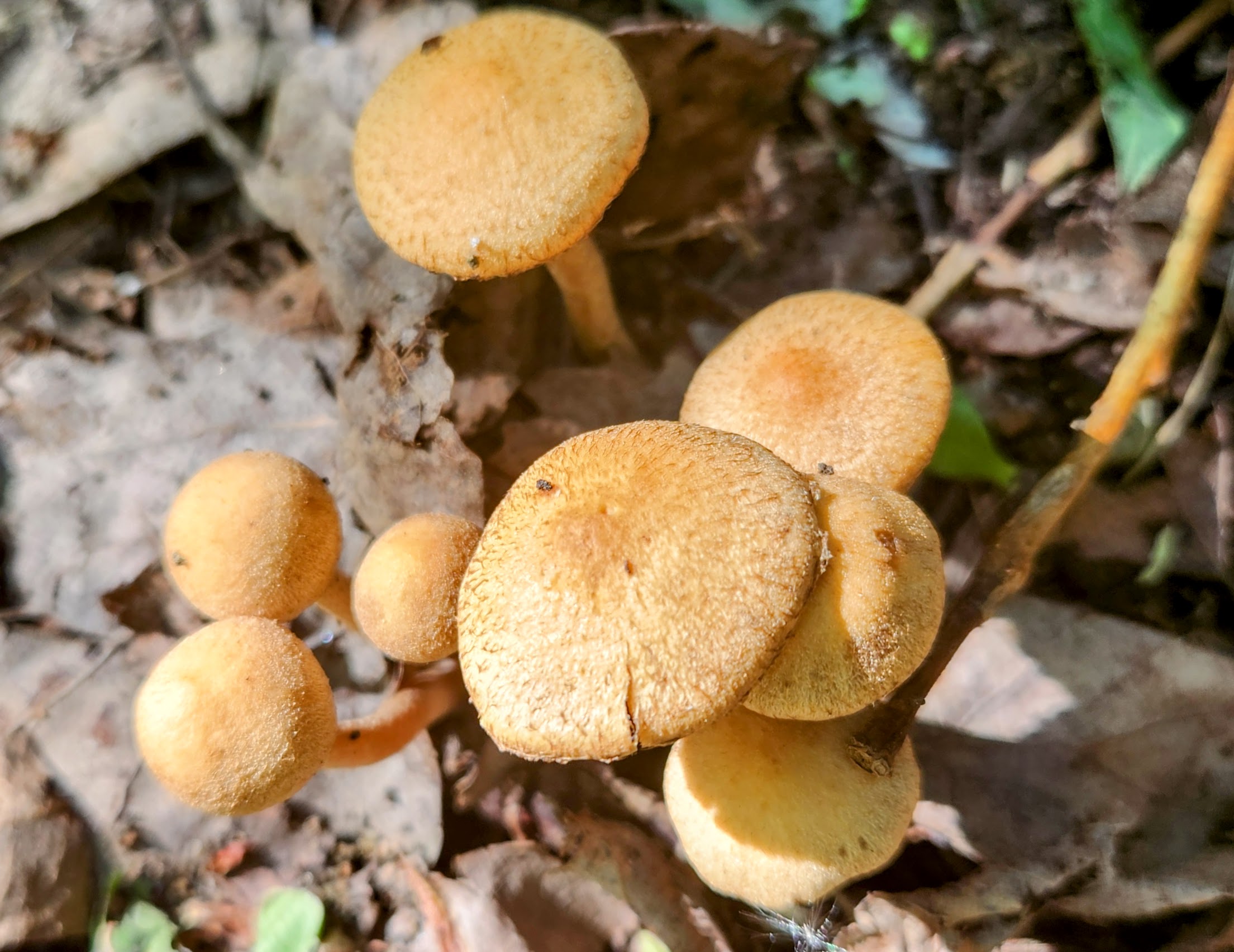
4-10 cm in diameter, hemispherical when young with a blunt central tubercle, becoming bell-shaped as it matures, and finally resembling a wide-brimmed hat. The cap surface is densely covered with bright or dull reddish radial fibers, the coloration usually becoming richer in the center, visually emphasizing the central tubercle. Fibrous reddish-brown remnants of the spathe hang more or less abundantly along the margins, which is especially noticeable in young specimens.
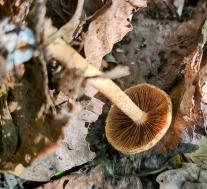
The gills are frequent, adnate or pitted-adnate, unevenly colored brown, and become almost black as the spores mature. The ribs of the gills, which do not produce spores, remain more or less light. A characteristic genus feature is small dark droplets on the gills of young mushrooms.
Cylindrical, hollow, proportionally folded, 4-8 cm high, 0.5-1.5 cm thick. The surface of the stem, also covered with reddish fibers, is colored like the cap, but paler. The quickly disappearing web-like covering leaves more or less pronounced longitudinal striations on the upper part of the stem.
Dense, yellowish, brittle, without a distinct taste or with a weak earthy taste, may taste slightly bitter after chewing.
Weak, mushroomy.
Spore powder is dark brown. Spores are (9.5) 9.9-11.2 (11.6) x (6.2) 6.4-7.2 (7.5) µm, almond-shaped, slightly flattened on the adaxial side, with a distinct germinal pore and a small apiculus, transparent in aqueous solution, chocolate-brown in 5% KOH.
It is relatively rare, but quite abundant under favorable conditions and on rich substrate. It is a humic saprotroph. According to some observations, it prefers broadleaf forests; according to others, it prefers ruderal habitats (although the former does not always exclude the latter).
A more common representative of the same genus, Lacrymaria lacrymabunda, is more dull in color, the remains of the partial cover have a grayish-ocher color and this species is often of more modest dimensions.
Add new comment