Weeping-widow (Lacrymaria lacrymabunda)
Index Fungorum Lacrymaria lacrymabunda (Bull.) Pat.
MycoBank Lacrymaria lacrymabunda (Bull.) Pat.
Lacrymābundus, a, um 1) crying, shedding tears; 2) tearful. From lacrima + abundus, a, um – abundant in water, full.
Agaricus lacrymabundus Bull., Herbier de la France 5 (49-60): tab. 194 (1785) - basionym
Hypholoma lacrymabundum (Bull.) Sacc., Syll. Fung. 5: 1033 (1887)
Psathyrella lacrymabunda (Bull.) M.M. Moser ex A.H. Sm., Kleine Kryptogamenflora von Mitteleuropa - Die Blätter- und Bauchpilze (Agaricales und Gastromycetes) 2: 204 (1953)
Psathyra lacrymabunda (Bull.) P. Kumm., Führer Pilzk.: 71 (1871)
Cortiniopsis lacrimabundus (Bull.) J. Schröt. (1889) [MB#431502]
Hypholoma lacrimabundum (Bull.) Sacc., Mém. Soc. Émul. Montbéliard Ser. 2, 5: 144 (1872)
Psathyrella lacrymabunda (Bull.) M.M. Moser, Kleine Kryptogamenflora von Mitteleuropa - Die Blätter- und Bauchpilze (Agaricales und Gastromycetes) 2: 207 (1953)
Geophila lacrymabunda (Bull.) Quélet, Enchiridion Fungorum in Europa media et praesertim in Gallia Vigentium: 113 (1886)
Geophila lacrymabunda var. lacrymabunda (Bull.) Quél. (1886)
Cortiniopsis lacrymabundus (Bull.) J. Schröt. (1889)
Cortiniopsis lacrymabunda (Bull.) J. Schröt., Kryptogamen-Flora von Schlesien 3.1 (5): 566 (1889)
Glyptospora lacrymabunda (Bull.) Fayod, Ann. Sci. Nat., Bot. Ser. 7, 9 (3-6): 378 (1889)
Agaricus macrourus Pers., Abb. Schwämme (1793)
Psathyrella lacrimabunda (Bull.) M.M. Moser ex A.H. Sm. (1953)
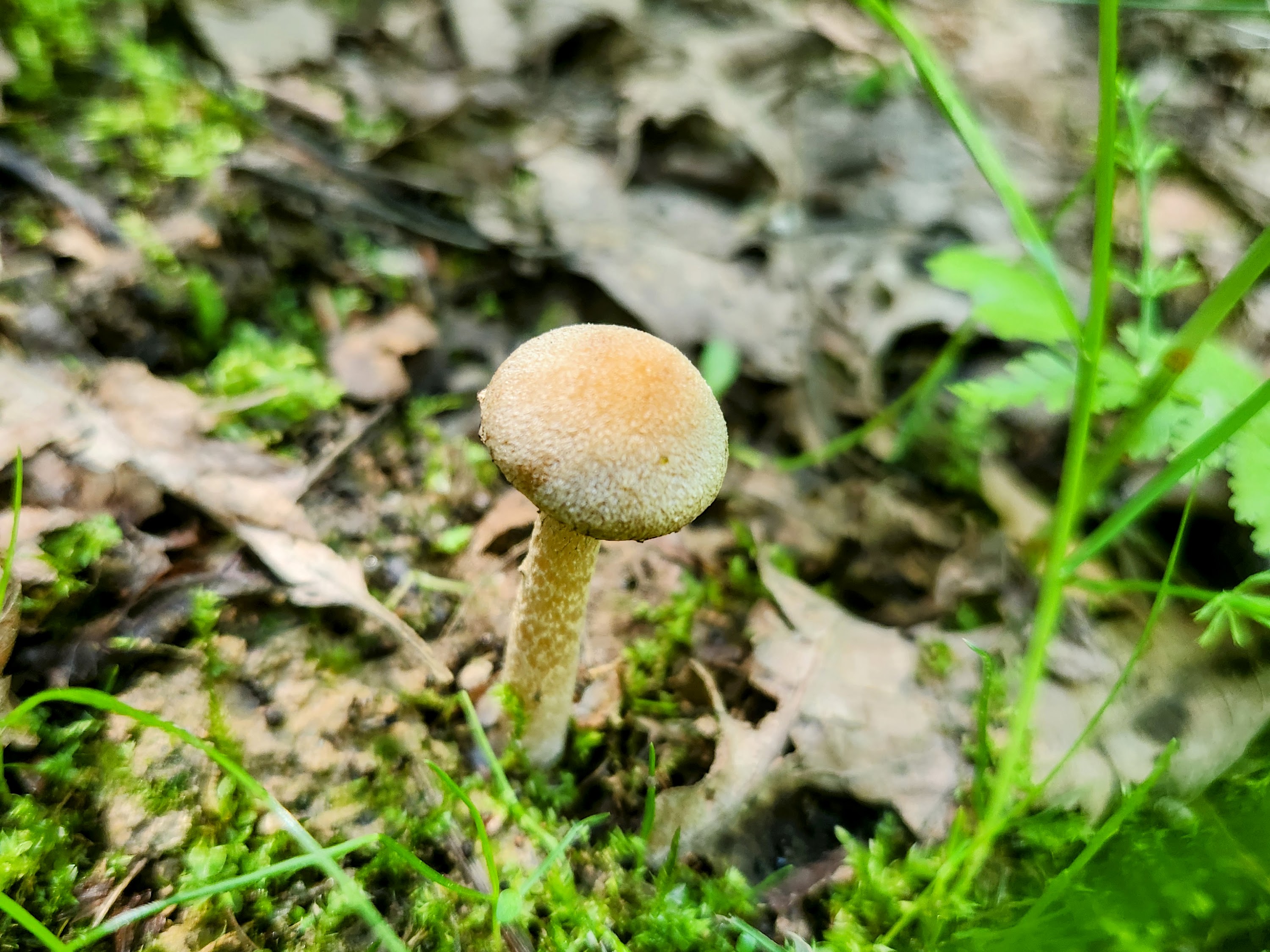
2-8 cm in diameter, the webby spathe is loose and quickly disappears. The cap is hemispherical or broadly bell-shaped, flattening slightly with age, remaining distinctly convex even in mature mushrooms. Reddish-brown to light brown, sometimes fading to beige or straw. The surface is distinctly velvety, finely hairy (a characteristic feature of the species), and dry. The cap margin is turned inward, with dark spots.
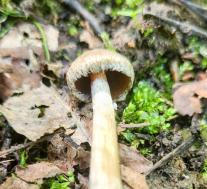
Gills: frequent, adnate perpendicularly or with a slight notch, quickly darkening to dark brown with a glaucous or violet tint, with a light margin, often with drops of clear liquid (guttation).
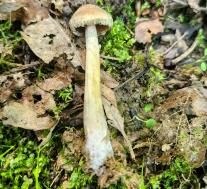
Cylindrical, slightly thickened at the base. Same color as the cap or slightly lighter, the upper surface of the gills is whitish, dirty white, or light brownish, sometimes with a moiré-like pattern.
The upper surface of the gills is smooth, while the middle and base are shaggy, covered with coarse reddish pubescence, or fibrous and scaly. The cavity in the stipe is central and narrow.
The annulus is cobwebby, dirty yellow or reddish, darkening on the upper surface (if preserved) from shedding spores, usually quickly disappearing; it may leave a dark annular zone on the stipe.
Creamy, dirty yellow, or brownish, darker at the stem. Color remains unchanged when broken. The flavor is mild and slightly bitter.
Weak, musty - earthy or barely noticeable.
The spore powder is almost black. The spores are ellipsoid or lemon-shaped, warty, 8–11 x 5–7 µm, with a germ pore.
A soil or wood saprotroph, it grows on heavily decayed wood, wood dust, and soil, primarily sandy soil, in groups and singly, in open, sparse forests, in clearings, forest edges, and glades, in gardens and parks, in urban and rural areas, and along roadsides. It is most often found in cemeteries (usually directly on grave mounds, hence the popular name "grave mushroom"). It is generally quite rare, except in years with the emergence of a late-spring layer of earth.
Distribution: In the former USSR, it grows throughout the European part of the country and in some areas of Kazakhstan. Abroad, it grows throughout Europe, North and Central America, and New Zealand.
Other species of the genus Lacrymaria, including Psathyrella, are distinguished by their less intense or absent pubescence and/or smaller fruiting bodies. The small mushroom Cystoagaricus hirtosquamulosus (hairy-scaly cystoagaricus) grows on decaying maple and ash wood. Agrocybe pediades (foot vole) has a bare, glabrous cap and stem and a "row" smell of fresh flour; other species of Agrocybe are usually lighter in color and lack pubescence, their gills darken slowly and do not guttate.
Add new comment