Larch Bolete, Larch Suillus (Suillus grevillei)
Index Fungorum Suillus grevillei (Klotzsch) Singer
MycoBank Suillus grevillei (Klotzsch) Singer
Greville's Bolete, yellow larch bolete.
Grevillei, in honor of Greville (Robert Kaye Greville, 1794–1866, Scottish botanist and mycologist).
Boletinus grevillei (Klotzsch) Pomerl., Naturaliste Canad. 107: 303 (1980)
Ixocomus grevillei (Klotzsch) Vassilkov, Outline of a geographical investigation of the cap fungi in the U.S.S.R.: 20 (1955)
Boletinus grevillei (Klotzsch) Pomerl.: 429 (1980)
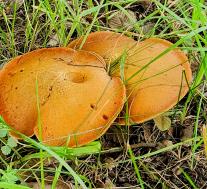
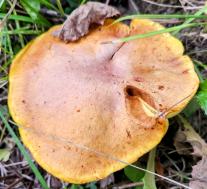
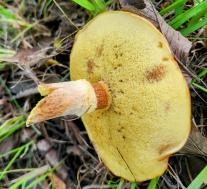
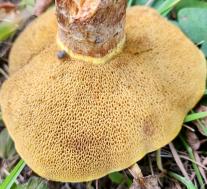
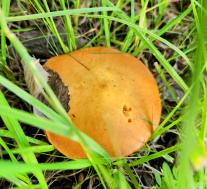
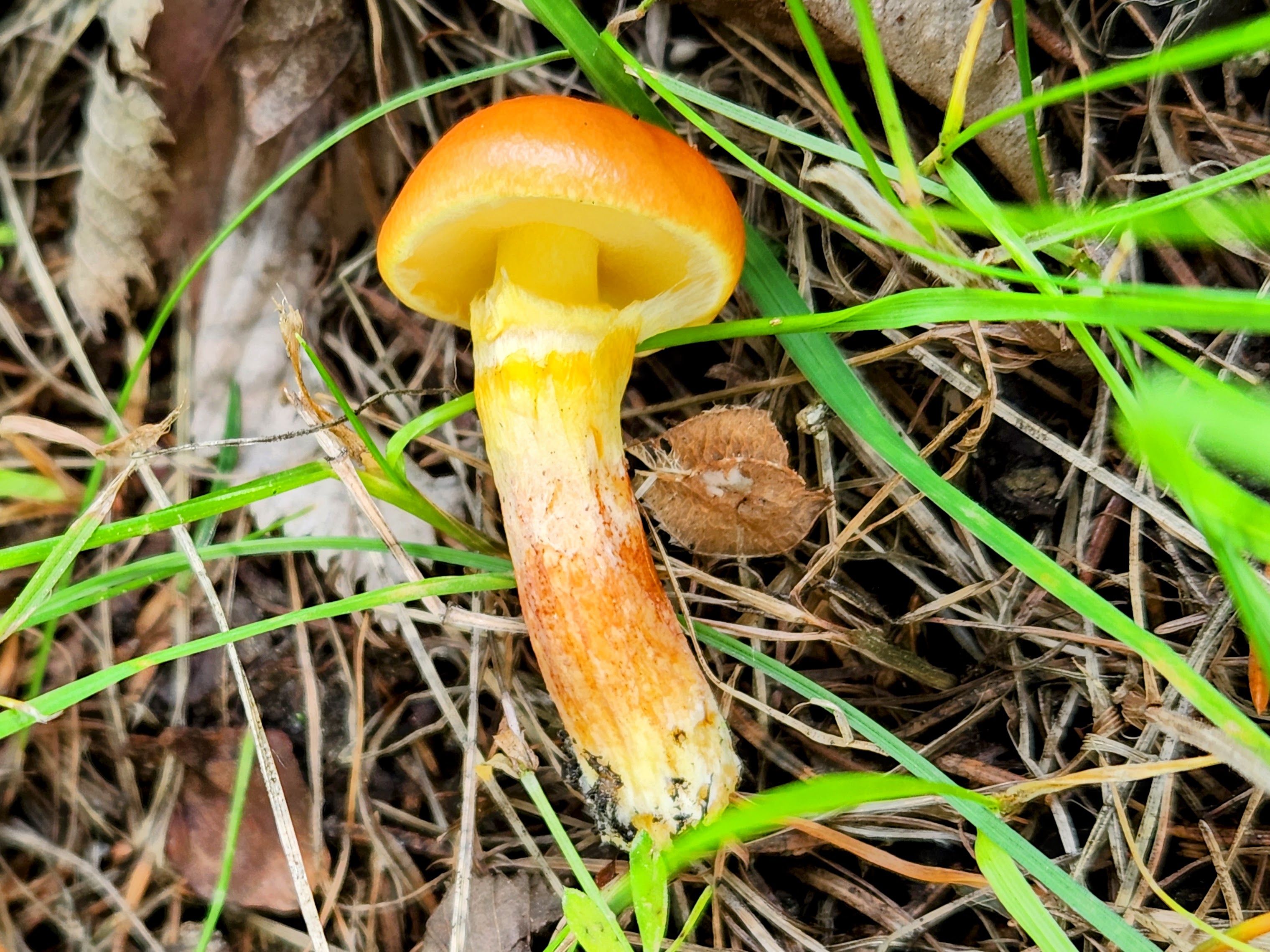
5–10 cm, initially globose, practically inseparable from the stipe, then gradually expanding to become hemispherical and cushion-shaped. The cap surface is very slimy, especially in young specimens and in moist weather; the pellicle separates easily. Color is quite variable, from lemon-yellow to egg-yellow, orange, or reddish-brown; the cap is often unevenly colored.
The hymenophore is tubular, slightly decurrent on the stipe, finely porous, lemon-yellow in youth, gradually darkening with age to acquire a somewhat dirty hue. Initially covered by a membranous veil of the same color, which quickly disappears.
4–8 cm high, 1–2 cm thick, cylindrical, often curved, solid. Light remnants of the partial veil are clearly visible. The stipe surface is slimy above the ring and dry below; color varies from yellow, close to the cap color in the upper part, to darker in the lower part.
Cap flesh thick, yellowish, soft, with a faint mushroom odor; does not change color when broken. In the stipe, the flesh is darker and firmer. On cutting, it turns slightly brownish.
Pleasant, slightly sweet, with subtle fruity notes.
Spore print yellow-brown (ochre). Spores 6.6–11.4 (12.8) × 2.7–4 μm, Q = 1.9–3.1, ellipsoid to ellipsoid-fusiform, smooth.
Grows singly and in groups on soil among grass under larches, in forests with admixture of larch and fir, and in plantings (parks, squares, avenues), in urban and rural areas, preferably in well-lit places.
Distribution: In Russia, it occurs wherever larch grows, including regions where it has been introduced. In the European part, it is fairly common in larch plantings and forests with its participation in the central zone, the Volga-Vyatka region, and the northeast; in more western and southern regions it is less frequent. Further east, in Siberia and the Far East, it grows in wild forests as well. Under the same conditions (presence of trees of the genus Larix), it is widespread in Europe and North America.
Status 4. Species of uncertain status.
Limiting factors: Narrow trophic specialization of the species, increased recreational pressure, and collection of fruiting bodies by the public.
It resembles only the edible Clinton's bolete (Suillus clintonianus), which differs by its dark (brown-chestnut) cap coloration and is considered by some specialists to be merely a color variation of the larch bolete.
Under laboratory conditions, it forms mycorrhiza with pines (Pinus) and Norway spruce (Picea abies).
According to some sources, it may have a beneficial effect on the body in cases of headaches.
Add new comment