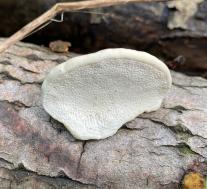
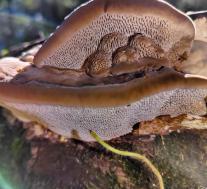
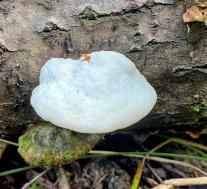
Lumpy Bracket (Trametes gibbosa)

Траметес горбатый
Current name

Index Fungorum Trametes gibbosa (Pers.) Fr.

MycoBank Trametes gibbosa (Pers.) Fr.

Other names

Humpback Polypore (Lumpy Bracket)

Systematic position
Specific epithet etymology

Gibbōsus, a, um. 1) humpbacked, gibbous; 2) tangled, complicated; 3) mycol. with numerous tubercles on the cap, tuberculate. From gibbus + -ōsus.

Synonyms

Daedalea gibbosa (Pers.) Pers., Synopsis methodica fungorum: 501 (1801) 

Pseudotrametes gibbosa (Pers.) Bondartsev & Singer, Mycologia 36 (1): 68 (1944) 

Lenzites gibbosa (Pers.) Hemmi, Ann. Phytopathol. Soc. Japan 9 (1): 1 (1939) 

Polyporus gibbosus (Pers.) P. Kumm., Der Führer in die Pilzkunde: 59 (1871) 

Trametes gibbosa f. gibbosa (?) [MB#424828]

Habit
Fruiting body
Sessile, bracket-shaped, hoof-shaped, or as an irregular crust/rosette
Hymenophore
Tubulate, poroid
Fruiting period (list)
JulJuly (1st–10th)July (11th–20th)July (21st–31st)AugAugust (1st–10th)August (11th–20th)August (21st–31st)SepSeptember (1st–10th)September (11th–20th)September (21st–30th)OctOctober (1st–10th)October (11th–20th)October (21st–31st)
Fruit body

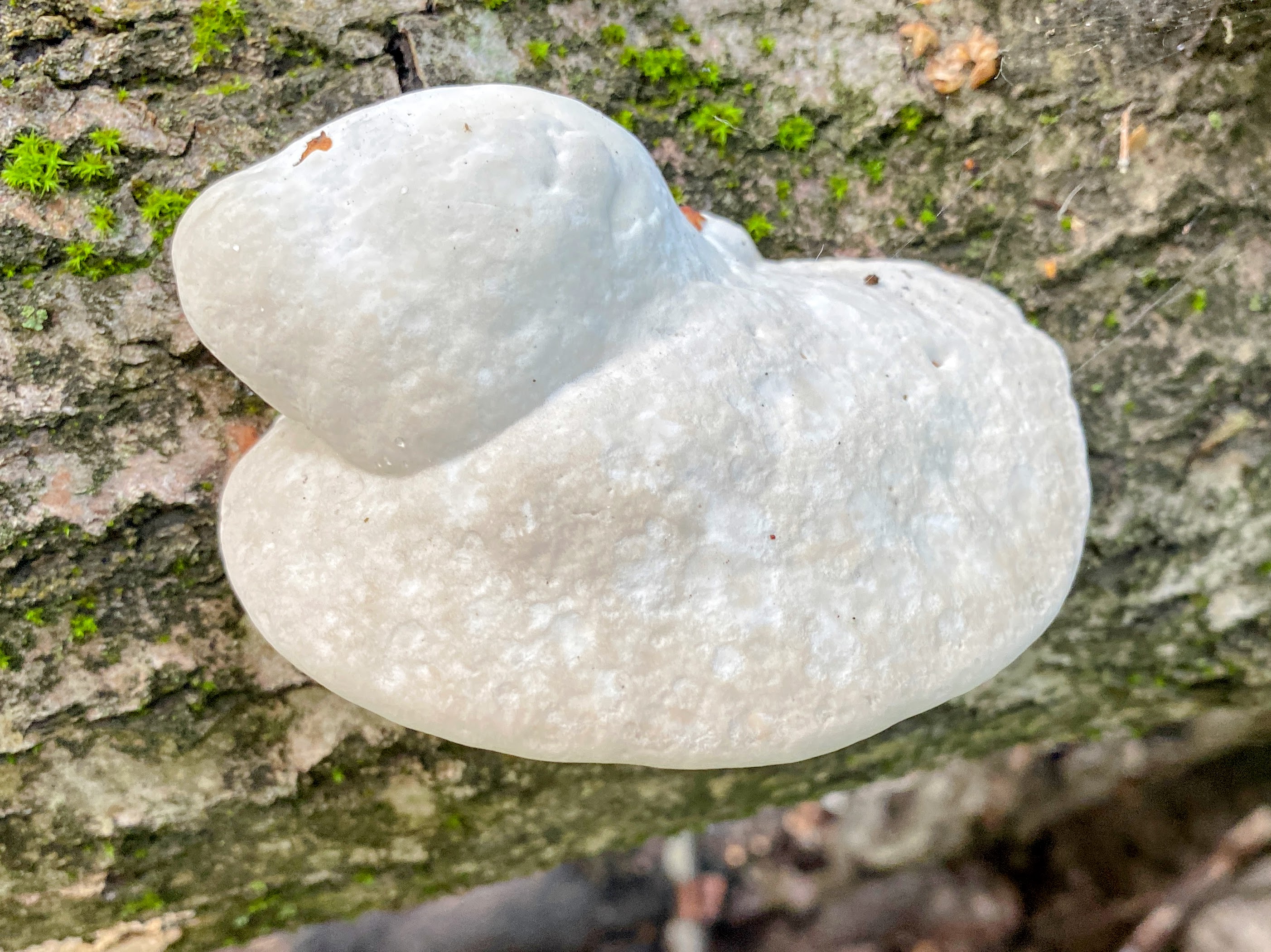
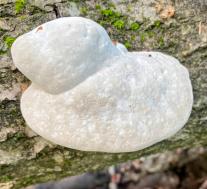
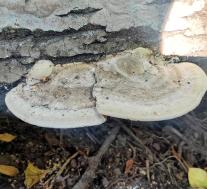
Annual, appearing as sessile semicircular caps or rosettes 5–20 cm across, occurring singly or in small groups. Cap thickness varies on average from 1 to 6 cm. Caps more or less flat, with a small hump at the base. Surface white, often with scattered darker concentric bands in brownish, ochre, or olive shades (alternatively, white with a pinkish-brown margin), slightly pubescent. Fruit bodies may be covered with algae, acquiring a greenish tint. The cap margin is rounded in young specimens. With age, the pubescence is lost, the cap becomes smooth, creamy-ochre, and becomes overgrown (to a greater extent in the central part, though it can occur across nearly the entire surface) with epiphytic algae. The cap margin becomes sharper.

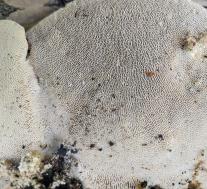
Tubes single-layered, occasionally 2–3-layered, white, sometimes yellowish, 5–15 mm long. Hymenophore surface white, creamy, or light straw-yellow; pores rectangular, elongated, radially arranged, appearing dotted, 1.5–5 mm long, 1–2 per mm in width, sometimes almost labyrinthine.

Flesh

Dense, leathery or corky, whitish, sometimes yellowish or grayish, up to 3 cm thick at the base of the cap. Taste indistinctive.

Odor

Weak, mushroom-like.

Microscopy

Spore print white. Spores smooth, hyaline, non-amyloid, more or less cylindrical, measuring 2–2.8 × 4–6 μm.

Ecology and distribution

The Lumpy Bracket grows on deciduous trees (deadwood, fallen logs, stumps—but also on living trees). Found on birch, alder, and poplar. Within Russia, it occurs in the European part, Siberia, and the Far East. Records also exist from the Caucasus. Throughout the Eurasian continent, it is found in the temperate zone (significantly more common in southern regions of the zone than in northern ones); it is also known from North America. Causes white rot.

Fruiting

Fruit bodies appear in summer and continue growing until late autumn. They persist well through the winter and can be found again the following spring.

Nutritional properties
Inedible
Conservation status
Red Data Book of the Republic of Buryatia (2023 edition)

Status 5. Recovering species.

Similar species

Elegant Trametes (Trametes elegans) — distinguished by smaller and thinner basidiomes and distinctive hymenophore structure: its pores radiate in fountain-like trajectories from the initial areas of the fruit body, often split to nearly lenzites-like. Dickins' Daedalea (Daedalea dickinsii) — similar in size and appearance, but has darker flesh, ranging from dark creamy to brownish (a Far Eastern species). Small young fruiting bodies of Trametes gibbosa may resemble rough-haired Trametes (Trametes hirsuta), from which they differ by elongated pores and barely noticeable pubescence on the caps. Trametes hirsuta is characterized by smaller, round pores and more pronounced cap pubescence.

Notes

According to biochemical and medical research on the Lumpy Bracket, its active compounds are capable of exerting anti-inflammatory, antiviral, and antitumor effects.

Link to this page for printed editions
Shipovalov A.G. Lumpy Bracket (Trametes gibbosa) - Mushrooms of Vologda Region [Electronic resource] URL: https://xn----7sbancweblffgklubds60aja.xn--p1ai/en/lumpy-bracket-trametes-gibbosa (accessed: 13.04.2026).
Share link

Add new comment

One file only.
2 MB limit.
Allowed types: png jpeg jpg jpe gif webp svg.
Allowed types: png gif jpg jpeg webp svg.

Plain text

  • No HTML tags allowed.
  • Lines and paragraphs break automatically.
  • Web page addresses and email addresses turn into links automatically.
Add image
Maximum 8 files.
2 MB limit.
Allowed types: png jpeg jpg jpe gif webp svg.
Allowed types: png gif jpg jpeg webp.
January (1st–10th)
January (1st–10th)
January (11th–20th)
January (11th–20th)
January (21st–31st)
January (21st–31st)
February (1st–10th)
February (1st–10th)
February (11th–20th)
February (21st–28th/29th)
March (1st–10th)
March (1st–10th)
March (11th–20th)
March (11th–20th)
March (21st–31st)
March (21st–31st)
April (1st–10th)
April (1st–10th)
April (11th–20th)
April (11th–20th)
April (21st–30th)
April (21st–30th)
May (1st–10th)
May (1st–10th)
May (11th–20th)
May (11th–20th)
May (21st–31st)
May (21st–31st)
June (1st–10th)
June (1st–10th)
June (11th–20th)
June (11th–20th)
June (21st–30th)
June (21st–30th)
July (1st–10th)
July (1st–10th)
July (11th–20th)
July (11th–20th)
July (21st–31st)
July (21st–31st)
August (1st–10th)
August (1st–10th)
August (11th–20th)
August (11th–20th)
August (21st–31st)
August (21st–31st)
September (1st–10th)
September (11th–20th)
September (21st–30th)
October (1st–10th)
October (1st–10th)
October (11th–20th)
October (11th–20th)
October (21st–31st)
October (21st–31st)
November (1st–10th)
November (1st–10th)
November (11th–20th)
November (21st–30th)
December (1st–10th)
December (1st–10th)
December (11th–20th)
December (21st–31st)