Index Fungorum Hydnellum aurantiacum (Batsch) P. Karst
MycoBank Hydnellum aurantiacum (Batsch) P. Karst.
Other names
Orange Root
Specific epithet etymology
from aurantiacus, a, um, orange, orange-colored
General description
At present, there is no unified understanding of the systematics of the species complex around H. aurantiacum; traditionally, all collections of hydnoid fungi with pronounced orange tones in their coloration were assigned to it, both European and North American. Some authors, without strong justification, synonymize it with H. auratile, which is almost certainly a separate taxon with pronounced morphological differences. North American researchers distinguished several forms within H. aurantiacum (Maas Geesteranus 1964), and later suggested that this was probably a complex of four separate taxa, but Baird in 1986 again reduced them to a single species. Nevertheless, obvious morphological and chemical differences among different collections argued against the validity of such a step. Eventually, Baird himself came to doubt that these were different ecological variations of a single species: a team of researchers under his leadership undertook a large-scale study of the systematics of North American hydnoid fungi, published in 2013, but its results only compounded the confusion: North American specimens did indeed split into three taxa, quite distant from each other phylogenetically, but the ITS sequences of these taxa did not match any of the sequences of European specimens deposited in GenBank under the name "Hydnellum aurantiacum". The absence of a type specimen of Hydnellum aurantiacum finally renders meaningless any attempts to clarify this group without a large-scale revision of the "orange Hydnellum" complex, with study of well-documented collections from different continents.
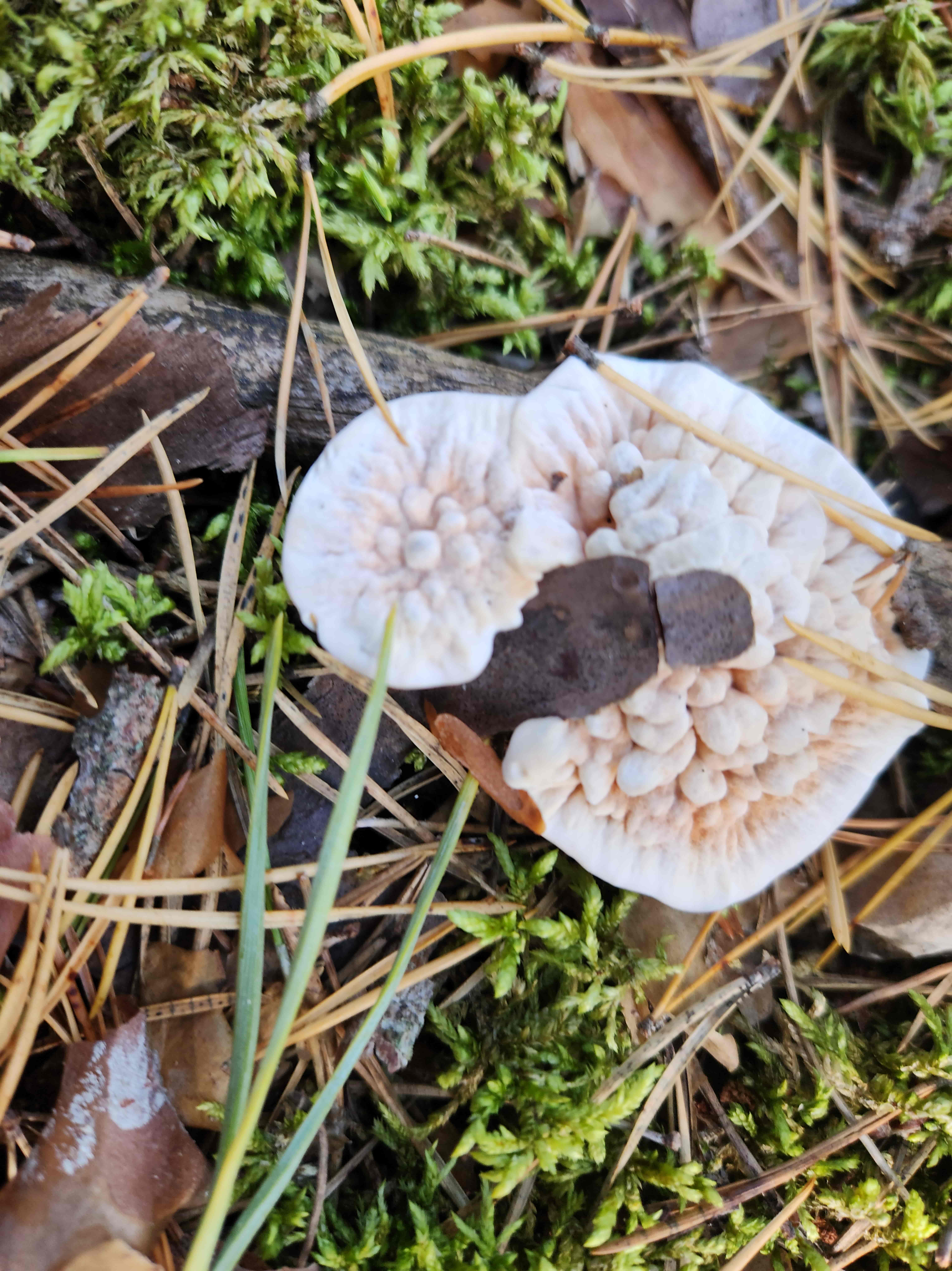
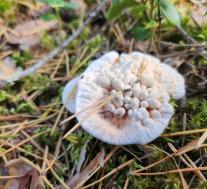
5–15 cm in diameter, obconical, convex, flat or slightly depressed. Surface in young fruiting bodies softly woolly, radially wrinkled; with age becomes nearly glabrous with irregular outgrowths. Color initially white or peach with an orange tint in the central part; upon maturation the coloration becomes more intensely orange, darkening to reddish or rust-brown in old fruiting bodies. The margin is always lighter than the rest of the cap, darkening and acquiring brown coloration only in old age after complete cessation of fruiting body growth.
Stem
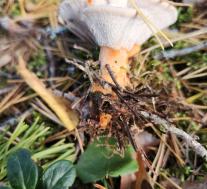
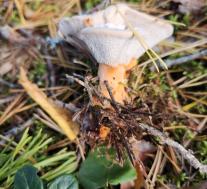
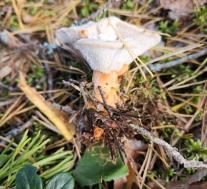
2–5 cm long, 1.5–2 cm in diameter, cylindrical, uneven; during growth it absorbs and envelops numerous fragments of forest litter; stem surface woolly, orange or brown.
Fruit body
Agaricoid structure, fruiting body clearly differentiated into cap and stem. Fruiting bodies large, annual, with a central or laterally displaced stem; develop rather slowly, over several weeks; during growth they envelop fragments of forest litter (twigs, needles, etc.) and living plants, and can fuse together. Under favorable conditions they form large chains and fairy rings.
Flesh
Flesh soft, spongy near the surface, white to light orange, bright orange in the core, sometimes zonate, corky-fibrous, darker and denser toward the stem, up to woody; in the stem distinctly two-layered. Taste slightly sour, odor slightly sour-earthly.
Odor
Weak, not pronounced.
Microscopy
Spore print light brown. Spores almost spherical, rough.
Ecology and distribution
Grows in groups on soil, in coniferous and mixed forests.
Conservation status
Protected.
The species is listed as endangered in the United Kingdom.
Similar species
Golden Hydnellum (Hydnellum auratile) differs by smaller fruiting bodies, uniformly orange-colored flesh in cross-section, and golden-orange coloration of the spines. Microscopically, it differs by smaller spores.
Notes
There is one mysterious circumstance, difficult to comprehend from a logical point of view. For some reason, in Russian nomenclature phellodons are often called hedgehog fungi, while hydnellums never are. This is all the more surprising since we call "hedgehog fungi" not only the true hedgehogs (genus Hydnum), and sarcodons (genus Sarcodon), but even a mushroom infinitely distant from all Bankeraceae - the Coral Hedgehog, Hericium coralloides from the family Hericiaceae...
Related resources
Hall D, Stuntz DE (1972). "Pileate Hydnaceae of the Puget Sound area. III. Brown spored genus: Hydnellum"Mycologia. 64 (3): 560–590. doi:10.2307/3757873
McKnight VB, McKnight KH (1987). A Field Guide to Mushrooms, North America. Boston, Massachusetts: Houghton Mifflin. pp. 92–93.
Orr DB, Orr RT (1980). Mushrooms of Western North America. California Natural History Guides. Berkeley, California: University of California Press. p. 55.
Persoon C. H. Synopsis methodica fungorum. Tom 1. Germany, Göttingen; Henricus Dieterich, 1801. — P. XXX.
Albertini I. B., Schweiniz L. D. Conspectus Fungorum in Lusatiae Superioris Agro Niskiensi Crescentium. E Methodo Persooniana. — Lipsiae, Sumtibus Kummerianis, 1805. — P. 265
Add new comment