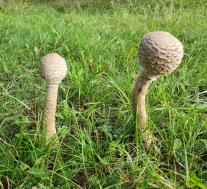
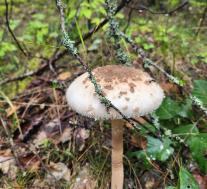
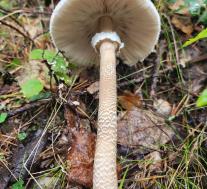
Parasol Mushroom (Macrolepiota procera)
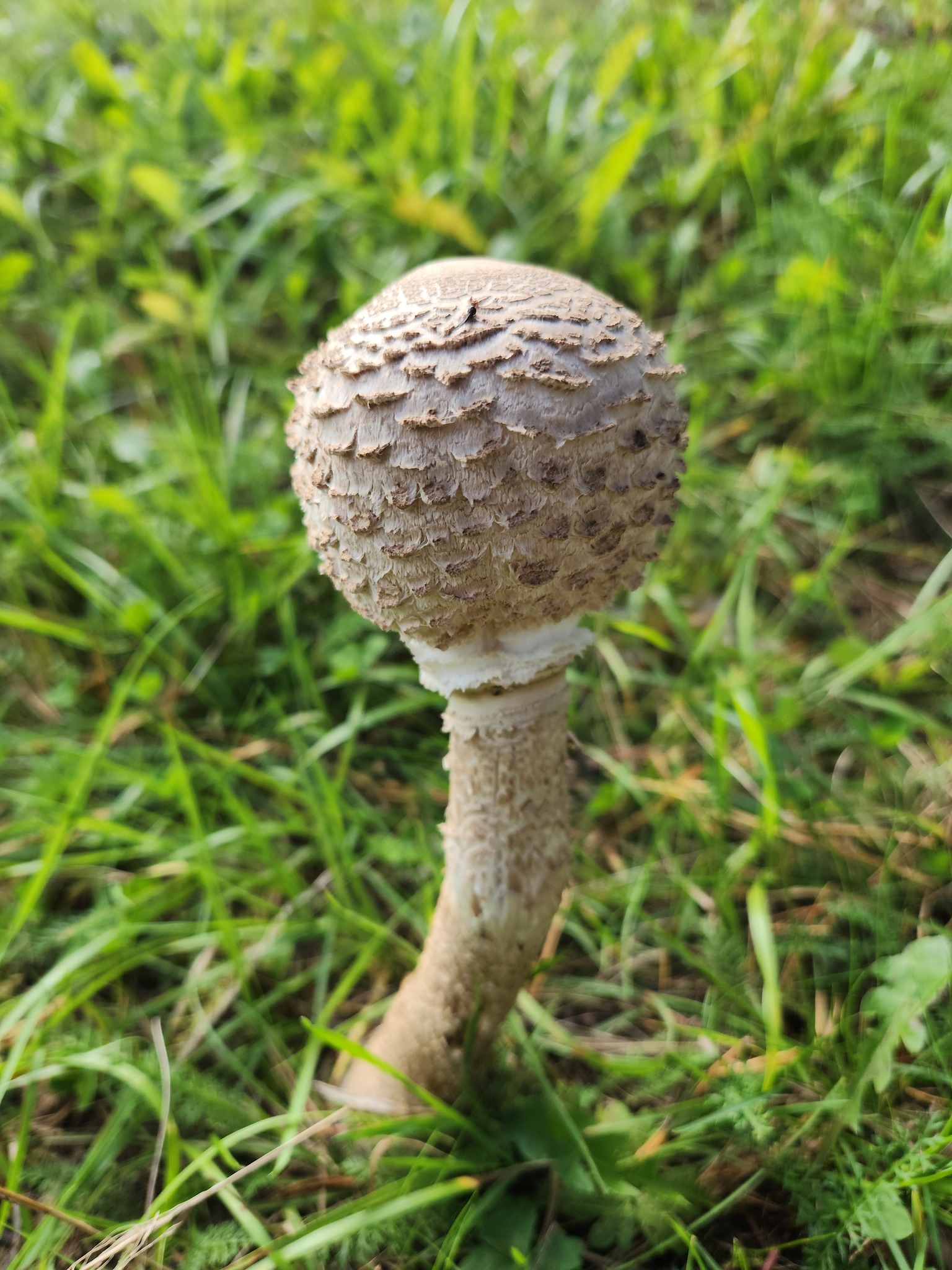
Гриб-зонтик высокий
Current name

Index Fungorum  Macrolepiota procera (Scop.) Singer
MycoBank  Macrolepiota procera (Scop.) Singer
 

Other names

Parasol Mushroom. The name in many languages is connected to the umbrella-like shape of this mushroom (English: parasol mushroom; Italian: ombrellone, parasole). In Italy, young mushrooms with unopened caps are called "drumsticks" (Italian: mazza di tamburo).

Systematic position
Specific epithet etymology

Procerus, a, um, лат. — длинный, высокий, стройный.

Synonyms

Agaricus procerus Scop., Fl. carniol., Edn 2 (Wien) 2: 418 (1772)

Lepiota procera (Scop.) Gray, Nat. Arr. Brit. Pl. (London) 1: 601 (1821)

Amanita procera (Scop.) Fr., Anteckn. Sver. Ätl. Svamp.: 33 (1836)

Mastocephalus procerus (Scop.) Pat., Essai Tax. Hyménomyc. (Lons-le-Saunier): 171 (1900)

Leucocoprinus procerus (Scop.) Pat., (1900)

Lepiotophyllum procerum (Scop.) Locq., Bull. mens. Soc. linn. Soc. Bot. Lyon 11: 40 (1942)
Habit
Fruiting body
Agaricoid (cap and stipe)
Hymenophore
Lamellate (gills present, including folded or rudimentary)
Fruiting period (list)
JulJuly (1st–10th)July (11th–20th)July (21st–31st)AugAugust (1st–10th)August (11th–20th)August (21st–31st)SepSeptember (1st–10th)September (11th–20th)September (21st–30th)
Mushroom cap

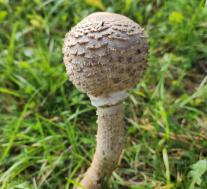
15–55 cm in diameter, initially spherical and tightly enclosing the stipe, then expanding from broadly conical or convex to umbrella-shaped; the margin may remain slightly incurved. A dark, rounded umbo is often clearly visible in the center. The cuticle is radially fibrous, grayish-brown, covered with easily detachable dark brown angular scales. The margin is floccose-fibrous, with the cuticle overhanging the gills. Hymenophore: lamellate (gilled). Gills free, broad, white to creamy.

Stem

10–40 cm long, 1–3 cm in diameter, central, cylindrical, hollow, with a tuberous enlargement at the base up to 2.5–5 cm in diameter, whitish to light brown, covered with darker brown fibrous scales arranged in a zigzag pattern or concentric circles, with a ring in the upper part.
The ring becomes movable with age, with a split margin, light-colored on the upper side and brownish below.

Flesh

In the cap, white and soft; in the stipe, thick, fibrous-cartilaginous. Taste pleasant, nutty.
Smell: pleasant, mushroom-like with nutty notes.

Microscopy

Spore print: pinkish-cream. Spores smooth, colorless, ellipsoid, slightly almond-shaped, with a germ pore and a well-distinguishable apiculus.

Ecology and distribution

A soil saprotroph. Grows on sandy soils in light forests, in clearings and forest edges, along firebreaks and logged areas; also found in open grassy places, parks, fields, and gardens. Fruits singly or in loose groups, and can form rows or "fairy rings".

Fruiting

July–September

Nutritional properties
Edible

Geographical culinary mycology sometimes presents surprises that are difficult to explain. This is why the Parasol Mushroom is considered a delicacy with excellent flavor properties in European countries, while in Russia many people perceive it as an overgrown fly agaric.

An excellent edible mushroom with high culinary value. Typically, young caps are used for frying (preliminary boiling is not recommended). When cooked, they taste reminiscent of chicken with a nutty undertone.

They can be prepared like pancakes — dipped whole in beaten eggs, coated in flour, and fried. They are very tasty as a filling for pies together with fried onions. Suitable for soups, salting, pickling, and drying. Sometimes used raw in salads and sandwiches. In some countries, the tough stipes are dried and ground into a powder that serves as a seasoning with a pronounced mushroom flavor and aroma.

In the Baltic states, whole breaded parasol caps are served as a delicacy in restaurants, and the mushrooms themselves are valued there even higher than porcini, birch boletes, and orange-cap boletes.

In France, this mushroom is called "steak on a leg" — this is precisely how the taste of young caps fried in batter is described.

Conservation status
Red Data Book of the Republic of Karelia

Status 3. Rare species.

Similar species

The Reddening Parasol (Chlorophyllum rhacodes) differs by its smaller size, "shaggy" cap surface, and flesh that turns red when broken. In Conrad's Parasol (M. conradii), the scales are concentrated in the center of the cap. The Dark Brown Chlorophyllum differs by its smaller size, a pronounced thickening on the stipe, and a single ring.

Notes

In China, it is considered a medicinal mushroom. However, it should be noted that in China, any food is considered medicinal.

Link to this page for printed editions
Shipovalov A.G. Parasol Mushroom (Macrolepiota procera) - Mushrooms of Vologda Region [Electronic resource] URL: https://xn----7sbancweblffgklubds60aja.xn--p1ai/en/parasol-mushroom-macrolepiota-procera (accessed: 13.04.2026).
Share link

Add new comment

One file only.
2 MB limit.
Allowed types: png jpeg jpg jpe gif webp svg.
Allowed types: png gif jpg jpeg webp svg.

Plain text

  • No HTML tags allowed.
  • Lines and paragraphs break automatically.
  • Web page addresses and email addresses turn into links automatically.
Add image
Maximum 8 files.
2 MB limit.
Allowed types: png jpeg jpg jpe gif webp svg.
Allowed types: png gif jpg jpeg webp.
January (1st–10th)
January (1st–10th)
January (11th–20th)
January (11th–20th)
January (21st–31st)
January (21st–31st)
February (1st–10th)
February (1st–10th)
February (11th–20th)
February (21st–28th/29th)
March (1st–10th)
March (1st–10th)
March (11th–20th)
March (11th–20th)
March (21st–31st)
March (21st–31st)
April (1st–10th)
April (1st–10th)
April (11th–20th)
April (11th–20th)
April (21st–30th)
April (21st–30th)
May (1st–10th)
May (1st–10th)
May (11th–20th)
May (11th–20th)
May (21st–31st)
May (21st–31st)
June (1st–10th)
June (1st–10th)
June (11th–20th)
June (11th–20th)
June (21st–30th)
June (21st–30th)
July (1st–10th)
July (1st–10th)
July (11th–20th)
July (11th–20th)
July (21st–31st)
July (21st–31st)
August (1st–10th)
August (1st–10th)
August (11th–20th)
August (11th–20th)
August (21st–31st)
August (21st–31st)
September (1st–10th)
September (11th–20th)
September (21st–30th)
October (1st–10th)
October (1st–10th)
October (11th–20th)
October (11th–20th)
October (21st–31st)
October (21st–31st)
November (1st–10th)
November (1st–10th)
November (11th–20th)
November (21st–30th)
December (1st–10th)
December (1st–10th)
December (11th–20th)
December (21st–31st)