Index Fungorum Sarcoscypha austriaca (Beck ex Sacc.) Boud
MycoBank Sarcoscypha austriaca (Beck ex Sacc.) Boud
Other names
Elf Cup.
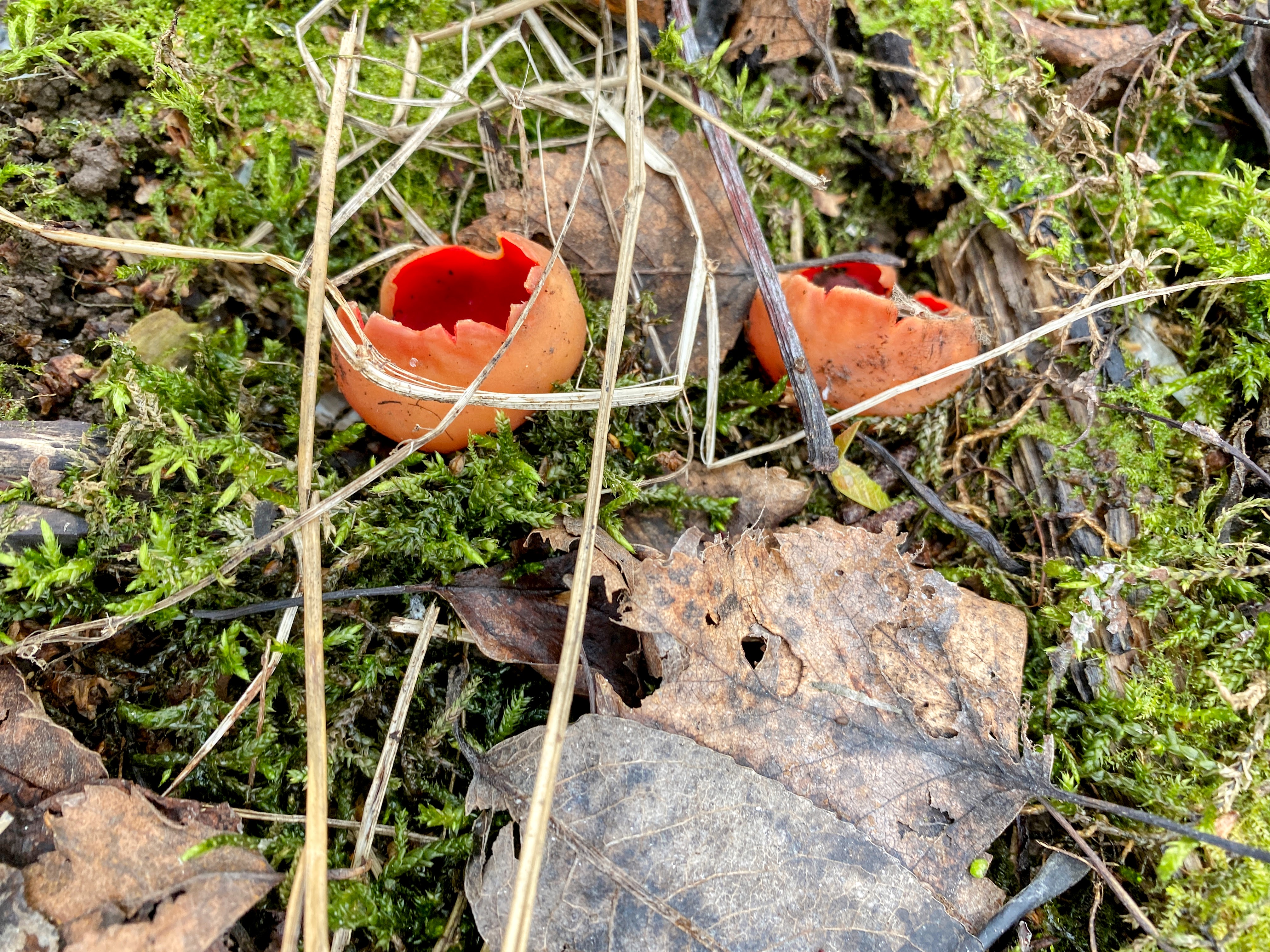
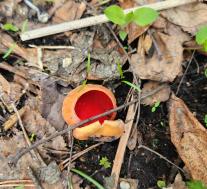
The name "elf cup," besides its beauty, very accurately describes the appearance of this mushroom. A small scarlet goblet on a thin stalk—that is what Sarcoscypha austriaca looks like.
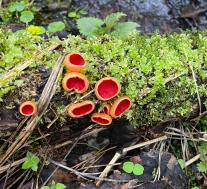
The appearance of these mushrooms marks the beginning of the mushroom season—after them come the false morels, morels, Sarcosoma, and then other edible mushrooms. But first, when the snow has not yet melted, appear the sarcoscyphas. Their emergence resembles a small explosion that has scattered bright clusters around. The mushrooms appear en masse and disappear just as quickly.
Specific epithet etymology
austriacus, a, um geogr. Austrian. From Austria f Austria + -acus.
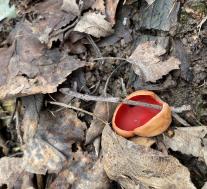
2–7 cm in diameter. Initially cup-shaped, with an inrolled, lighter-colored margin, gradually becoming saucer-shaped or disc-shaped, often with an uneven edge. The inner surface is bright scarlet or red, fading with age; smooth, becoming wrinkled over time. The outer surface is paler, pinkish, very finely pubescent (clearly visible only under microscopy). The stipe is rudimentary or weakly developed, small, short, and concolorous with the outer surface.
Spore print white. Spores ellipsoid, smooth, with large oil droplets.
Ecology and distribution
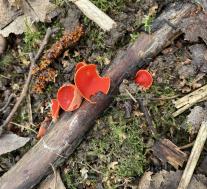
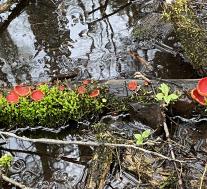
Cosmopolitan. Grows in clusters on deadwood of deciduous trees, often on buried wood. In such cases, it creates the impression that the fruiting bodies—apothecia—are growing directly from the soil. Found singly and in groups. Considered an indicator of environmental pollution—it does not grow near highways or industrial facilities.
Similar species
Scarlet Elf Cup (Sarcoscypha coccinea) is very similar and is considered nearly indistinguishable from the Austrian species in appearance. The main difference: the Scarlet Elf Cup has a more southern distribution range, while the Austrian species is found in more northern regions.
Notes
Its use in folk medicine is quite modest—it serves to stop bleeding and disinfect minor wounds. Sarcoscypha austriaca has not gained widespread use due to its short vegetative period.
Related resources
Harrington F. A., Potter D. Phylogenetic relationships within Sarcoscypha based upon nucleotide sequences of the internal transcribed spacer of nuclear ribosomal DNA. // Mycologia. — 1997. — Vol. 89(2). — P. 258–267.
Otani Y. Sarcoscyphineae of Japan. // Transactions of the Mycological Society of Japan. — 1980. — Vol. 21(2). — P. 149–179.
Wang Z., Zhuang W. Y. Taxonomic studies of the genus Sarcoscypha in China. // Mycosystema. — 1995–1996. — Vol. 8–9. — P. 39–52.
Zhuang W. Y. The genus Sarcoscypha in Jiaohe, Jilin province, with notes on surface morphology of ascospores. // Mycosystema. — 1992. — Vol. 5. — P. 65–72.
Raitviir A. Sarcoscyphaceae in the Far East. // Proceedings of the Academy of Sciences of the Estonian SSR. Biological Series. — 1965. — Vol. 14. — No. 4. — P. 529–535.
Raitviir A. New species and genera of fungi Discomycetes and Heterobasidiomycetae. // Proceedings of the Academy of Sciences of the Estonian SSR. Biological Series. — 1964. — Vol. 13. — No. 1. — P. 28–32.
Add new comment