Shield dapperling (Lepiota clypeolaria)
Index Fungorum Lepiota clypeolaria (Bull.) P. Kumm.
MycoBank Lepiota clypeolaria (Bull.) P. Kumm.
Shaggy-stalked Lepiota.
Clypeolārius, -a, -um, resembling a small round shield; shield-like. From clypeus, -i (clypeātus) + -olārius, -a, -um (diminutive suffix).
Agaricus clypeolarius Bull., Herbier de la France 9 (97–108): t. 405 (1789) - Basionym
Lepiota clypeolaria var. clypeolaria (?)
Agaricus calceolarius Pers., Synopsis methodica fungorum: 259 (1801)
Lepiota clypeolaria var. minor J.E. Lange, Flora Agaricina Danica 5: V (1940)
Lepiota ochraceosulfurescens Locq. ex Bon, Doc. Mycol. 16 (61): 46 (1985)
Agaricus colubrinus Pers., Synopsis methodica fungorum: 258 (1801)
Lepiota ochraceosulfurescens Locq., Bull. Mens. Soc. Linn. Lyon 14: 56 (1945)
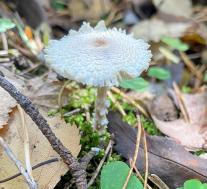
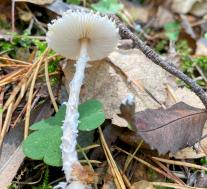
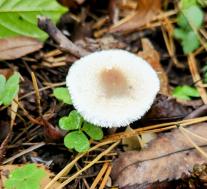
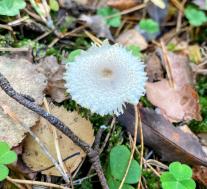
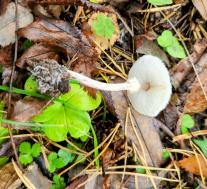
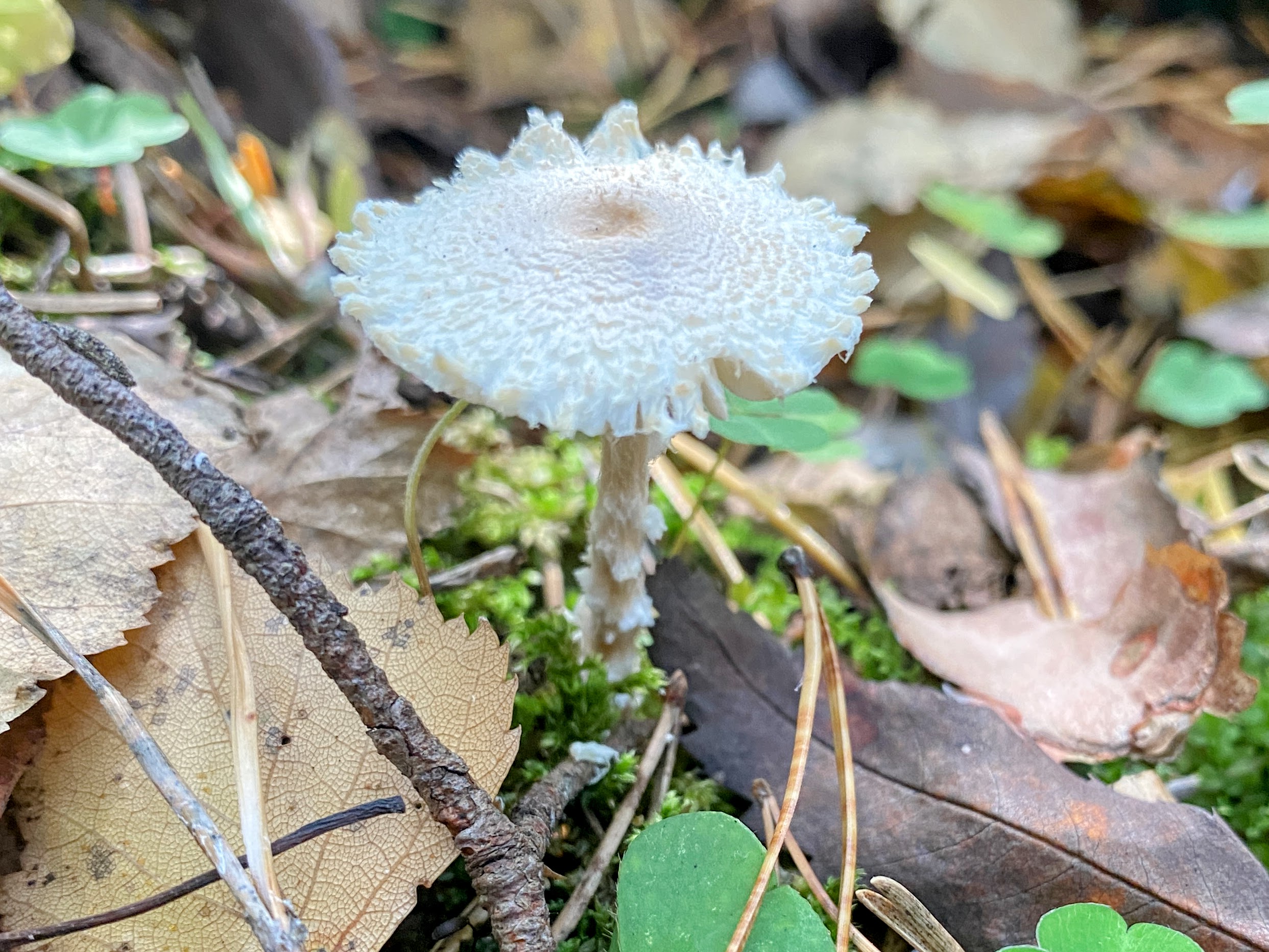
2.5–8 cm in diameter; initially conical with a small umbo, expanding with age to become convex-expanded with a low, broad umbo. The surface is felt-like and fibrous at the center, generally pale or light in color—pale brown, light orange-brown, or reddish. Towards the margin, the surface cracks finely and breaks up into concentrically arranged, soft, woolly scales that are slightly darker than the whitish flesh visible between them. The margin is fringed with fibrous veil remnants and is sometimes radially ribbed.
The gills are free, white to cream-colored, sometimes veined, with even or finely granular edges.
5–10 cm tall and up to 1 cm in diameter; cylindrical, often expanded at the base or with a small bulbous thickening; hollow; with an annular zone. The surface is white or cream-colored; more or less smooth, silky, and longitudinally fibrous in the upper part; and covered towards the base with irregularly distributed white or brownish fibrous scales, which may form bands at the base.
White to pale cream. The taste is unremarkable, but since some similar species are highly poisonous, one should not taste Lepiota mushrooms.
Weak, neutral, or unpleasant - chemically - rubbery.
Spore print white. Spores 11.0–18.5 × (4.0) 4.5–6.0 (6.5) µm, Q = 2.1–3.4, almond-shaped in side view.
A widely distributed species in the temperate regions of the Northern Hemisphere. It is found in Asia, Europe, and North and South America. In China, it occurs in the provinces of Heilongjiang, Jilin, Liaoning, Jiangsu, Guangdong, and Yunnan.
It grows singly or in small groups on soil and leaf litter in deciduous and mixed forests. It prefers rich soils.
Lepiota magnispora can easily be confused with L. clypeolaria due to similar coloration and habit; however, the veil of L. magnispora is typically more abundant and looser, giving the mushroom a "shaggier" appearance, and the species is readily distinguished microscopically by the shape and larger size of its spores.
Lepiota erminea is a meadow-dwelling species with snow-white coloration. Pale specimens of Lepiota clypeolaria can be confused with L. erminea. Microscopically, this species closely resembles *L. clypeolaria*, differing only in having statistically slightly larger spores.
Despite a superficial resemblance, Lepiota angustispora is reliably distinguished microscopically by its smaller, "boletus-like" spores.
Add new comment