Stinking dapperling (Lepiota cristata)
Index Fungorum Lepiota cristata (Bolton) P. Kumm.
MycoBank Lepiota cristata (Bolton) P. Kumm.
Stinking parasol/
Cristatus, -a, -um (Lat.), having a crest.
Agaricus cristatus Bolton, An History of Fungusses, Growing about Halifax 1: t. 7 (1788) - Basionym
Lepiota cristata var. cristata (?)
Lepiotula cristata (Bolton) E. Horak, Beitr. Kryptogamenfl. Schweiz 13: 338 (1968)
Agaricus colubrinus var. cristatus (Bolton) Pers., Synopsis methodica fungorum: 259 (1801)
Lepiota colubrina var. cristata (Bolton) Gray, A natural arrangement of British plants 1: 602 (1821)
Lepiota colubrina β cristata (Bolton) Gray: 602 (1821) [MB#537604]
Lepiota cristata var. pallidior Bon, Doc. Mycol. 11 (43): 34 (1981)
Lepiota cristata var. exannulata Bon, Doc. Mycol. 11 (43): 34 (1981)
Lepiota cristata var. felinoides Bon, Doc. Mycol. 11 (43): 34 (1981)
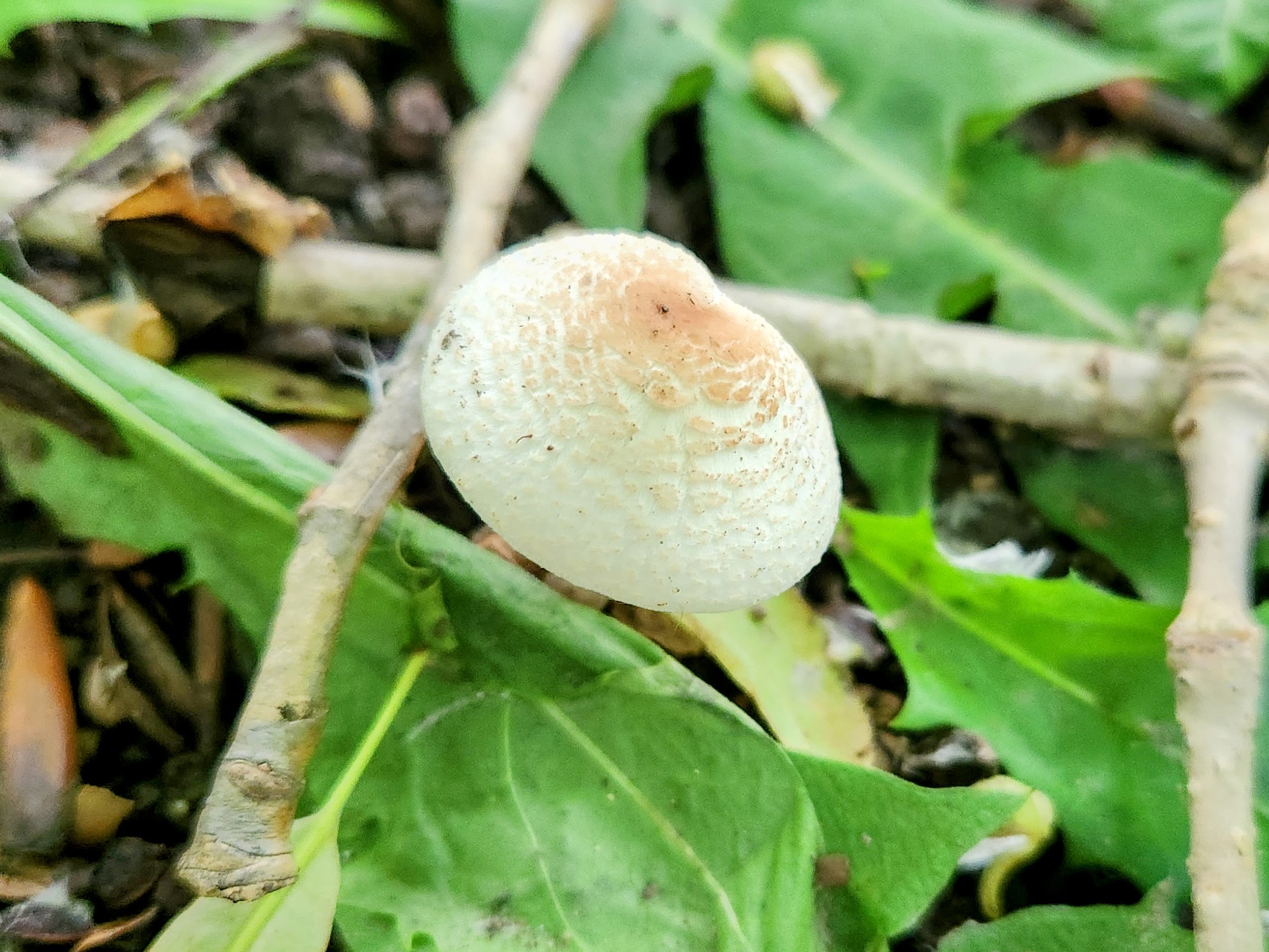
1–6.5 cm in diameter; initially bell-shaped, later expanding to convex-flat, with or without a central umbo. It is covered with small orange-brown to reddish-brown scales—forming a solid cap-like patch at the center, while becoming sparser and paler toward the margin. The surface between the scales is white or slightly beige, and the margin tends to crack.
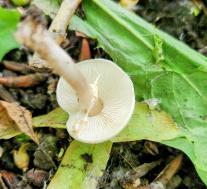
The gills are free, white to cream-colored, thin, and crowded. In young specimens, the gills are protected by a white partial veil, which subsequently ruptures and remains on the stem as a ring.
3–7 cm tall and up to 1 cm in diameter; cylindrical, even or slightly thickened at the base; solid in young specimens, becoming hollow with age. The ring is membranous, thin, and white or cream-colored (matching the spore print); it may be absent in mature specimens. Coloration: light—almost white—above the ring zone, and noticeably darker below, ranging to pinkish-brown at the base. In young Lepiota specimens, the stem surface is covered with small, sparse scales.
Thin and white; the flesh turns slightly pink where the stem is broken. The taste is unpleasant and indistinct.
Weak, unpleasant, with a rubbery undertone.
The spore print is yellowish-cream. The spores are triangular or wedge-shaped (bullet-shaped) in profile, with a spur-like appendage, measuring (5.0) 5.5–8.5 (10.0) × 2.5–3.5 µm, and are slightly thick-walled. They stain yellow to brown in Melzer’s reagent (dextrinoid); they stain in Congo red solution; and they do not stain in cresyl blue.
It grows singly or in groups on the ground in deciduous, coniferous, and mixed forests, as well as in forest clearings, meadows, and pastures. A common ruderal species, it fruits abundantly in short grass on old lawns within high-rise residential areas and along roadsides.
It resembles other Lepiota species.
Add new comment