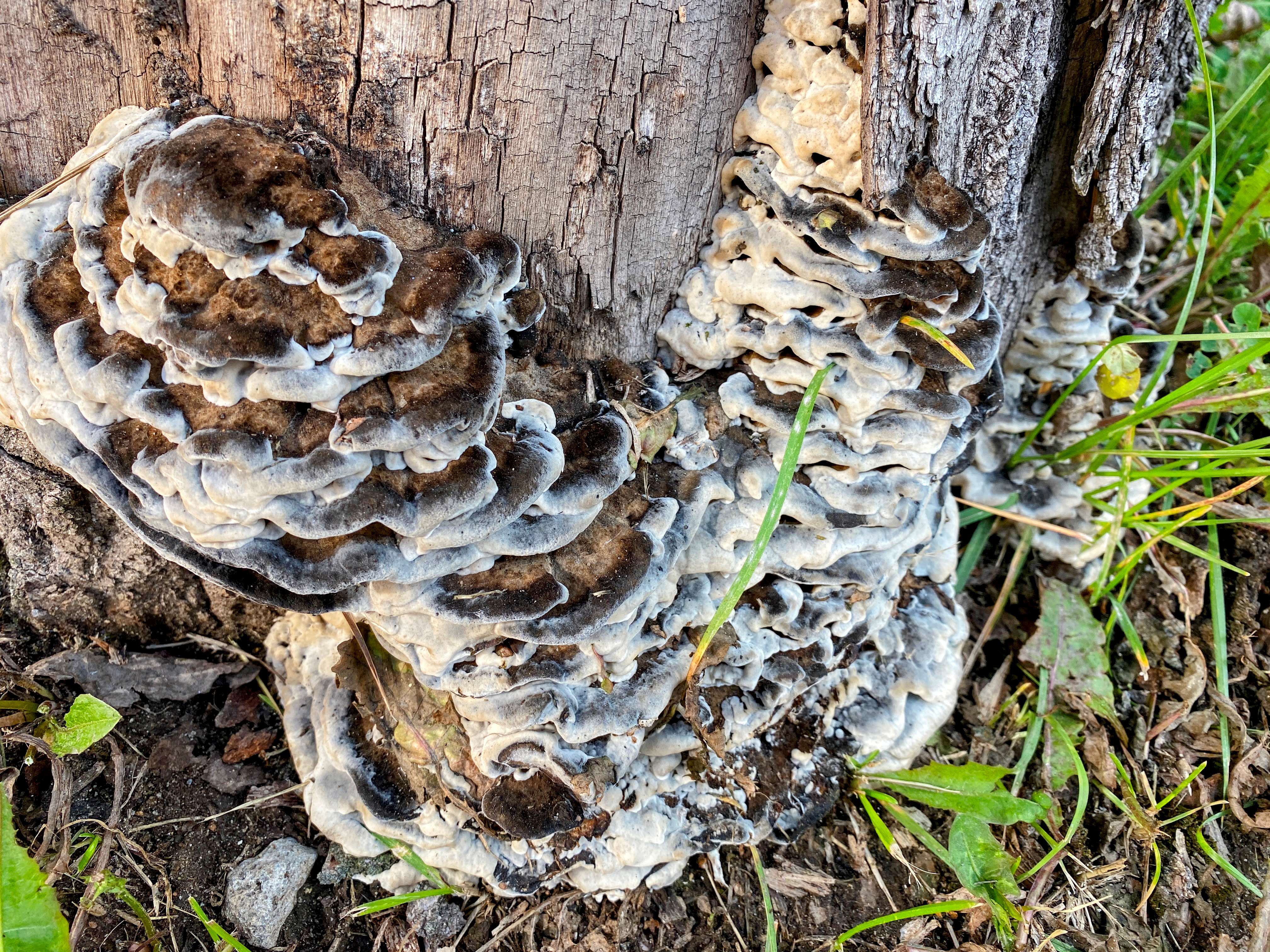
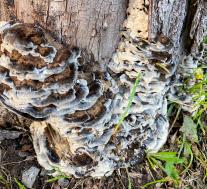
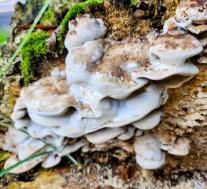
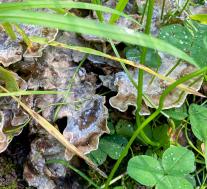
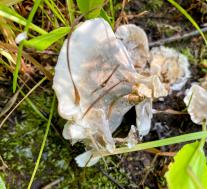
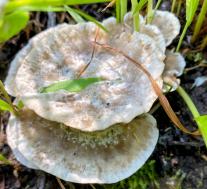
Fruiting bodies are annual, sometimes overwintering, up to 7 cm in the largest dimension, often forming imbricate clusters united by a common base, relatively thin (up to 5 mm thick), wavy, sometimes radially ribbed at the margin; initially with a finely tomentose surface that later becomes glabrous, weakly zonate, and variably colored (depending on age and weather conditions) — from light grayish-brown with a white margin to brownish-brown, almost black.
The hymenophore is up to 2 mm thick, grayish-brownish, darker toward the center, sometimes bearing 2–3 alternating pale grayish and brownish zones at the margin; the broad sterile edge is white. In overwintering or post-winter fruiting bodies, the hymenophore coloration is usually more uniform. Pores are small, 5–7 per 1 mm, grayish-brown inside the tubes, with pore margins grayish-white.
Flesh
Soft-leathery, whitish, becoming brownish in old fruiting bodies, without a black line above the tubular layer. Taste mushroom-like, sometimes slightly astringent.
Odor
Pleasant, mushroom-like.
Microscopy
Spore print whitish in mass. Spores 4–5.5 x 2.0–2.5 μm, ellipsoid, smooth, hyaline, inamyloid.
Ecology and distribution
Xylotroph. A cosmopolitan species with a very wide distribution. In Russia, it is known in all regions from the European part to the Far East. One of the most widespread fungi in the world. Found on damaged, dead, and fallen trunks and stumps of birch, aspen, alder, elm, willow, and shrub stems, rarely on conifers. Causes white rot.
Similar species
From Turkey Tail (Trametes versicolor), which inhabits the same substrates, it is well distinguished by the coloration of the hymenophore and the weakly expressed zonality of the caps; it is more difficult to distinguish this species from the related Smoky Bjerkandera (B. fumosa), with particularly close similarity observed in young fruiting bodies. B. fumosa has a more uniform creamy or slightly brownish cap coloration, a lighter hymenophore color, and the presence of a black line separating the tubular layer from the flesh. On average, the fruiting bodies of B. fumosa are slightly larger. Sometimes these two species occur side by side on the same substrate.
Notes
Bjerkandera adusta has demonstrated high antimicrobial activity against Escherichia coli, Pseudomonas aeruginosa, Staphylococcus aureus, Micrococcus luteus, Streptococcus pneumoniae and Candida albicans. This activity may be associated with the presence of phenolic and related compounds that have been identified in the species.
Related resources
Bondartsev A. S. Polypores of the European Part of the USSR and the Caucasus. — Moscow – Leningrad: Publishing House of the Academy of Sciences of the USSR, 1953. — 1106 p.
Bondartseva M. A. Order Aphyllophorales. Issue 2. / Keys to the Fungi of Russia. — Saint Petersburg: "Nauka", 1998. — 391 p.
Breitenbach J, Kränzlin F. Fungi of Switzerland. A contribution to the knowledge of the fungal flora of Switzerland. Vol 2. Heterobasidiomycetes, Aphyllophorales, Gasteromycetes. — Lucerne: Verlag Mykologia, 1986. — 412 p.
Ryvarden L., Melo I. Poroid fungi of Europe. / Synopsis Fungorum. Vol. 31 — Oslo: Fungiflora, 2014. — 455 p.
Add new comment