Summer honey fungus (Kuehneromyces mutabilis)
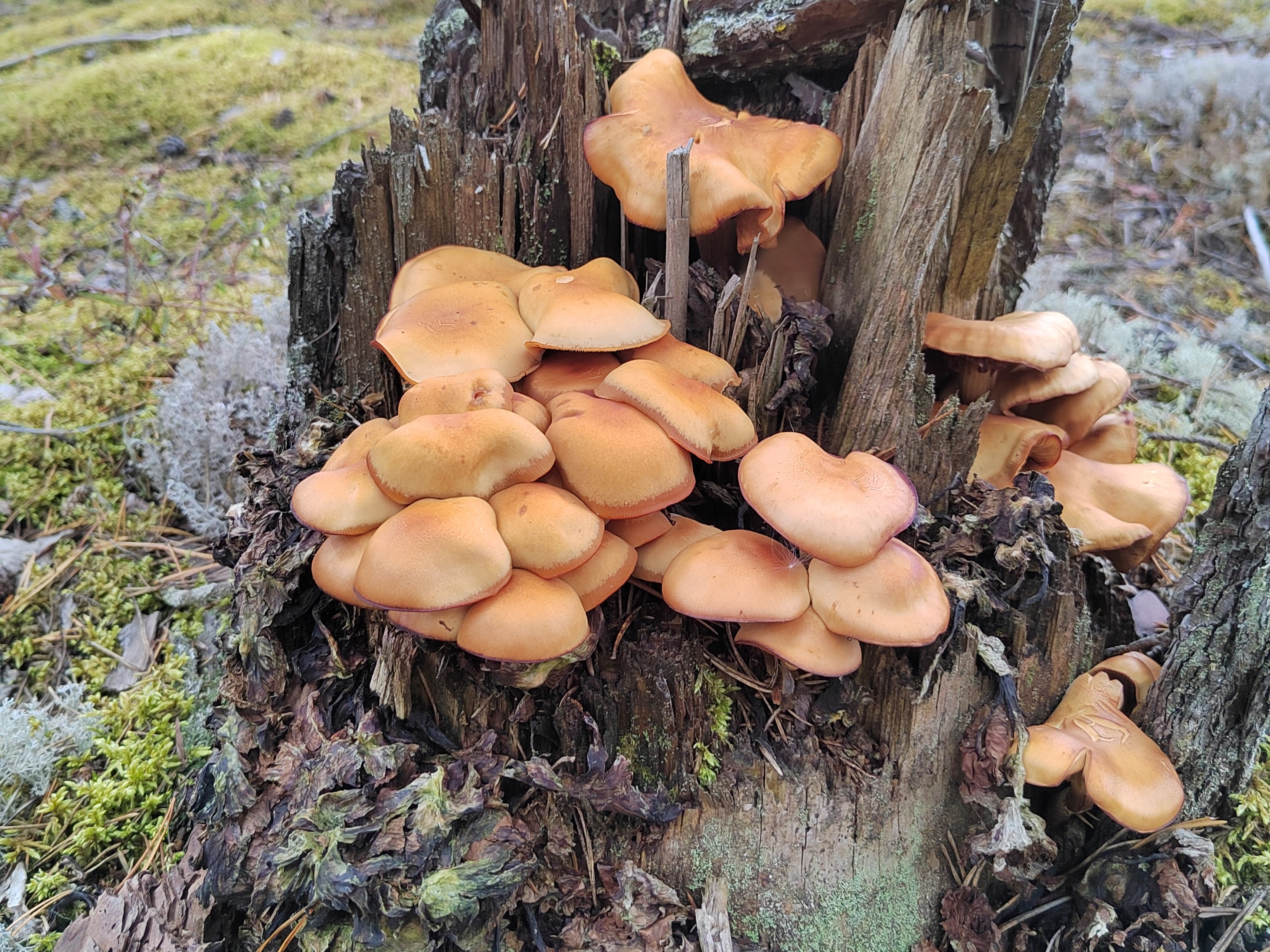
Index Fungorum Kuehneromyces mutabilis (Schaeff.) Singer & A.H. Sm.
Mycobank Kuehneromyces mutabilis (Schaeff.) Singer & A.H. Sm.
Varushka, linden honey mushroom.
Honey mushroom (plural honey mushrooms or oyata) — folk or nonsystematic name for group of mushrooms belonging to different genera and families. Name comes from characteristic habitat of these mushrooms: most grow on living and dead wood, on stumps.
Mūtābilis, e – unchangeable, changeable
Agaricus mutabilis Schaeff., Fung. bavar. palat. nasc. (Ratisbonae) 4: 6 (1774)
Pholiota mutabilis (Schaeff.) P. Kumm., Führ. Pilzk. (Zerbst): 83 (1871)
Dryophila mutabilis (Schaeff.) Quél., Enchir. fung. (Paris): 69 (1886)
Galerina mutabilis (Schaeff.) P.D. Orton, Trans. Br. mycol. Soc. 43(2): 176 (1960)
Lepiota caudicina Gray, Nat. Arr. Brit. Pl. (London) 1: 603 (1821)
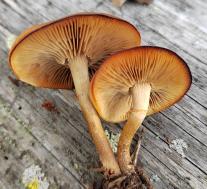
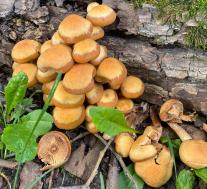
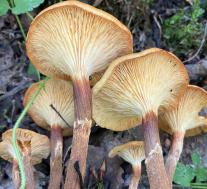
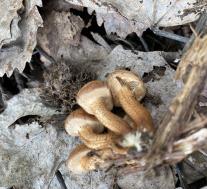
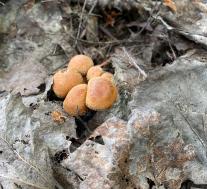
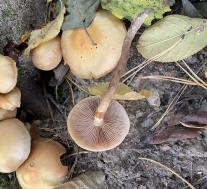
Up to 8 cm in diameter, quite watery and thin, initially hemispherical, with age becoming plane-convex to fully expanded, reddish-brown, yellow-brown, with clear concentric color zones, at center with flat umbo and brighter. Often occurs that caps of mushrooms from "lower tier" are covered with brown layer of spore print from upper mushrooms, creating impression that they are rotten. Hymenophore lamellar. Gills decurrent on stem or adnate, initially cream-colored, then brown.
3.5 – 5 cm high, 0.3 – 0.4 cm wide, with ring in upper part of stem, above ring whitish, below – brown, scaly, cylindrical, slightly narrowed toward bottom, hollow. Ring same color as cap. Sometimes it disappears, but on stem clear trace from it remains. Ring fibrous, brown.
Flesh fibrous, thin, whitish. Smell strong fungal, pleasant. Taste fungal.
Spore print dark-brown. Spores ellipsoid, with pore.
Xylophile. Summer honey grows in dense colonies on rotten wood or on damaged living trees. Prefers deciduous species. Widely distributed in deciduous and mixed forests of northern temperate climate, in arid areas found less frequently.
Not listed in the Red Data Book of RF and regions.
Similar species:
- differs from autumn and winter honey by fruiting period, gills that brown over time, and from winter honey also by scaly stem with ring;
- from false honey (Hypholoma) and various psathyrellas (Psathyrella) – by gill color, presence of ring, scaly stem (in hypholomas and psathyrellas it is usually smooth), and zonally colored hygrophanous cap;
- from deadly poisonous Galerina marginata (Galerina marginata) – by place of growth, zonally colored cap (in Galerina it is monotonously colored), narrow ring and scales on stem (in Galerina ring is wider and instead of small scales there are large light fibers), smell (in Galerina – floury or musty), and tendency to grow in large colonies: Galerina does not form large clusters – grows scattered groups of individual mushrooms or small bunches of 3-6 fruit bodies. Summer honey is not recommended for harvesting in wet coniferous forests where Galerina is usually found, which decomposes buried conifer wood.
Very close species with similar medicinal properties, practically a twin species, is wood-inhabiting honey, or spring honey (Kuehneromyces lignicola), differing by slightly earlier fruiting period, less contrasting colored cap and stem without brown scales below ring. It is precisely wood-inhabiting honey that is practically externally indistinguishable from deadly Galerina.
In dry weather Kuehneromyces mutabilis loses many of its characteristics, and then it can be confused literally with all mushrooms growing in similar conditions. For example, with winter honey (Flammulina velutipes), sulfur-yellow false honey (Hypholoma fasciculare) and brick-red false honey (Hypholoma sublateritum), as well as with blue-gilled false honey, Hypholoma capnoides.
Summer and autumn honey are united only by colloquial name, related to dense growth of fruit bodies on wood: summer and autumn honey mushrooms belong to different genera and families. Autumn honey (large complex of species Armillaria) belongs to family Physalacriaceae (Physalacriaceae), summer honey – to Strophariaceae (Strophariaceae)
Add new comment