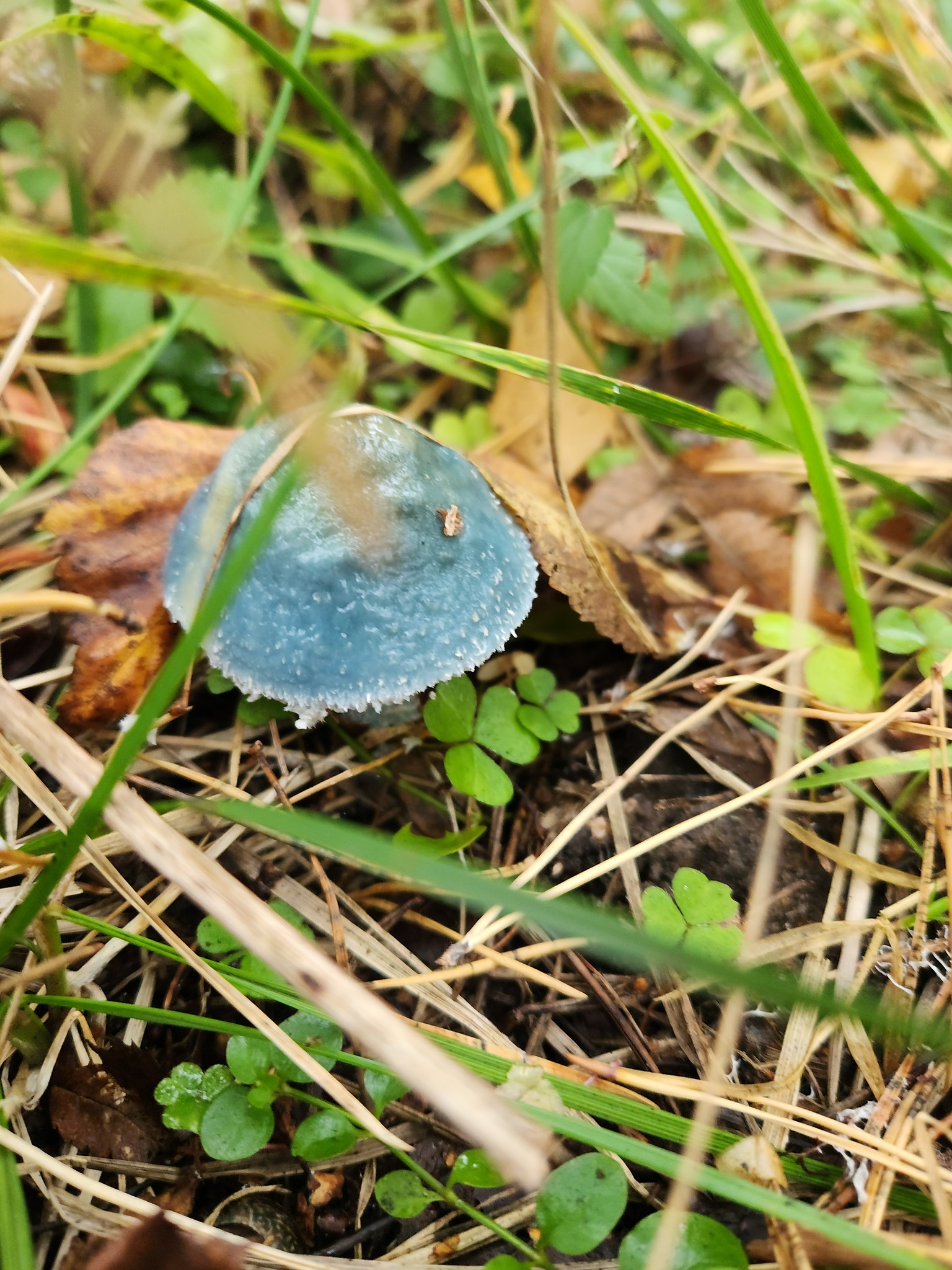
Verdigris Agaric (Stropharia aeruginosa)
Index Fungorum Stropharia aeruginosa (Curtis) Quél
MycoBank Stropharia aeruginosa (Curtis) Quél
Verdigris Stropharia, Copper-green Stropharia.
Aerūginōsus, a, um — цвета медной патины, сине-зелёный.
Agaricus acuminatus Scop., Fl. carniol., Edn 2 (Wien) 2: 447 (no. 1542) (1772)
Agaricus aeruginosus Curtis, Fl. Londin. 2: tab. 309 (1782)
Geophila aeruginosa (Curtis) Quél., Enchir. fung. (Paris): 111 (1886)
Pratella aeruginosa (Curtis) Gray, Nat. Arr. Brit. Pl. (London) 1: 626 (1821)
Psalliota aeruginosa (Curtis) P. Kumm., Führ. Pilzk. (Zerbst): 73 (1871)
Psilocybe aeruginosa (Curtis) Noordel., Persoonia 16(1): 128 (1995)
Stropharia acuminata (Scop.) Murrill, Mycologia 14(3): 128 (1922)
Stropharia aeruginosa f. azafranoides Dähncke, in Dähncke, Innocenti, López Quintanilla, Bailón Casanova, Chávez Barreto & Escobio García, Cantarela 42: 1 (2009)
Stropharia aeruginosa f. brunneola Hongo, J. Jap. Bot. 40: 312 (1965)
Stropharia aeruginosa var. alpina M. Lange, Meddr Grønland, Biosc. 147(11): 63 (1955)
Stropharia aeruginosa var. earthwormia T.X. Meng & T. Bau, in Bau & Meng, J. Fungal Res. 6(1): 25 (2008)
Stropharia aeruginosa var. exsquamosa L. Krieg., Mycologia 19(6): 313 (1927)
Stropharia aeruginosa var. neuquenensis M.M. Moser & Singer, Beih. Nova Hedwigia 29: 229 (1969)
Stropharia alpina (M. Lange) M. Lange, Bot. Tidsskr. 75: 8 (1980)
The collection and consumption of this species is not prohibited by Russian legislation, as psilocybin has not been detected in the Verdigris Agaric. Consumption of the mushroom raw does not lead to hallucinations, but causes gastroenterological poisoning that is not life-threatening.
3–10 cm in diameter, initially conical, at maturity expanding to convex and convex-expanded with an umbo in the center. Surface slimy, sticky, non-hygrophanous; in young fruiting bodies blue-green, gradually fading unevenly, forming spots and smooth transitions between yellow-green, ochre, and blue hues.
Hymenophore: lamellate. Gills adnate or adnate with a tooth, with lamellulae, slightly swollen, initially light, pinkish-beige, at maturity creamy with a lilac tint, lilac-brown; gill edge finely serrated, fringed, contrastingly white.
10 × 0.4–2 cm, hollow, concolorous with the cap, with a distinct lighter ring; white with a bluish tint, sometimes brownish in the lower part; below the ring covered with scales, above it smooth or fibrous.
Thin, soft in the cap, bluish; denser in the stipe, with greenish-blue shades.
Weak, herbaceous or slightly spicy-sharp.
Spore print light brown. Spores ellipsoid or slightly almond-shaped, smooth, with an indistinct germ pore.
Litter saprotroph. Grows singly and in groups on more or less acidic, nutrient-rich soil, leaf litter, and decaying wood in forests of various types, in shrublands, along roadsides, in parks and gardens, on refuse heaps, sometimes among mosses at the edges of pastures and grazing lands.
Not listed in the Red Data Book of the Russian Federation or its regional Red Lists.
Sky-blue Stropharia (Stropharia caerulea) grows outside forests, in parks, on pastures and clearings. It has a more blue hue. False-blue Stropharia (Stropharia pseudocyanea) is a meadow species, with a more slender build of fruiting bodies.
Да, это верное наблюдение. Концентрация действующих веществ в грибах действительно непостоянна и зависит от множества факторов: состава почвы, климатических условий, стадии развития плодового тела, времени сбора и даже способа приготовления.
Поэтому один и тот же вид в разных условиях может проявлять себя по-разному — от полностью съедобного до вызывающего лёгкое отравление или, в редких случаях, более серьёзные реакции. Именно по этой причине многие грибы классифицируются как «условно-съедобные»: они требуют обязательной предварительной обработки (отваривания, вымачивания, ферментации) и индивидуального подхода к оценке рисков.
Если ты собираешь грибы для еды, важно не только точно определять вид, но и учитывать местную специфику: где растёт гриб, в какой экосистеме, не загрязнена ли почва тяжёлыми металлами или другими токсинами. Даже съедобные виды могут накапливать вредные вещества из окружающей среды.
Так что осторожность, умеренность и знание местных условий — ключевые правила безопасного грибного сбора.
Add new comment