Winter honey fungus (Flammulina velutipes)
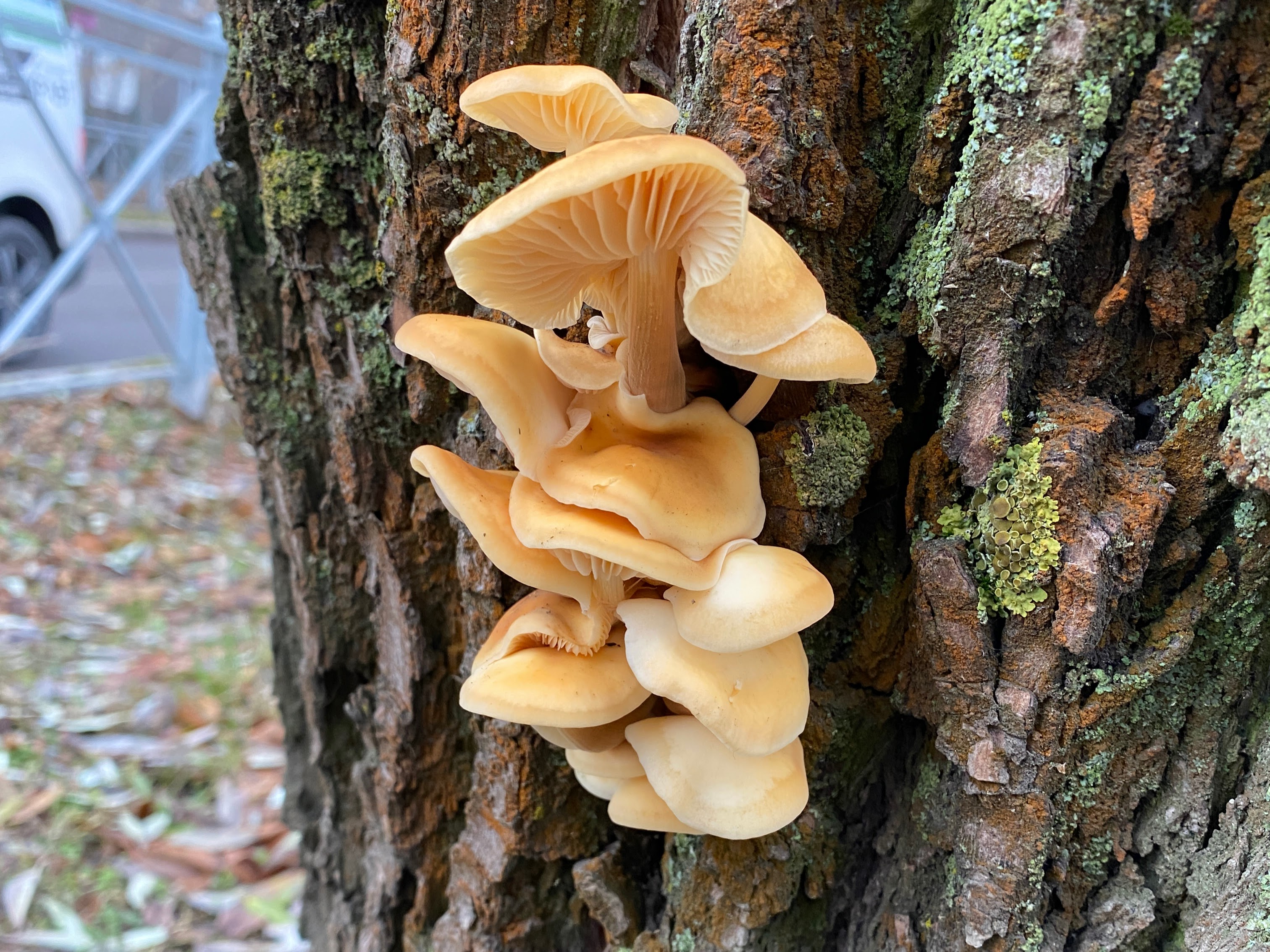
Index Fungorum Flammulina velutipes (Curtis) P. Karst.
MycoBank Flammulina velutipes (Curtis) Singer, Lilloa
Velvet-stemmed flammulin, winter mushroom.
In translation from Latin the genus name Flammulina means "little flame"
From velutum + pēs. Velutum, i n – velvet; pēs, pēdis m 1) leg, foot; 2) stem.
Agaricus atropes Schumach., Enum. pl. (Kjbenhavn) 2: 285 (1803)
Agaricus fuscipes Vahl, Fl. Danic. 7: tab. 1194, fig. 2 (1797)
Agaricus sphinx Batsch, Elench. fung. (Halle): 145 (1783)
Agaricus velutipes Curtis, Fl. Londin. 2: pl. [69] (1782)
Collybia eriocephala Rea, in Smith & Rea, Trans. Br. mycol. Soc. 3(1): 46 (1908) [1907]
Collybia veluticeps Rea, in Smith, Trans. Br. mycol. Soc. 1(4): 157 (1901) [1899-1900]
Collybia velutipes (Curtis) P. Kumm., Führ. Pilzk. (Zerbst): 116 (1871)
Collybia velutipes f. aestivalis Singer, Z. Pilzk. 1(2): 40 (1922)
Collybia velutipes f. curta Killerm., Denkschr. Bayer. Botan. Ges. in Regensb. 18: 85 (1930)
Collybia velutipes f. microspora J.E. Lange, Dansk bot. Ark. 9(no. 6): 74 (1938)
Collybia velutipes var. alba Cool, Medded. Nedl. Mycol. Ver. 12: 24 (1922)
Flammulina velutipes (Curtis) P. Karst., Meddn Soc. Fauna Flora fenn. 18: 62 (1891)
Flammulina velutipes f. brevipes Blanco-Dios, Yesca, Revista Sociedad Micólogica de Cántabria 31: 84 (2019)
Flammulina velutipes f. vinaceoroseolus P. Zhang, in Liu & Zhang, J. Fungal Res. 4: 1 (2016)
Flammulina velutipes var. campolameirana Blanco-Dios, Tarrelos 19: 19 (2017)
Flammulina velutipes var. cytiseicola Blanco-Dios [as 'cytisicola'], Boln Soc. Micol. Madrid 37: 110 (2014) [2013]
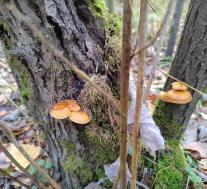
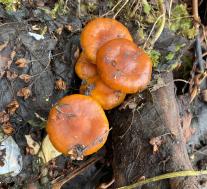
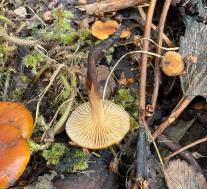
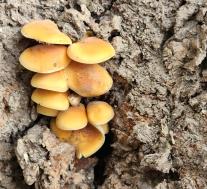
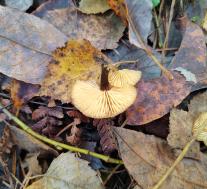
Round-convex, with age acquires flat shape. Diameter from 2 to 8 cm, however some large specimens can reach 10 and even 12 cm. Cap color varies from yellow to orange-brown. In most cases cap edges have lighter shade than central zone. Surface slimy, smooth, upon slight drying acquires shiny tint. Hymenophore lamellar. Gills not crowded, adnate, cream-colored with age become darker.
Length 4–10 cm and diameter 0.5–1 cm, cylindrical, sometimes narrowed toward base, often curved, fibrous, initially solid, then hollow, at top light yellowish, below velvet-textured (distinctive feature), black-brown, in old mushrooms – entirely black, hard.
Watery, cream-colored. In stem flesh more hard, fibrous. Smell fungal, pleasant.
Spore print white-colored. Spores from ellipsoid to cylindrical.
Saprotroph and parasite. Grows on fallen wood and living weakened deciduous trees. Forms clusters of fruit bodies. Fruiting frequently and annually. Capable of forming fruit bodies during winter thaws or spring-summer frosts. In the Holarctic zone, distributed widely.
Not listed in the Red Data Book of RF and regions.
In Europe there are 8 (9 if counting Laccariopsis mediterranea, previously F. mediterranea) well-known species of Flammulina: F. elastica, F. velutipes, F. populicola, F. rossica, F. fennae, F. finlandica, F. ononides and F. cephalariae. (Also possibly, though unlikely, that F. filiformis could have gotten out of control in some places and occurs in the wild.) Except for very rare F. ononides on Ononis spinosa, F. cephalariae on Cephalaria leucantha and Laccariopsis mediterranea on Ammophila litoralis, microscopy is always required for differentiation of these species. Especially important are spore sizes and Q (ratio of spore length to width). In most cases one should also pay attention to pileipellis. (And no, the fact that there are several species of Flammulina changes nothing regarding edibility of this group.) From harvesting point of view in nominal fruiting period (when snow lies), winter honey cannot be confused with anything because nothing else exists. However, at out-of-season times, winter honey can in principle be confused with some other wood-destroyers, from which it differs by white spore print and absence of ring on stem. In recent years fruiting of flammulina overlaps with Galerina marginata. Here one needs to be extremely careful. Main difference lies in stem of mushroom. Most main distinctive feature of Galerina is no fuzziness on stem. Also Galerina has ring on stem or trace from ring (remnant of partial veil). Therefore collect mushrooms only together with stem. Collybia fusipes – mushroom of questionable food quality, differs by reddish-brown cap, stem orange-red, often twisted, at bottom strongly narrowed; usually found on roots of old oaks. Some species of Gymnopilus genus, inedible due to bitterness or with unexplored toxic properties, often growing late in autumn during winter honey fruiting period, having similar cap coloration to winter honey. Inexperienced mushroom pickers may confuse winter honey with Gymnopilus, which easily differ by rusty-brown gill color and completely different, dense, texture of stem.
In Western tradition there is officially established term LBM — "little brown mushroom" («маленький коричневый гриб»). For ordinary Western (Europe and USA) mushroom pickers LBM unites huge number of small and medium-sized dark or dull-colored difficult-to-distinguish species, just as for ordinary Russian mushroom pickers our word "poganka". Experienced mushroom pickers often already able to determine genus of LBM or even group of species to which LBM may belong, but "reach" proper species usually not capable. Exact determination available only to specialists armed with microscope and chemical reagents. Less frequently used term BWM — «big white mushroom» («большой белый гриб»). It is applied to large difficult-to-determine light-colored mushrooms, first of all — various clavarias (Clitocybe).
Add new comment