Black Milkcap (Lactarius turpis)
Груздь черный
Current name

Index Fungorum   Lactarius turpis (Weinm.) Fr. 

MycoBank   Lactarius turpis (Weinm.) Fr.

Other names

Olive-black Milkcap, Chernushka, Chernysh, Black Duplyanka, Gypsy.

Systematic position
Specific epithet etymology

Turpis, e: ugly, repulsive; hideous; disfigured.

Synonyms

Lactifluus turpis (Weinm.) Kuntze, Revisio generum plantarum 3 (3): 857 (1891) 

Galorrheus turpis (Weinm.) P. Kumm., Der Führer in die Pilzkunde: 125 (1871) 
Habit
Fruiting body
Agaricoid (cap and stipe)
Hymenophore
Lamellate (gills present, including folded or rudimentary)
Fruiting period (list)
JulJuly (11th–20th)July (21st–31st)AugAugust (1st–10th)August (11th–20th)August (21st–31st)SepSeptember (1st–10th)September (11th–20th)September (21st–30th)OctOctober (1st–10th)October (11th–20th)
Mushroom cap

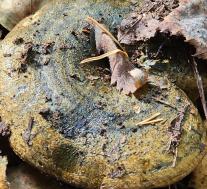
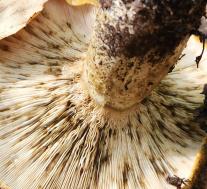
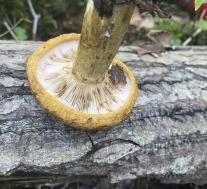
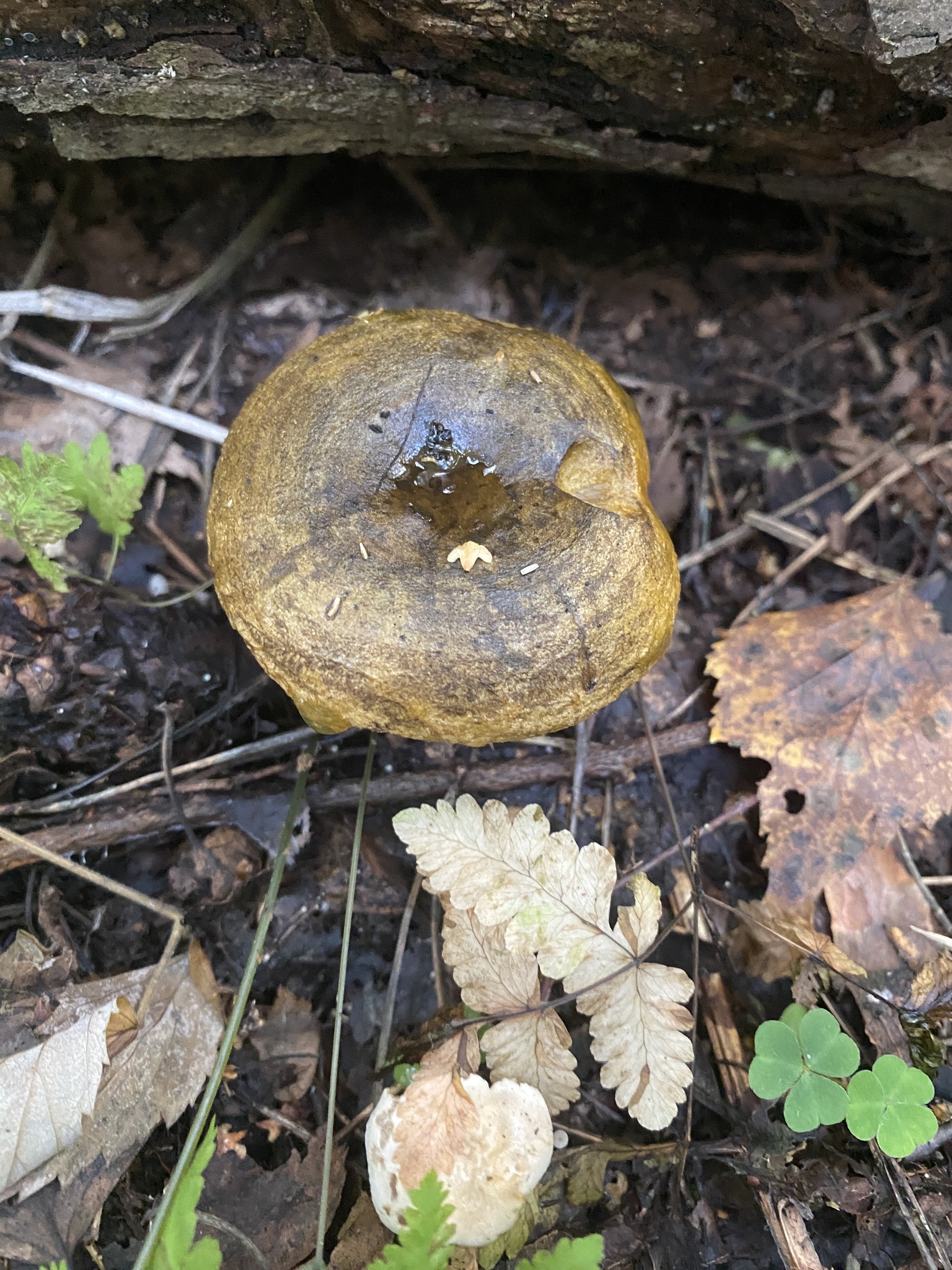
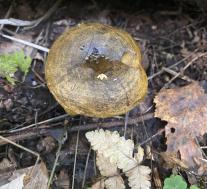
Large, fleshy, 7–20 cm in diameter. Young specimens are rounded and compact, with a depressed center and tightly inrolled margins; with age, the cap expands and eventually becomes funnel-shaped. The coloration is highly distinctive: blackish-olive, with faint concentric zones or none at all. The black pigment seems to soak into the cap surface, creating a false impression that the mushroom is dirty. The surface is bare, dry, and slightly sticky in wet weather; young specimens have margins covered with a faint, quickly disappearing fringe. The gills are crowded, slightly decurrent onto the stipe, white when young, later turning yellowish.

Stem

Short and thick (3–6 cm tall, 1–3 cm thick), hollow inside in mature specimens, sometimes giving a "barrel-shaped" impression; colored like the cap, with the surface covered in the characteristic depressed spots typical of milkcaps.

Flesh

Flesh dense, brittle, white, darkening when broken, and abundantly exuding a pungent, acrid milky latex.

Odor

Weak, with fruity notes.

Microscopy

Spore print: cream. Spores measuring 6.3–8.8 × 4.8–6.5 µm, broadly ellipsoid, warted, with warts connected by ridges forming a net-like pattern up to 1 µm high.

Ecology and distribution

Forms mycorrhiza with Betula (birch). Grows in coniferous forests (with spruce) and mixed forests (with birch), in large groups, less commonly singly, often at the base of large trees. Found among moss and along forest edges. In the Vologda Region, it is a widespread and common species.

Fruiting

July–October.

Nutritional properties
Conditionally edible

According to some studies widely cited in mycological and medical literature, the Black Milkcap contains a biologically active substance called necatorin — a powerful mutagenic carcinogen; its concentration can reach up to 20 mg per 1 kg of fresh mushrooms. According to this research, boiling destroys about half of the necatorin, leaving approximately 25% of the original concentration in the mushrooms and 25% in the cooking water.

The mutagenicity test for necatorin was conducted using the Ames test, which is performed on Salmonella bacteria. However, this is not the most suitable model for extrapolating the results to other living organisms.

Another study on the chemical properties of two Lactarius species, published in 2014, showed no toxic effects of L. turpis extracts on pig liver cells. The researchers, however, do not draw conclusions regarding the edibility of the species.

Similar species

There are no truly similar species. Sometimes inexperienced foragers confuse the Black Milkcap with the Poison Pax (Paxillus involutus).

Notes

In foreign popular literature, it is considered poisonous due to its acrid milky latex.

Link to this page for printed editions
Shipovalov A.G. Black Milkcap (Lactarius turpis) - Mushrooms of Vologda Region [Electronic resource] URL: https://xn----7sbancweblffgklubds60aja.xn--p1ai/en/black-milkcap-lactarius-turpis (accessed: 13.04.2026).
Share link

Add new comment

One file only.
2 MB limit.
Allowed types: png jpeg jpg jpe gif webp svg.
Allowed types: png gif jpg jpeg webp svg.

Plain text

  • No HTML tags allowed.
  • Lines and paragraphs break automatically.
  • Web page addresses and email addresses turn into links automatically.
Add image
Maximum 8 files.
2 MB limit.
Allowed types: png jpeg jpg jpe gif webp svg.
Allowed types: png gif jpg jpeg webp.
January (1st–10th)
January (1st–10th)
January (11th–20th)
January (11th–20th)
January (21st–31st)
January (21st–31st)
February (1st–10th)
February (1st–10th)
February (11th–20th)
February (21st–28th/29th)
March (1st–10th)
March (1st–10th)
March (11th–20th)
March (11th–20th)
March (21st–31st)
March (21st–31st)
April (1st–10th)
April (1st–10th)
April (11th–20th)
April (11th–20th)
April (21st–30th)
April (21st–30th)
May (1st–10th)
May (1st–10th)
May (11th–20th)
May (11th–20th)
May (21st–31st)
May (21st–31st)
June (1st–10th)
June (1st–10th)
June (11th–20th)
June (11th–20th)
June (21st–30th)
June (21st–30th)
July (1st–10th)
July (1st–10th)
July (11th–20th)
July (11th–20th)
July (21st–31st)
July (21st–31st)
August (1st–10th)
August (1st–10th)
August (11th–20th)
August (11th–20th)
August (21st–31st)
August (21st–31st)
September (1st–10th)
September (11th–20th)
September (21st–30th)
October (1st–10th)
October (1st–10th)
October (11th–20th)
October (11th–20th)
October (21st–31st)
October (21st–31st)
November (1st–10th)
November (1st–10th)
November (11th–20th)
November (21st–30th)
December (1st–10th)
December (1st–10th)
December (11th–20th)
December (21st–31st)