Blusher (Amanita rubescens)
Index Fungorum Amanita rubescens Pers.
MycoBank Amanita rubescens Pers.
Eurasian blusher.
Rubescens — becoming red. Present active participle of rubēsco, buī, -, ere (to turn red). This epithet refers to the change in color of the flesh when damaged.
Amanita rubescens Pers., Tent. disp. meth. fung. (Lipsiae) : 67 (1797) - Basionym
Amplariella rubescens (Pers.) E.-J. Gilbert, Iconogr. Mycol., Suppl. I (Milan) 27: 79 (1940)
Amplariella rubescens f. rubescens (Pers.) E.-J. Gilbert, Iconogr. Mycol., Suppl. I (Milan) 27: 79 (1940)
Limacium rubescens (Pers.) J. Schröt., Krypt.-Fl. Schlesien (Breslau) 3.1(33–40): 531 (1889)
Agaricus rubescens (Pers.) Fr., Syst. mycol. (Lundae) 1: 18 (1821)
Agaricus rubescens var. rubescens (Pers.) Fr., Syst. mycol. (Lundae) 1: 18 (1821)
Amanita rubescens var. radicata (Voglino) Contu & Bon, Docums Mycol. 14(no. 56): 26 (1985)
Amplariella rubescens (Pers.) E.-J. Gilbert, Iconogr. Mycol., Suppl. I (Milan) 27: 79 (1940)
Amanita rubens f. magnifica (Fr.) Veselý, Annls mycol. 31(4): 244 (1933)
Amanita rubens f. radicata (Voglino) Veselý, Annls mycol. 31(4): 243 (1933)
Amanita rubens f. annulo-sulphurea (Gillet) Veselý, Annls mycol. 31(4): 244 (1933)
Amanita rubescens var. magnifica (Fr.) Rea, Brit. basidiomyc. (Cambridge) : 104 (1922)
Amanita rubens var. circinnata (Pers.) Sacc., Fl. ital. crypt., Hymeniales (Genoa) 1(14): 45 (1915)
Amanita radicata Voglino, Boll. Soc. bot. ital., 1894 : 120 (1894)
Limacium rubescens (Pers.) J. Schröt., Krypt.-Fl. Schlesien (Breslau) 3.1(33–40): 531 (1889)
Lepiota magnifica (Fr.) P. Karst., Bidr. Känn. Finl. Nat. Folk 32: 12 (1879)
Amanita rubescens var. verrucosa Gillet, Hyménomycètes (Alençon) : 45 (1874)
Amanita magnifica (Fr.) Gillet, Hyménomycètes (Alençon) : 23 (1874)
Agaricus magnificus Fr., Monogr. Hymenomyc. Suec. (Upsaliae) 1: 13 (1857)
Agaricus rubescens var. circinnata (Pers.) Weinm., Hym. à Gast. Imp. Ross. Obs. (Petropoli) : 7 (1836)
Agaricus rubescens (Pers.) Fr., Syst. mycol. (Lundae) 1: 18 (1821)
Amanita circinnata Gray, Nat. Arr. Brit. Pl. (London) 1: 600 (1821)
Agaricus verrucosus Bull., Herb. Fr. (Paris) 7: pl. 316 (1787)
Agaricus margaritifer Batsch, Elench. fung. (Halle) : 57 (1783)
Agaricus myodes Schaeff., Fung. bavar. palat. nasc. (Ratisbonae) 4: 69 (1774)
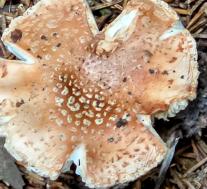
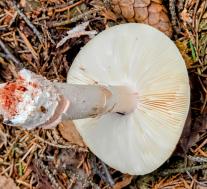
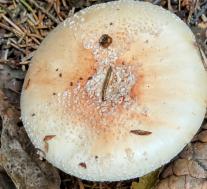
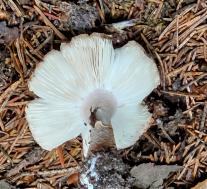
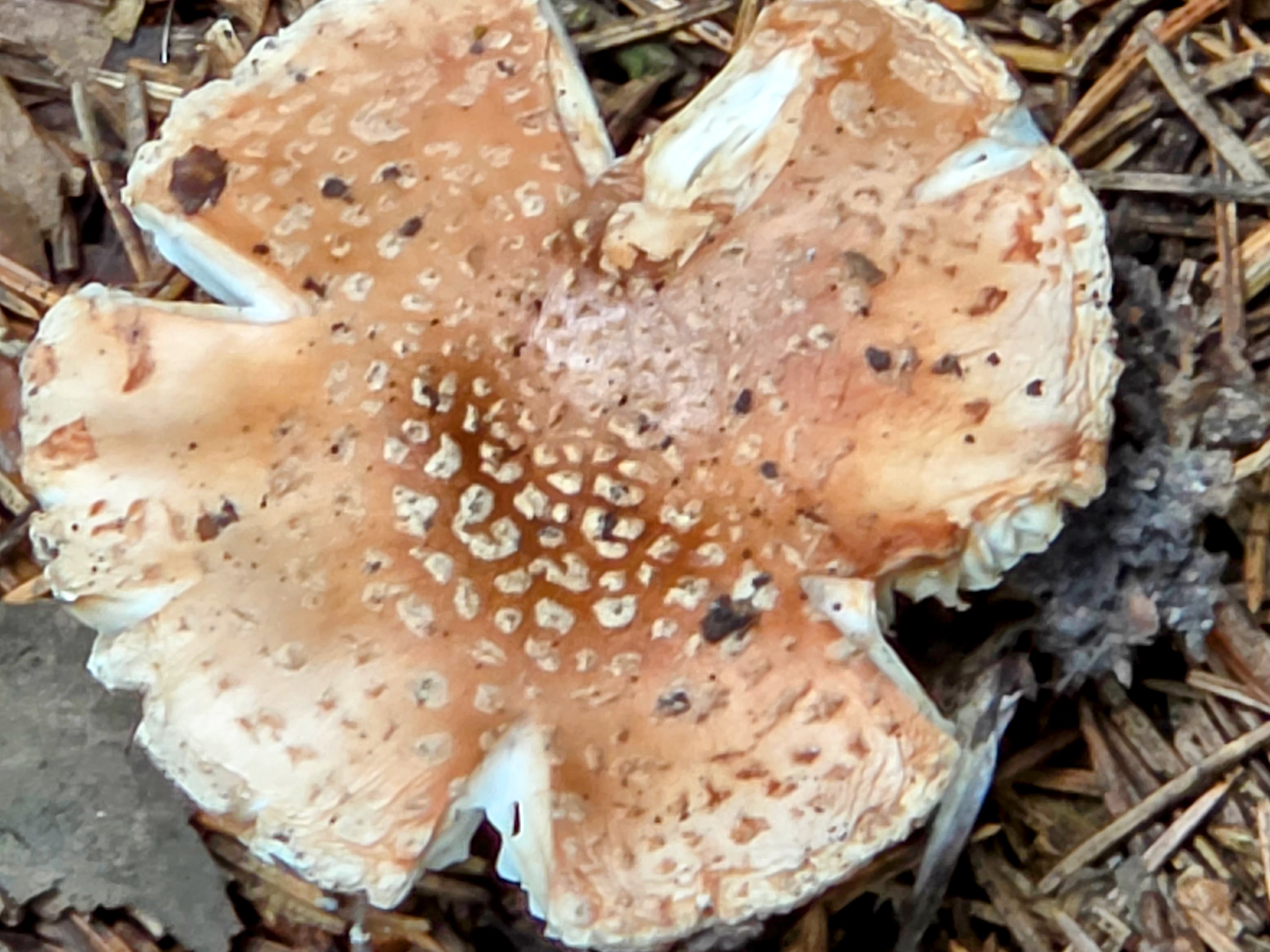
An amanita mushroom with a grayish-brown or pinkish-brown cap, covered in remnants of the universal veil. A characteristic feature is that the flesh gradually turns pink and then reddish-brown when damaged—most notably at the base of the stipe and around the tunnels made by insect larvae.
5–20 cm in diameter; initially convex, later expanding to become flat, sometimes with a shallow central depression. The coloration is variable: grayish, pinkish-brown, or brown, with reddish tints. The surface is covered with whitish, grayish, or brownish wart-like remnants of the universal veil, which may be washed away by rain. The margin is typically smooth (not striated).
The gills are adnate or narrowly adnate to the stipe, white, and closely spaced. When damaged or as the mushroom ages, they develop pinkish or reddish-brown spots.
Typically 7–15 cm long and 1–2 cm thick, with a thickened base; initially solid, it may become hollow with age. It is whitish, turning pinkish or reddish-brown as it ages or when damaged.
The ring is membranous and pendulous, with a grooved upper surface, and tends to tear over time. There is no free, sac-like volva; remnants of the universal veil at the base are barely noticeable.
White, gradually turning pinkish and then reddish-brown when damaged. This color change is especially pronounced at the base of the stipe.
Weak, mushroom-like.
Spore print white. Spores 8.0–10.6 × 5.5–7.0 µm, ellipsoid to oblong, occasionally broadly ellipsoid, smooth, hyaline, amyloid.
Basidia 27–46 × 8–12 µm, four-spored; no clamp connections observed at their bases. Lamellar trama bilateral; subhymenium cellular. Surface layers of the pileipellis gelatinized.
An ectomycorrhizal fungus. It grows on the ground in deciduous, coniferous, and mixed forests, either singly or in groups. It forms mycorrhizal associations with spruce (Picea spp.), fir (Abies spp.), pine (Pinus spp.), beech (Fagus spp.), oak (Quercus spp.), and chestnut (Castanea spp.).
It is widespread in Europe. Introduced populations—linked to tree plantings—are known to exist outside its native range, for example in Chile. Reports from other parts of the world require careful distinction from closely related, reddening species of *Amanita*.
The blusher can primarily be confused with closely related species that share a similar coloration and also turn red when bruised or cut; all of these belong to the section Validae within the genus Amanita:
Amanita brunneolocularis - the darkest of the "blushing" Amanita species. It features a gray to dark-gray cap and dark-gray—nearly black—scales on the stipe below the ring. It has been recorded in Central America and Colombia.
Amanita congolensis - when damaged, it turns red, with a distinct orange hue. It is associated with trees in the Caesalpinaceae family. As the name suggests, it was first described in Africa.
Amanita novinupta - a fungus very similar to A. rubescens, but with a lighter coloration and a more refined, slender fruit body. It has been documented in the United States and Canada, and in the Russian Federation, it has also been found in Siberia.
Amanita orsonii - when damaged, it turns red, with a distinct orange hue. Its spore Q-value (~1.31) is noticeably lower than that of A. rubescens It has been recorded in India and Pakistan.
It is also sometimes confused with parasol mushrooms (Macrolepiota procera and Chlorophyllum rhacodes), although the universal veil remnants on an *Amanita* look quite different from the scales found on a parasol mushroom.
Окраска шляпки изменчива, а остатки покрывал могут утрачиваться. Для определения необходимо учитывать сочетание признаков, включая реакцию мякоти, строение кольца и основания ножки.
Название Amanita rubescens исторически применяли к нескольким похожим краснеющим мухоморам. Североамериканские описания под этим названием не следует автоматически использовать для характеристики европейского вида
Add new comment