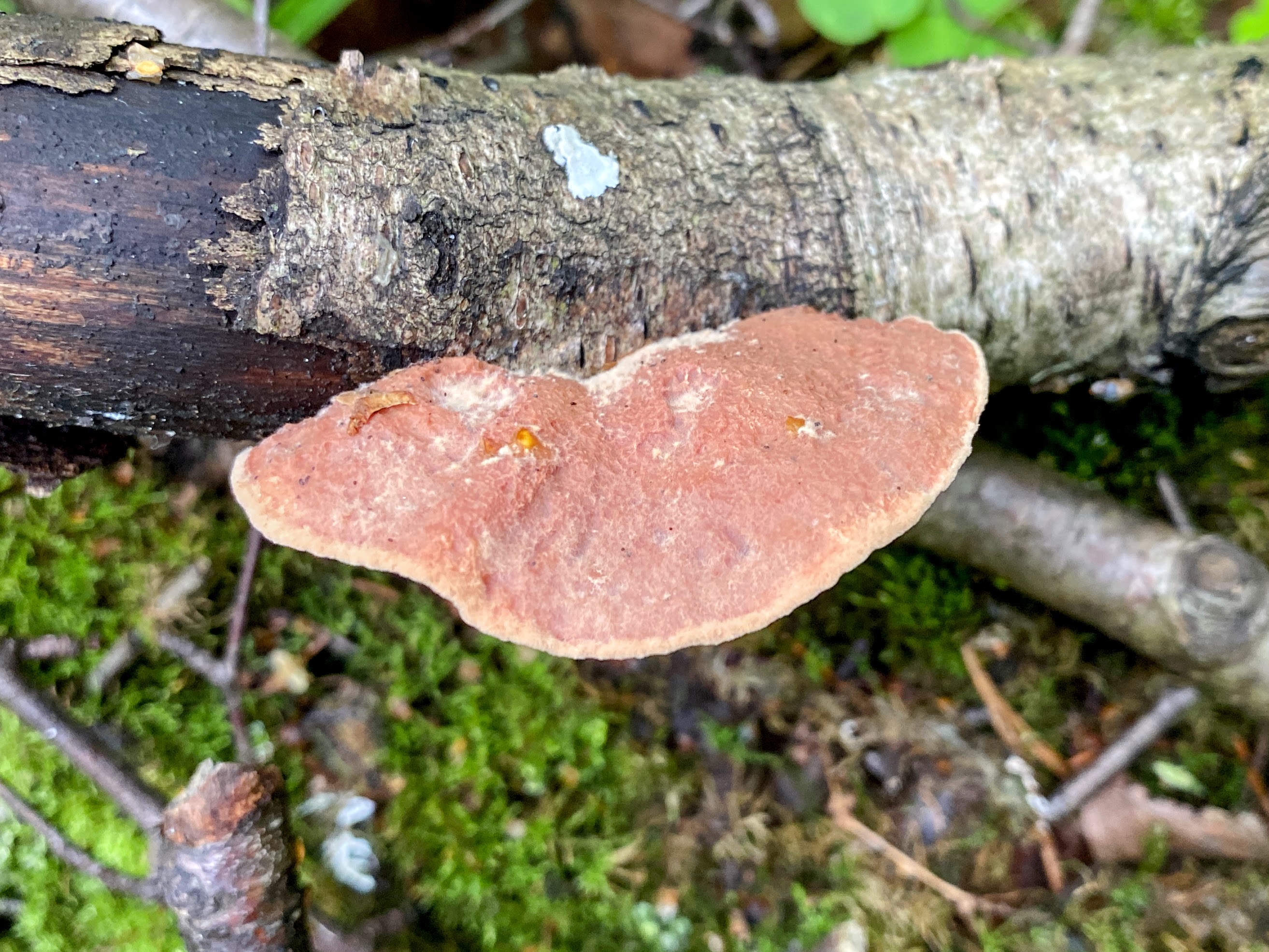
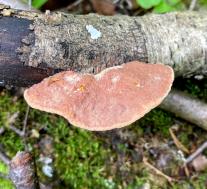
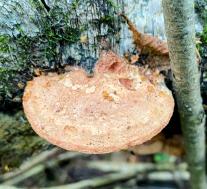
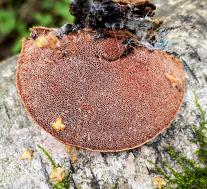
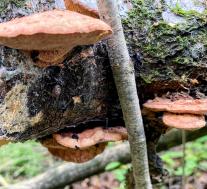
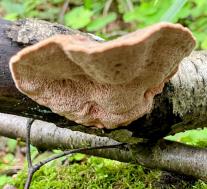
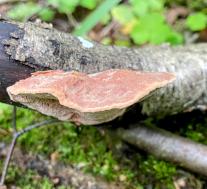
Cinnamon polypore (Hapalopilus rutilans)

Hapalopilus rutilans
Current name

Index Fungorum  Hapalopilus rutilans (Pers.) Murrill

MycoBank  Hapalopilus nidulans (Fr.) P. Karst

Other names

Nesting hapalopilus (Hapalopilus rutilans)

Systematic position
Specific epithet etymology

Rutilāns — reddening, turning rosy. Present active participle of rutilo, āvī, ātum, āre: to be reddish, to take on a reddish hue, to blush.

Synonyms

Polyporus rutilans (Pers.) Fr., Observationes Mycologicae 2: 260 (1818) 

Inodermus rutilans (Pers.) Quél., Flore mycologique de la France et des pays limitrophes: 391 (1888) 

Inonotus rutilans (Pers.) P. Karst., Bidrag Kännedom Finlands Natur Folk 37: 71 (1882)

Leptoporus rutilans (Pers.) Quél., Enchiridion Fungorum in Europa media et praesertim in Gallia Vigentium: 177 (1886) 

Polystictus rutilans (Pers.) Bigeard & H. Guill., La Flore des Champignons supérieurs de France 2: 366 (1913) 

Hemidiscia rutilans (Pers.) Lázaro Ibiza, Revta R. Acad. Cienc. exact. fis. nat. Madr.: 579 (1916) 

Phaeolus rutilans (Pers.) Bourdot & Galzin, Bull. Soc. Mycol. France 41 (1-2): 135 (1925) 

Inonotus rutilans var. rutilans (?) 

General description

A species widely distributed in the temperate zone of the Northern Hemisphere. The only known polypore species poisonous to humans. The toxic compound is polyporic acid, named after the family Polyporaceae to which this mushroom formerly belonged. It was first isolated from this species. Polyporic acid has neurotoxic, hepatotoxic, and nephrotoxic effects on the human body.

Habit
Fruiting body
Sessile, bracket-shaped, hoof-shaped, or as an irregular crust/rosette
Hymenophore
Tubulate, poroid
Fruiting period (list)
JulJuly (1st–10th)July (11th–20th)July (21st–31st)AugAugust (1st–10th)August (11th–20th)August (21st–31st)SepSeptember (1st–10th)September (11th–20th)September (21st–30th)OctOctober (1st–10th)October (11th–20th)
Fruit body

Fruiting bodies are annual.

Caps are semi-appressed to fully appressed, kidney-shaped, convex, growing singly or in overlapping, tile-like groups. Caps reach up to 120 mm in diameter and up to 50 mm thick at the base. The surface is finely fuzzy at first, becoming bare and rough with age. Color is brown or ochre. Faint concentric zones are rarely visible. The margin is usually blunt and rounded.

The hymenophore is tubular, with round or angular pores. The tubes match the flesh in color. In mature specimens, the hymenophore often develops cracks.

Flesh

Волокнистая, губчатая. При сдавливании, по тактильным ощущениям напоминает плотный поролон. При высыхании одревесневает. Ломкая, бледно-коричневая, ближе к краю более светлая.

Odor

Weak. A freshly cut mushroom has an anise-like, mushroomy scent. Later, the smell turns unpleasant — almond-like, then rotten.

Microscopy

Spore print: colorless, appearing whitish in mass. Spores are non-amyloid, ranging from elliptical to cylindrical. When exposed to an alkaline solution, all parts of the fruiting body characteristically turn bright violet.

Ecology and distribution

Xylotroph. Grows mainly on dead branches, less often on trunks of various hardwoods — birch (Betula), oak (Quercus); rarely found on conifers. Causes white rot.

The beetles Sulcacis affinis, Hallomenus axillaris, H. binotatus, and Orchesia fasciata use the fruiting bodies of Hapalopilus rutilans to raise their young.

Fruiting

July–October.

Nutritional properties
Poisonous

Toxicity is due to a high concentration of polyporic acid — up to 40% of the dry residue. This compound is also found in other mushrooms, but in much smaller amounts. Symptoms of poisoning include nausea, loss of coordination, blurred vision, and liver or kidney failure. Additionally, urine may take on a violet tint.

Similar species

All Hapalopilus species are similar, but none of them are edible. In poisoning cases, this mushroom was mistakenly identified as the beefsteak fungus (Fistulina hepatica), which differs by its more fleshy, very juicy flesh, intense coloration, and distinctive smell.

Notes

One of the most valuable mushroom species used for dyeing wool. When dyed with potassium alum, it yields a rich violet color; with iron sulfate, a dark olive shade.

Link to this page for printed editions
Shipovalov A.G. Cinnamon polypore (Hapalopilus rutilans) - Mushrooms of Vologda Region [Electronic resource] URL: https://xn----7sbancweblffgklubds60aja.xn--p1ai/en/cinnamon-polypore-hapalopilus-rutilans (accessed: 13.04.2026).
Share link

Add new comment

One file only.
2 MB limit.
Allowed types: png jpeg jpg jpe gif webp svg.
Allowed types: png gif jpg jpeg webp svg.

Plain text

  • No HTML tags allowed.
  • Lines and paragraphs break automatically.
  • Web page addresses and email addresses turn into links automatically.
Add image
Maximum 8 files.
2 MB limit.
Allowed types: png jpeg jpg jpe gif webp svg.
Allowed types: png gif jpg jpeg webp.
January (1st–10th)
January (1st–10th)
January (11th–20th)
January (11th–20th)
January (21st–31st)
January (21st–31st)
February (1st–10th)
February (1st–10th)
February (11th–20th)
February (21st–28th/29th)
March (1st–10th)
March (1st–10th)
March (11th–20th)
March (11th–20th)
March (21st–31st)
March (21st–31st)
April (1st–10th)
April (1st–10th)
April (11th–20th)
April (11th–20th)
April (21st–30th)
April (21st–30th)
May (1st–10th)
May (1st–10th)
May (11th–20th)
May (11th–20th)
May (21st–31st)
May (21st–31st)
June (1st–10th)
June (1st–10th)
June (11th–20th)
June (11th–20th)
June (21st–30th)
June (21st–30th)
July (1st–10th)
July (1st–10th)
July (11th–20th)
July (11th–20th)
July (21st–31st)
July (21st–31st)
August (1st–10th)
August (1st–10th)
August (11th–20th)
August (11th–20th)
August (21st–31st)
August (21st–31st)
September (1st–10th)
September (11th–20th)
September (21st–30th)
October (1st–10th)
October (1st–10th)
October (11th–20th)
October (11th–20th)
October (21st–31st)
October (21st–31st)
November (1st–10th)
November (1st–10th)
November (11th–20th)
November (21st–30th)
December (1st–10th)
December (1st–10th)
December (11th–20th)
December (21st–31st)