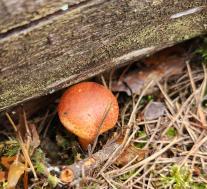
Dappled Webcap (Cortinarius bolaris)
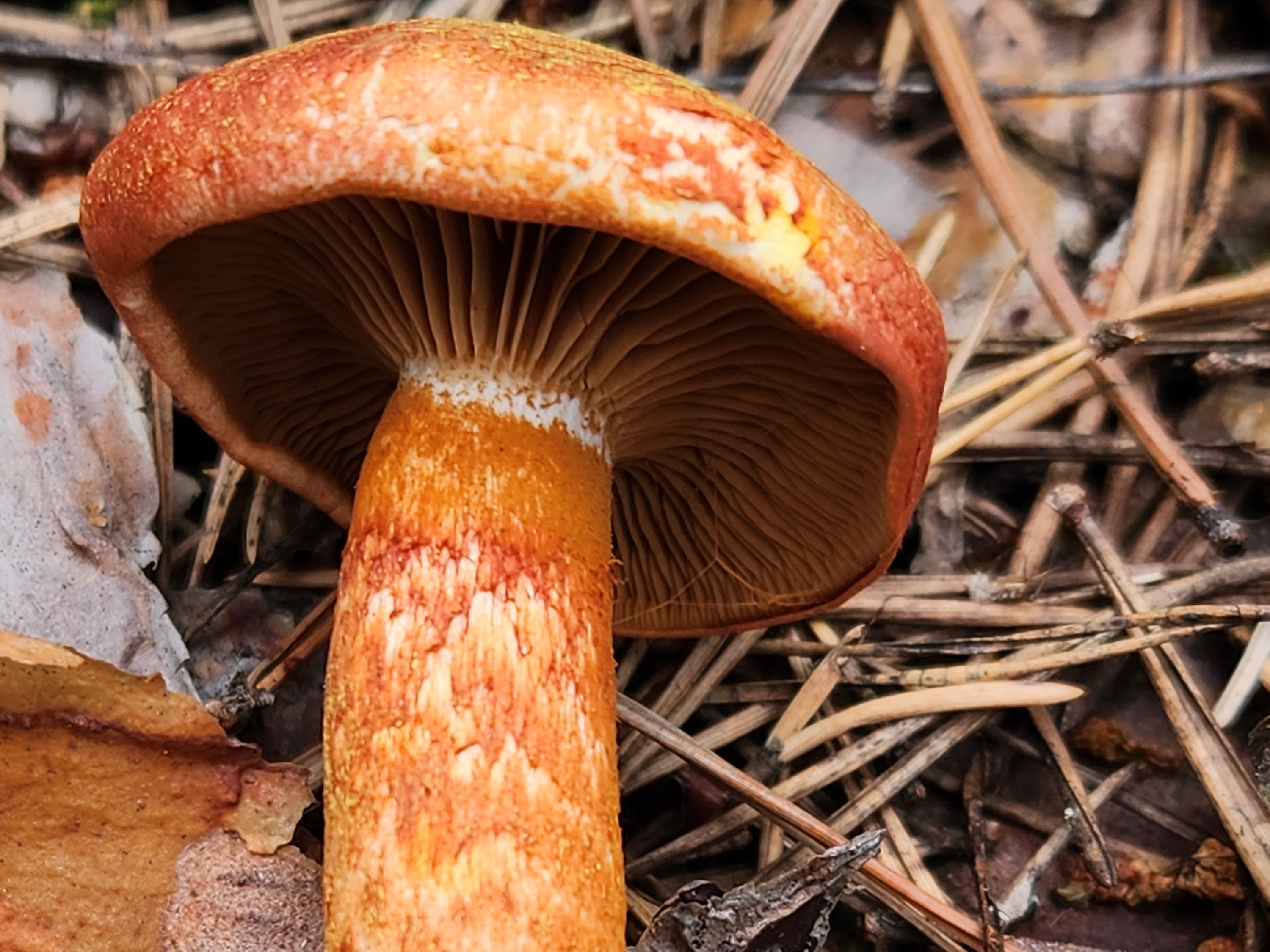
Паутинник ленивый
Current name

Index Fungorum  Cortinarius bolaris (Pers.) Zawadzki

MycoBank  Cortinarius bolaris (Pers.) Fr.
 

Other names

Dappled Webcap, Lazy Webcap. Possibly this name reflects the growth pattern of the fruiting bodies; sometimes it really seems as if they are too "lazy" to grow.

Systematic position
Specific epithet etymology

Bolaris, e — mycological: dark red, brick-red. From bolus + -aris.

Synonyms

Agaricus bolaris Pers., Syn. meth. fung. (Göttingen) 2: 291 (1801)

Gomphos bolaris (Pers.) Kuntze, Revis. gen. pl. (Leipzig) 2: 853 (1891)

Inoloma bolare (Pers.) Wünsche, Die Pilze: 127 (1877)

Phlegmacium bolaris (Pers.) M.M. Moser, in Gams, Kl. Krypt.-Fl., Edn 2 (Stuttgart) 2b: 217 (1955)
Habit
Fruiting body
Agaricoid (cap and stipe)
Hymenophore
Lamellate (gills present, including folded or rudimentary)
Fruiting period (list)
AugAugust (1st–10th)August (11th–20th)August (21st–31st)SepSeptember (1st–10th)September (11th–20th)September (21st–30th)
Mushroom cap

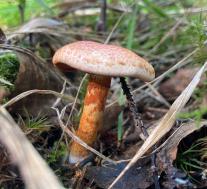
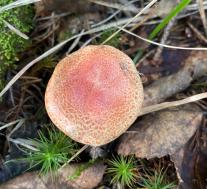
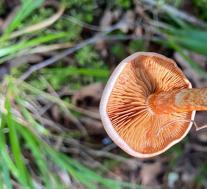
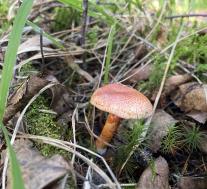
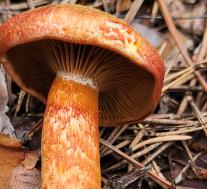
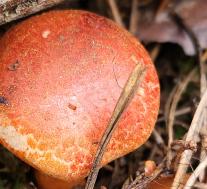
2.5–8 cm in diameter, initially convex or broadly bell-shaped, then becoming broadly convex or nearly flat. Dry surface, covered with scales ranging from red to brownish-red; as the cap expands, the scales become more scattered, exposing whitish, yellowish, or pinkish flesh. Gills broad, adnate, moderately spaced. In young specimens gray or dirty yellow; with age, like in most Cortinarius species, they become rusty-brown from maturing spores.

Stem

Short and thick (4–10 cm tall, 1–1.5 cm in diameter), often curved and twisted, dense and sturdy. Surface covered with reddish-red scales. Reddish bands are visible on the upper part of the stipe.

Flesh

Whitish, gradually turning yellow when cut or exposed to air. Flesh in the stipe is fibrous.

Odor

Weak, musty.

Microscopy

Spore print rusty-brown. Spores 6–8 × 5–6 µm; subglobose to ovoid; moderately warted.

Ecology and distribution

Forms ectomycorrhiza with trees of various species, both deciduous and coniferous. Found in mixed forests. Prefers acidic, sandy soils. Fruits in moist places, among mosses. Occurs singly and in groups consisting of fruiting bodies of different ages.

Fruiting

August–September

Nutritional properties
Poisonous

Orellanine — a mycotoxin found in fungi of the family Cortinariaceae. Structurally, this compound is an N-oxide of bipyridine, somewhat related to the herbicide diquat. Orellanine exhibits a wide spectrum of toxic effects, and although its mechanism of action is not fully understood, in the absence of treatment, death occurs due to renal failure.

Similar species

Literature mentions the Peacock Webcap (Cortinarius pavonius), which in young age is distinguished by purple gills; however, finding information about its occurrence in Russia is quite difficult. Otherwise, the Dappled Webcap has no known look-alikes.

Notes

Cortinarius is one of the largest genera in the order Agaricales. Different authors cite varying numbers of species in the genus, usually up to 700; however, according to the most comprehensive reference work, the "Dictionary of the Fungi," the number of species exceeds 2000.

Link to this page for printed editions
Shipovalov A.G. Dappled Webcap (Cortinarius bolaris) - Mushrooms of Vologda Region [Electronic resource] URL: https://xn----7sbancweblffgklubds60aja.xn--p1ai/en/dappled-webcap-cortinarius-bolaris (accessed: 13.04.2026).
Share link

Add new comment

One file only.
2 MB limit.
Allowed types: png jpeg jpg jpe gif webp svg.
Allowed types: png gif jpg jpeg webp svg.

Plain text

  • No HTML tags allowed.
  • Lines and paragraphs break automatically.
  • Web page addresses and email addresses turn into links automatically.
Add image
Maximum 8 files.
2 MB limit.
Allowed types: png jpeg jpg jpe gif webp svg.
Allowed types: png gif jpg jpeg webp.
January (1st–10th)
January (1st–10th)
January (11th–20th)
January (11th–20th)
January (21st–31st)
January (21st–31st)
February (1st–10th)
February (1st–10th)
February (11th–20th)
February (21st–28th/29th)
March (1st–10th)
March (1st–10th)
March (11th–20th)
March (11th–20th)
March (21st–31st)
March (21st–31st)
April (1st–10th)
April (1st–10th)
April (11th–20th)
April (11th–20th)
April (21st–30th)
April (21st–30th)
May (1st–10th)
May (1st–10th)
May (11th–20th)
May (11th–20th)
May (21st–31st)
May (21st–31st)
June (1st–10th)
June (1st–10th)
June (11th–20th)
June (11th–20th)
June (21st–30th)
June (21st–30th)
July (1st–10th)
July (1st–10th)
July (11th–20th)
July (11th–20th)
July (21st–31st)
July (21st–31st)
August (1st–10th)
August (1st–10th)
August (11th–20th)
August (11th–20th)
August (21st–31st)
August (21st–31st)
September (1st–10th)
September (11th–20th)
September (21st–30th)
October (1st–10th)
October (1st–10th)
October (11th–20th)
October (11th–20th)
October (21st–31st)
October (21st–31st)
November (1st–10th)
November (1st–10th)
November (11th–20th)
November (21st–30th)
December (1st–10th)
December (1st–10th)
December (11th–20th)
December (21st–31st)