Ringed Bonnet (Cortinarius caperatus)
Index Fungorum Cortinarius caperatus (Pers.) Fr
MycoBank Cortinarius caperatus (Pers.) Fr
Wrinkled cortinarius, kurochka, swamp white button, Rozites opalina, turk
Caperatus, a, um – wrinkled
Agaricus caperatus Pers., Observ. mycol. (Lipsiae) 1: 48 (1796)
Dryophila caperata (Pers.) Quél., Enchir. fung. (Paris): 66 (1886)
Hylophila caperata (Pers.) Quél., Fl. mycol. France (Paris): 98 (1888)
Lepiota caperata (Pers.) Zawadzki, Enum. plant. Galic. Bucow. (Breslau): 160 (1835)
Pholiota caperata (Pers.) Gillet, Hyménomycètes (Alençon): 89 (1874) [1878]
Rozites caperatus (Pers.) P. Karst., Bidr. Känn. Finl. Nat. Folk 32: 290 (1879)
Togaria caperata (Pers.) W.G. Sm., Syn. Brit. Basidiomyc.: 122 (1908)
In 1879, mycologist-systematist Petter Adolf Karsten (Petter Adolf Karsten; 1834 – 1917), in honor of Ernst Roze (Ernst Roze; 1833 – 1900), created the genus Rozites and included the described species there, arguing that this mushroom has a double membranous veil. This name in different grammatical forms (Rozites caperatus and Rozites caperata) was known and used until the early 21st century and still appears in publications.
Molecular-phylogenetic studies were conducted in 2000 and 2002 which showed that Rozites caperatus belongs to the genus Cortinarius. The mushroom turned out to be a close relative of New Zealand cortinarii Cortinarius meleagris and Cortinarius subcastanellus and returned to where Fries had placed it in his time, but now in his own section Rozites.
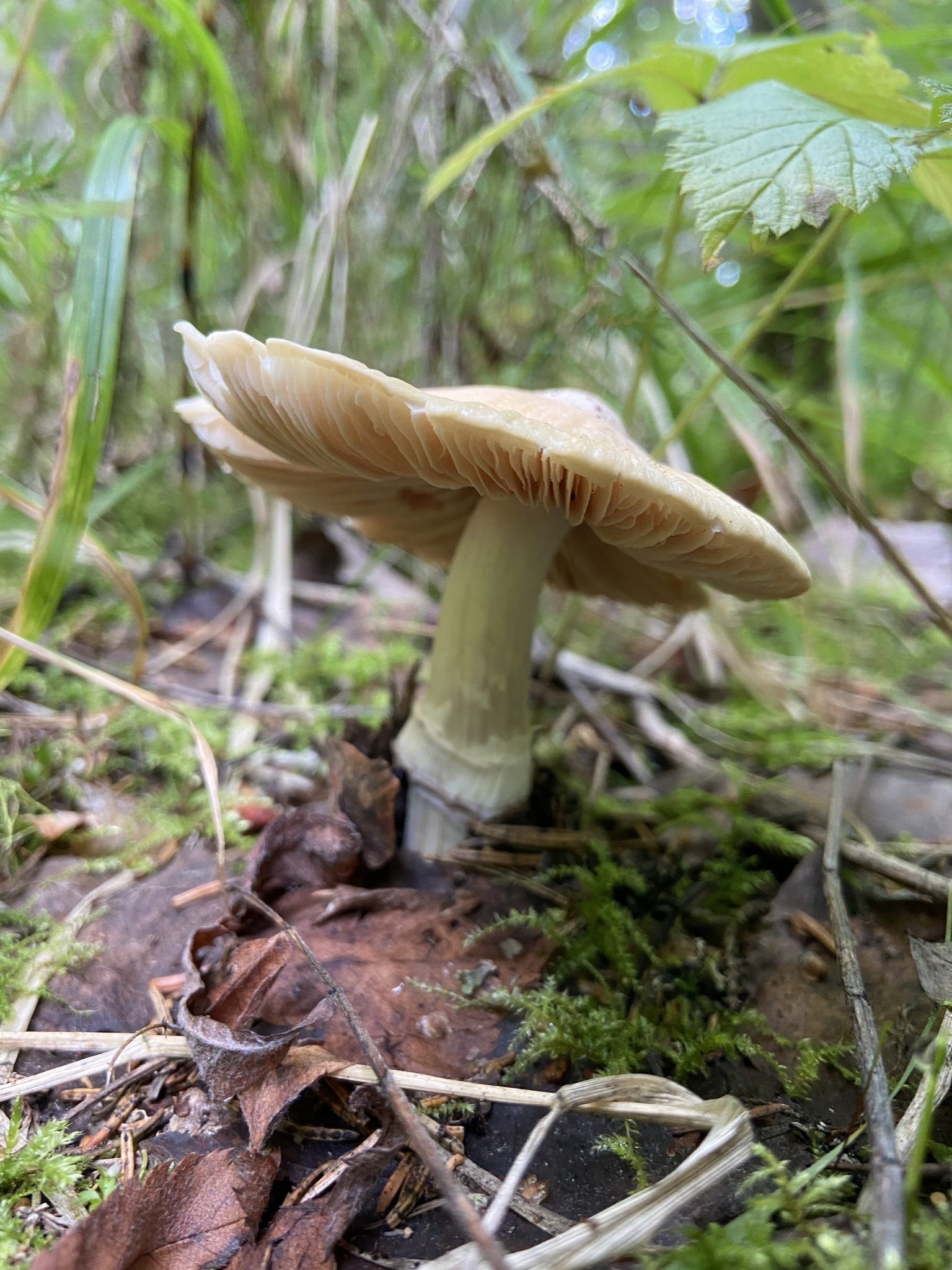
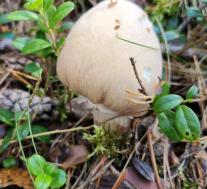
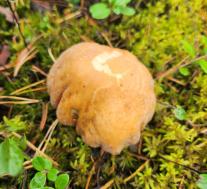
5 – 15 cm in diameter, initially almost spherical, unfolding when mature to convex or spreading with a broad umbo in the center. Margin even, in old fruiting bodies often lifted upward. Surface dry, smooth in the center, radially wrinkled toward the edge. Coloration not bright: pale-rust, buff, beige, dirty-white, sometimes lilac due to thin remnants of velum layer in young mushrooms.
Gills free or adnate with a tooth, wide, crowded, beige in young age, light brown with age, reddish, margin usually somewhat lighter.
7 – 13 cm long, 1 – 2 cm in diameter, cylindrical or narrowing upward, dense and hard in young fruiting bodies, hollow with age, with a ring. The ring is unusual for cortinarii, membranous with cottony velum remnants. Stem surface same color as cap or, more often, lighter; almost smooth or fibrous, above the ring fibers form a mottled, zigzag pattern.
Fleshy, juicy, whitish, sometimes rust-colored under the skin, without special taste.
Weak, unexpressed
Spore print ochre-yellow. Spores 10.2 – 13.5 × 7.1 – 9.0 µm, Q = 1.3 – 1.6, ellipsoid or almond-shaped, moderately warty, light ochre-yellow.
Grows on soil in coniferous and mixed forests, forms mycorrhiza with various species of trees and shrubs, among which are pine, birch, beech. Common in white moss pine forests, in mixed dark-coniferous forests with participation of pine. Apparently, restricted to old-growth coniferous forests.
Ringed Bonnet is listed as a vulnerable species in Germany and UK and is endangered in the Netherlands.
Early scaly cap (Agrocybe praecox) resembles Ringed Bonnet in general fruit body coloration and membranous ring, but differs in significantly less massive habit and completely different ecological niche: it is a litter saprotroph preferring pastures, lawns and anthropogenic habitats. Fruiting as the name suggests, in early summer.
Pine cortinarius (Cortinarius pinophilus), a characteristic species of pure pine forests, can be confused with Ringed Bonnet due to very similar coloration, habit and similar ecological preferences. Differs by absence of membranous ring at all stages of development.
C. caperatus accumulates radioactive cesium 137Cs — a product of nuclear tests — much more strongly than many other mushroom species.
Add new comment