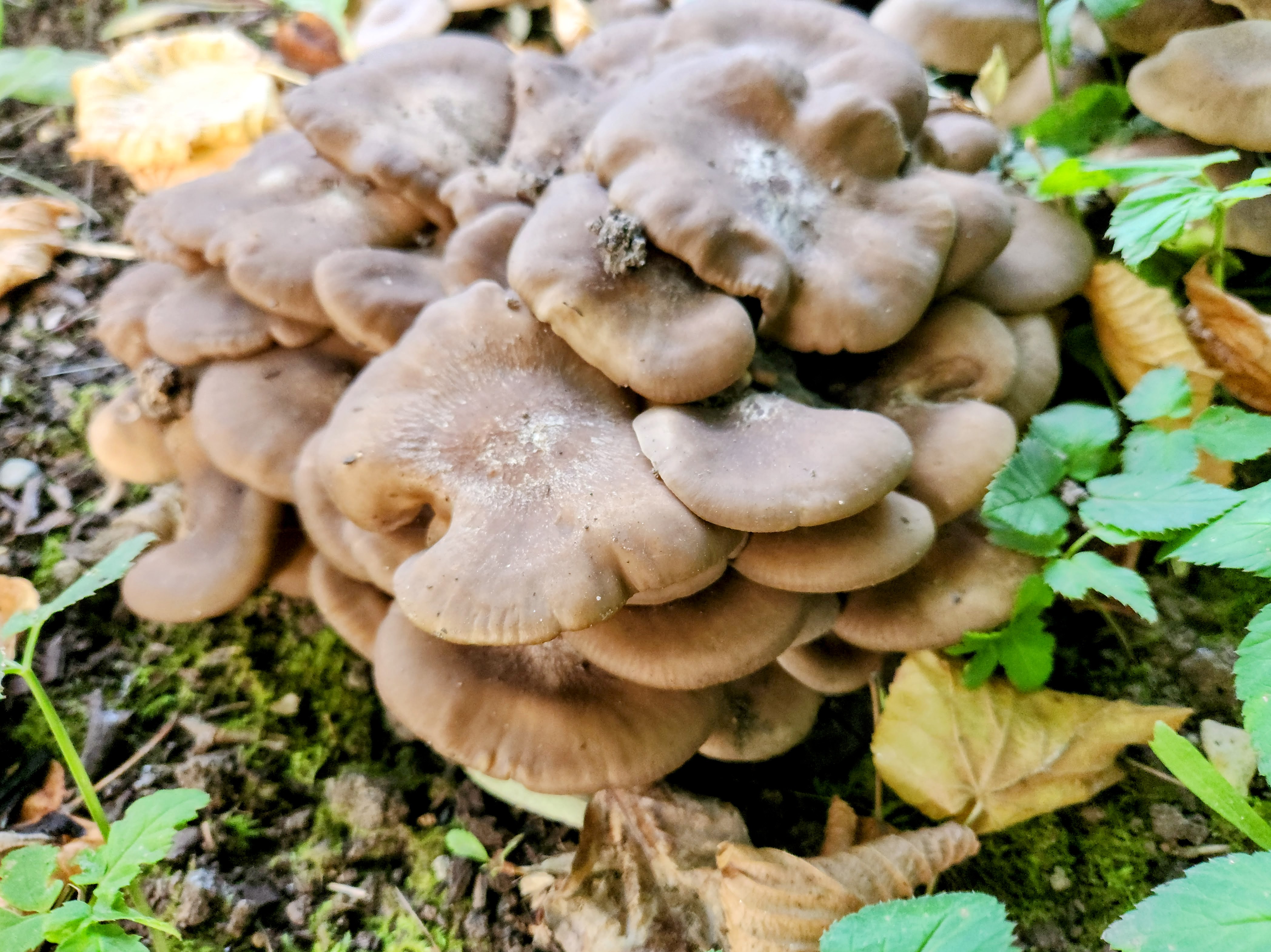
Family: Lyophyllaceae
Lyophyllaceae - family of fungi within order Agaricales.
Separated by Walter Jülich in 1981 during downsizing of enormous at that time family Tricholomataceae, which included, according to authors of reference book "Mushrooms of USSR", up to 25% of species of entire order Agaricales. All genera existing at that time, transferred to new family, previously belonged to Tricholomataceae. According to 2008 estimation, Lyophyllaceae included 157 species in 8 genera; according to 2014 estimation - 13 genera; in September 2023 list of Lyophyllaceae genera, provided in article about family in English-language Wikipedia, contains 18 genera.
Fruit bodies of small and medium sizes (exception - some species of genus Termitomyces), differentiated into cap and stem, in some genera have tendency to appear in large clusters. Caps 2-10(17) cm in diam., in young mushrooms hemispherical or bell-shaped, then - expanded, often with umbo, or weakly convex, faintly colored - white, gray, gray-brown, only in some species coloration bright. Hymenophore lamellar. Gills more or less developed, adnate or semi-free, light-colored or gray. Spore print white, cream or light-brown tones. Veils, as a rule, absent. Stems cylindrical or noticeably thickened at base, in species growing in clusters usually fused at base, dense, fibrous. Flesh more or less developed, often thick, dense, usually not changing color upon cutting.
Saprotrophs on soil, litter and various plant residues, less frequently - facultative parasites of trees; there are genera including symbionts of termite nests and parasite-mycofiles. Distributed across entire globe, except Antarctica.
Some species of Lyophyllaceae have noticeable significance as food products: popular in European cuisine mushroom Lyophyllum decastes in English-speaking countries known as fried chicken mushroom and Calocybe gambosa ("St. George's mushroom"), in Japanese cuisine - L. shimeji ("hon-shimeji", considered delicacy), in Africa widely consumed large thick-fleshed fruit bodies of species of genus Termitomyces. In Russian mushroom culture Lyophyllaceae represented weakly, but after wide spread of mycological literature gained some recognition L. decastes, C. gambosa, Hypsizigus ulmaris. Dangerous highly toxic species among Lyophyllaceae absent or so rare that still not studied in sufficient detail to confidently speak about their danger.