Fetid Russula (Russula foetens)
Index Fungorum Russula foetens Pers.
MycoBank Russula foetens Pers.
Fetid Russula, stinking Russula, weeping mushroom, little bull, little fist, snot mushroom.
Foetens, fetid, foul-smelling. Present active participle of foeteo, ēre 1) to emit a foul odor, to smell bad; 2) figuratively — to be unpleasant, disgusting.
Agaricus foetens (Pers.) Pers., Observ. mycol. (Lipsiae) 2: 102 (1800) [1799]
Agaricus foetens var. lactifluus Corda, Icon. fung. (Prague) 4: 49, tab. 10:139 (1840)
Agaricus incrassatus Sowerby, Col. fig. Engl. Fung. Mushr., Suppl. (London)(no. 30 [no. 3 of suppl.]): tab. 415 (1814)
Russula foetens var. minor Singer, Bull. trimest. Soc. mycol. Fr. 54(1): 135 (1938)
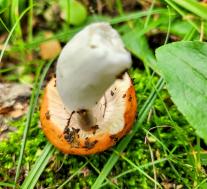
Among toadstools there are mushrooms that in some parts of Russia are considered harmful, while in other places are eaten, for example: pig's ears (Paxillus), valuys (Russula foetens), soaked mushrooms, blackening milk caps, and others; they are first boiled or soaked, then salted and eaten without any harm.
Aksakov S. T., "Notes and Observations of a Mushroom Gatherer, 1856".
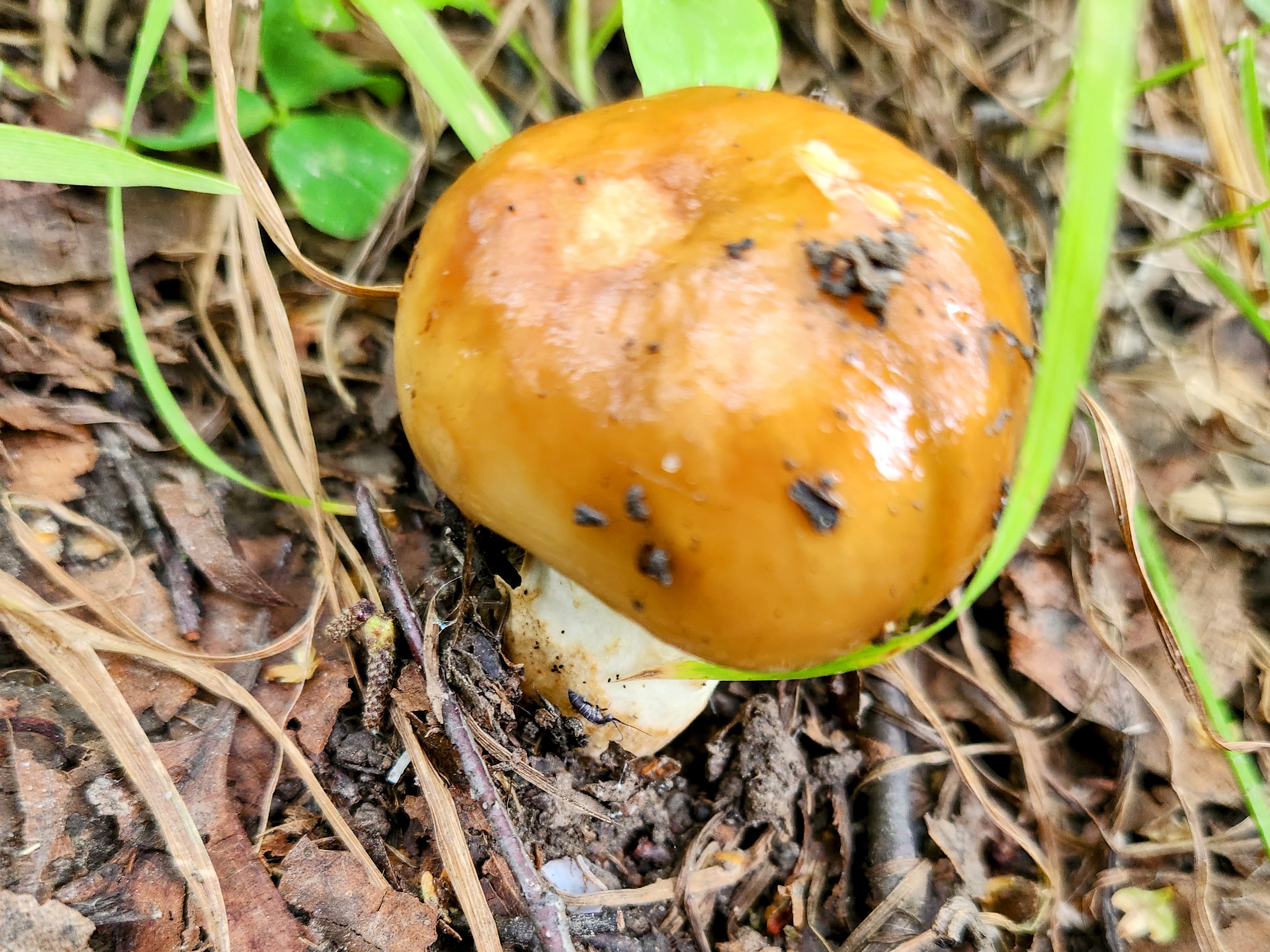
More accurately said, it cannot be! The Valuy is some kind of "Quasimodo" among mushrooms! It looks like a bolete, but in fact, it is a Russula. However, it cannot be eaten raw; it requires thorough soaking. Moreover, hygrophanous spots are often found on the stipe, giving it a certain resemblance to milk caps (Lactarius). And the general appearance of young mushrooms does not inspire confidence: slimy, with a characteristic "fist-like" shape, with a hollow stipe often filled with debris and dirt.
Up to 15 cm in diameter, yellowish-brown or honey-colored, initially hemispherical, of characteristic shape (for which a special name is provided: "kulbik"), then spreading, with a striate margin, very slimy in humid weather. Often with a depressed center. However, the cuticle does not peel off but is easily removed. Often noticeably damaged by various organisms. Gills adnate, yellowish-white, with brownish spots, forked-branched, crowded, usually exuding droplets of liquid along the margin.
6–12 × 1.5–5 cm, cylindrical, often slightly thickened in the middle, dirty-white to brownish (but always lighter than the cap), with brown spots when pressed, dense, but as it grows always becomes loose or hollow.
Thick, dense, white, becoming yellowish with age, turning brown when cut. In the stipe, the flesh is spongy, porous. Taste ranging from sharp to acrid (especially strong in the gills), but often pleasant.
Described by many authors as unpleasant: Persoon — "odor of burnt feathers"; Bon — "strong smell of burnt, rotting meat"; Einhellinger — "unpleasant and sweet"; Cetto — "smell of chlorine bleach". With age, the unpleasant odor intensifies.
Spore print: white or cream-colored. Spores spherical, almost spherical, ornamentation warty, warts up to 1.6 μm high, some of them connected by faint ridges.
An ectomycorrhizal fungus that forms a symbiotic association with birch, spruce, and pine. Often occurs, and in places abundantly, in forests of any type.
There are several very similar Russula species, yellow and aromatic, but the true Valuy is easily identified by a combination of features: sliminess, acridity, and intensity of odor. Moreover, a stipe with yellowish-brown cavities will not allow for a major mistake. The real challenge for an enthusiast is posed by the false Valuy (Russula subfoetens) — almost the same mushroom, only slightly less firm, not as fragrant and acrid; its stipe yellows from a drop of KOH, which is unthinkable for the true Valuy. Almond Russula (Russula laurocerasi) and Morse's Russula (R. illota) are less similar — primarily in odor.
In traditional Chinese medicine, it is used to relax muscles. Tinctures and compresses are applied externally to treat pain and relieve numbness in the limbs, in cases of lumbago!
Add new comment