Light Yellow Russula (Russula claroflava)
Index Fungorum Russula claroflava Grove
MycoBank Russula claroflava Grove
Bog Russula, yellow Russula.
clāroflāvus, a, um light yellow
Russula claroflava var. viridis Knudsen & T. Borgen, Persoonia 14(4): 514 (1992)
Russula constans Britzelm., Ber. naturhist. Augsburg 28: 141 (1885)
Russula decolorans subsp. flava (Romell) Romell, in Krok & Almquist, Svensk Flora för skolor, II. Kryptogamer (edn 2) (Stockholm): 200 (1898)
Russula decolorans var. constans (Britzelm.) P. Karst., Bidr. Känn. Finl. Nat. Folk 48: 464 (1889)
Russula flava Romell, in Lönnegren, Nordisk Svampbok, edn 2: 27 (1895)
Russula flava var. pacifica Kauffman, Pap. Mich. Acad. Sci. 11: 205 (1930) [1929]
Russula ochroleuca var. claroflava (Grove) Cooke, Handb. Brit. Fungi, 2nd Edn: 380 (1890)
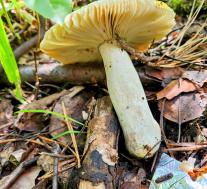
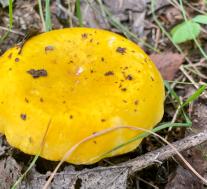
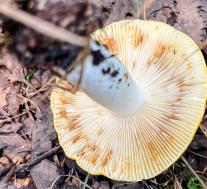
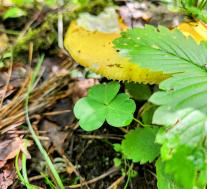
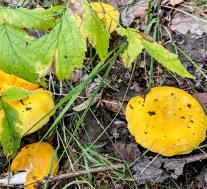
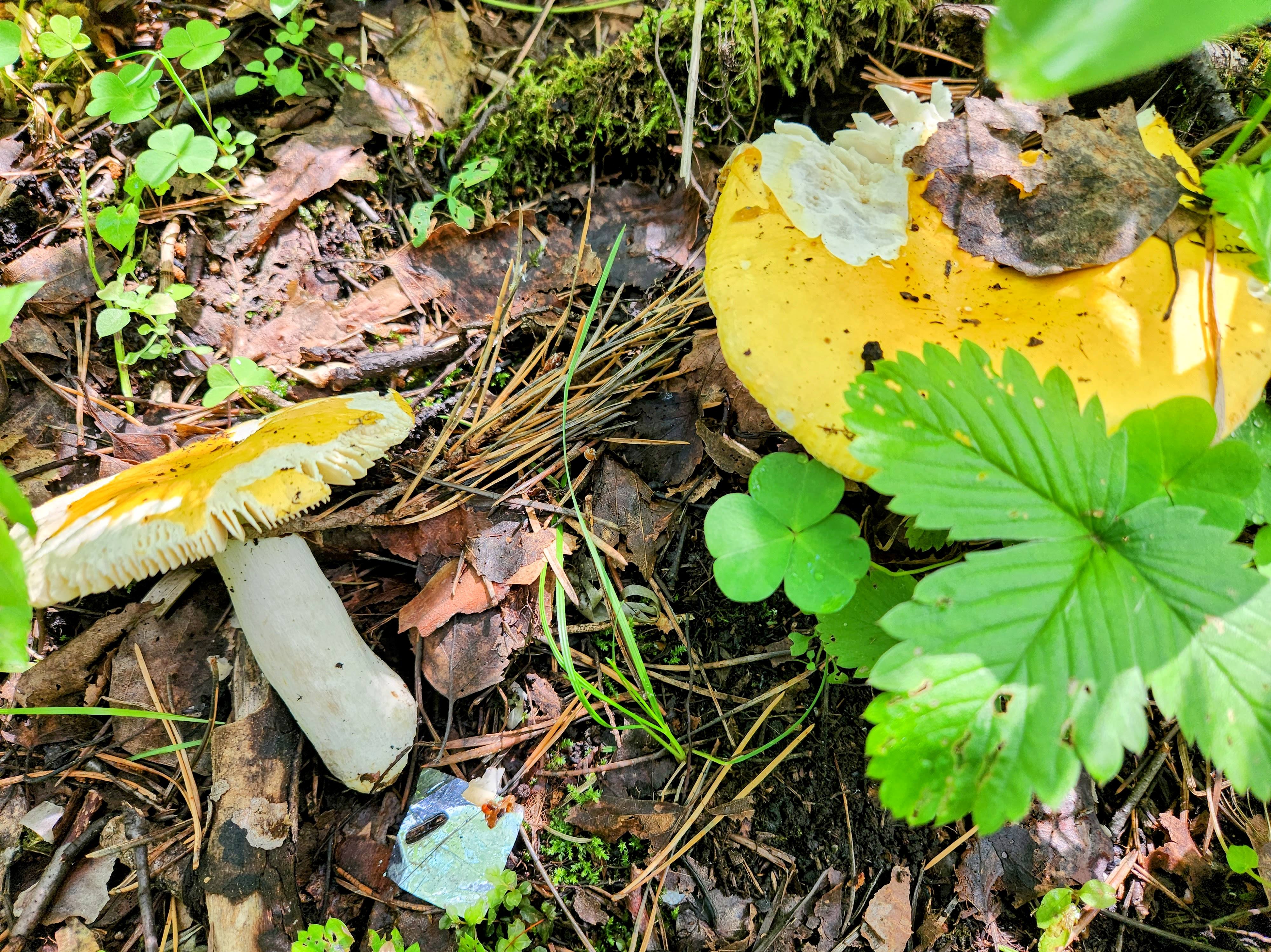
The yellow Russula is immediately noticeable by its intensely yellow cap.
Reaches 3–12 cm in diameter, initially hemispherical, then convex, flattened and slightly depressed, with a striate margin in old specimens. Coloration yellow or ochre, less often, especially in the center, greenish-yellow. The cuticle is shiny, sticky, peeling off over half the cap.
Gills fairly crowded, branching near the stipe, almost free, light ochre, turning gray when damaged.
2–10 cm long, 1–3 cm in diameter, cylindrical or tapering downward, white or yellowish.
Soft, slightly cottony, white, juicy, usually turning gray when exposed to air.
Weak mushroom-like, slightly sweet, with floral notes and a slightly sweet or mildly sharp taste.
Spore print: ochre-colored. Spores ovoid, spiny, with a well-developed reticulum.
An ectomycorrhizal fungus that forms a symbiotic association with birches and aspens; grows singly or in groups. Often found in marshy and moist places. Occurs in deciduous and mixed forests.
Ochre Russula (Russula ochroleuca) prefers drier places, growing under both deciduous and coniferous trees. It has a sharper taste and lighter gills. It does not turn gray when damaged. It is terribly easy to confuse the Light Yellow Russula with the deadly poisonous Death Cap (Amanita phalloides), which differs by having a ring-like remnant (velum) on the stipe and a thickening (volva) at its base.
Add new comment