Goat Webcap (Cortinarius traganus)
Index Fungorum Cortinarius traganus (Fr.) Fr.
MycoBank Cortinarius traganus (Fr.) Fr.
Stinking Webcap, Goat Webcap.
Traganus, a, um goat-like, pertaining to goats. From tragus, i, goat + -anus, a, um, indicating quality.
Phlegmacium traganum (Fr.) M.M. Moser, Kleine Kryptogamenflora von Mitteleuropa - Die Blätter- und Bauchpilze (Agaricales und Gastromycetes) 2: 213 (1953)
Inoloma traganum (Fr.) Wünsche, Die Pilze. Eine Anleitung zur Kenntniss derselben: 127 (1877)
Cortinarius traganus f. traganus (1838)
Phlegmacium traganum var. traganum (1953)
Cortinarius traganus var. traganus (1838)
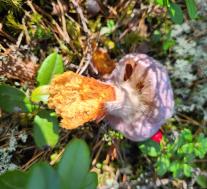
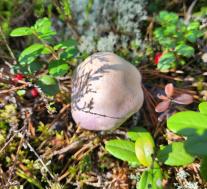
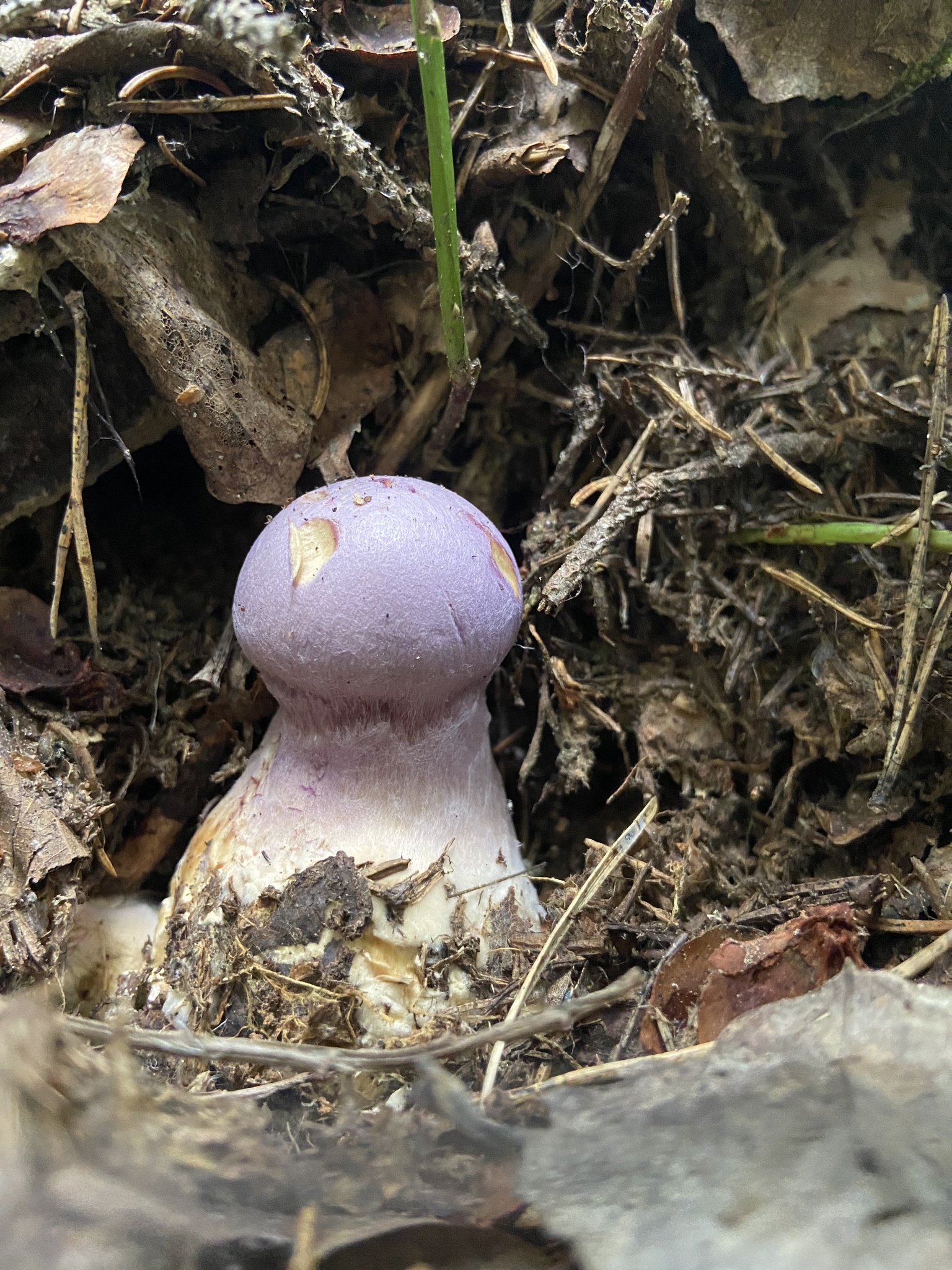
A bogeyman for collectors of the Purple Blewit, in reality it is far less dangerous than rumor suggests: a completely different, non-tricholomatoid habit (proportions of the fruiting body), rusty coloration of the gills even in fairly young mushrooms, and a distinctly non-floral scent will prevent even the most inattentive forager from making a mistake.
4–10 cm in diameter, initially hemispherical, at maturity expanding to convex, sometimes with a distinct broad umbo in the center. Surface matte, silky, silky-fibrous; when drying out or after rains following a dry period, it may crack into more or less large scales, exposing contrasting rusty-brown flesh; coloration lilac, silvery-blue, may fade to grayish or silvery-white, sometimes with a pale ochre tint. Universal veil absent.
Gills adnate, ranging from brownish-yellow to grayish-brown, becoming brown with a lighter margin with age. Partial veil — abundant bluish cobwebby cortina, clearly visible in young mushrooms.
In youth thick and short, with a massive bulbous thickening; as it develops, it gradually becomes cylindrical and even (height 6–10 cm, thickness 1–3 cm); in coloration similar to the cap but lighter. Abundantly covered with violet remnants of the cortina, on which, as the maturing spores disperse, beautiful rusty spots and stripes appear.
Thick, fleshy, becoming loose in the stipe core with age, yellowish, creamy-yellow, brownish, bluish under the cap cuticle. The mushroom can be worm-eaten, which should not mislead the collector. Change in flesh color when cut: not observed.
Unpleasant, suffocating, compared to the smell of rotting pears, acetylene, or goats (for which the species received its name); it intensifies sharply when heated.
Spore print rusty-brown. Spores 8–10 × 5–6 µm, ellipsoid, almond-shaped, moderately or finely warted.
A terrestrial mycorrhiza-forming species. Found singly and in small scattered groups in coniferous and mixed (with pine) forests, in moist places, often among mosses; occurs frequently.
Distribution: European part of Russia, Urals, Eastern Siberia (Krasnoyarsk Krai, Buryatia). Outside Russia — in the northern and central regions of Europe, Scandinavia, and the Baltic states. Not recorded in Africa or the USA.
There are many webcaps with bluish and violet coloration, however, few of them have a powerful bulbous or strongly swollen stipe base, and only this species is capable of such stench: other webcaps usually smell unappetizing, but nevertheless do not reek of a goat shed that has not been cleaned for many years. In Purple Blewits, the gills lack any rusty tint in coloration, the flesh is not yellow, and the scent is floral or perfumery; if the main fruiting period of the Goat Webcap occurs in August, then blewits appear no earlier than mid-September, when the Goat Webcap can still be found, but already noticeably less frequently than in summer.
Camphor Webcap (Cortinarius camphoratus) – a very similar species found in the same habitats, but generally preferring somewhat wetter places; similar in habit, lilac coloration of the stipe and cap, but differs in overall lighter, lilvery-silvery coloration of the fruiting bodies, lighter flesh with predominance of lilac rather than brown tones, and a sharper, chemical odor.
White-Goat Webcap (Cortinarius niveotraganus) – a rare species with similar habit and odor; associated with birch, externally distinguished by the practically complete absence of violet tones in coloration, except for young gills and marbling in the flesh of young fruiting bodies; its fruiting bodies are colored fawn, and the flesh is less bright and yellow than in C. traganus and its pale-colored form f. ochraceus.
White-Violet Webcap (Cortinarius alboviolaceus) is associated with birch, but in mixed forests these species may grow together; distinguished by less firm, more faded, whitish or lilac flesh without pronounced brown tones, white velum, and absence of a pronounced odor.
Fragrant Webcap (Cortinarius venustus), synonym C. calopus, — another common inhabitant of dark coniferous forests of Western Siberia. This is an elegant, distinctive small mushroom, which nevertheless resembles the Goat Webcap in violet tones of coloration, fragrant flesh, and abundant velum. It differs by a significantly more slender habit and smaller size, usually contrasting coloration of cap and stipe (the cap is fawn-toned, while the stipe is lilac or violet), as well as characteristic sparse, light-colored gills.
Violet Webcap (Cortinarius violaceus) – a distinctive species, distinguished by significantly darker dirty-violet coloration of the entire fruiting body and absence of a pronounced sharp odor.
Add new comment