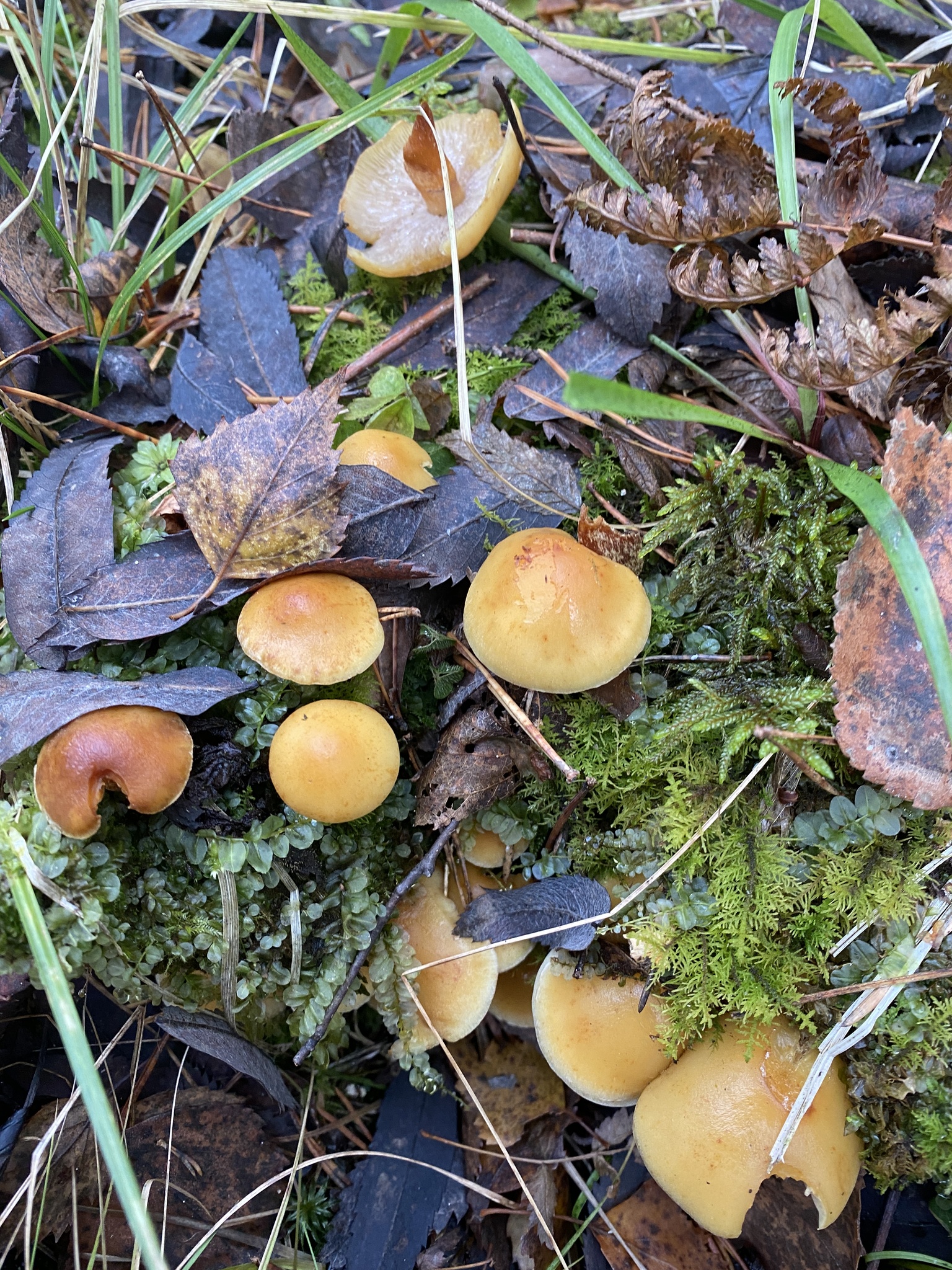
Grey-gilled Tuft (Hypholoma capnoides)
Index Fungorum Hypholoma capnoides (Fr.) P. Kumm
MycoBank Hypholoma capnoides (Fr.) P. Kumm
Grey-gilled Hypholoma, Grey-gilled Honey Mushroom, Poppy-seed False Honey Mushroom.
The epithet "false" became attached only to look-alikes of mushrooms that have long been the subject of mass collection and harvesting, and, importantly, such look-alikes had to be actually or supposedly inedible or poisonous. Thus we have: False Boletus (for Tylopilus felleus), False Chanterelle (for Hygrophoropsis aurantiaca), False Honey Mushrooms (for various species), False Valui (for Hebeloma crustuliniforme).
"False honey mushrooms" include representatives of several genera (Hypholoma, Galerina, Psathyrella, and others) that grow in clusters on trees, fallen wood, and stumps, externally resembling autumn and summer honey mushrooms (Armillaria and Kuehneromyces species).
Capnoides — smoky, fumy. From καπνός (capnos), smoke + είδος, εος (eidos, eos), appearance, form.
Naematoloma capnoides (Fr.) P. Karst., Bidrag till Kännedom av Finlands Natur och Folk 32: 495 (1880)
Psilocybe capnoides (Fr.) Noordel., Persoonia 16 (1): 128 (1995)
Geophila capnoides (Fr.) Quél., Enchiridion Fungorum in Europa media et praesertim in Gallia Vigentium: 113 (1886)
Dryophila capnoides (Fr.) Quél., Flore mycologique de la France et des pays limitrophes: 154 (1888)
Dryophila fascicularis var. capnoides (Fr.) Quél., Flore mycologique de la France et des pays limitrophes: 478 (1888)
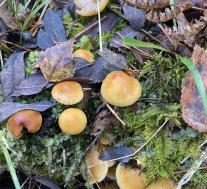
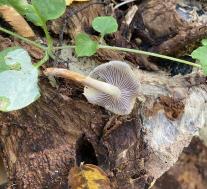
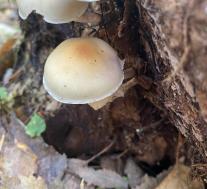
1.7–6.5 cm in diameter; initially bell-shaped or hemispherical with an incurved margin, expanding to spread-out at maturity, slightly hygrophanous. Surface mostly smooth, with fibrous white clusters closer to the margin. Coloration ochre-red, orange-brown, or reddish-brown in the center, lighter toward the margin, yellowish-cream, sometimes with a greenish tint; in fruiting bodies growing in open sunny places, for example on clear-cuts, the surface is more intensely colored in a uniform golden-brown and often cracks into radial fissures and large scales. The partial veil is well-developed, connecting the cap margin to the stipe in young fruiting bodies; in mature specimens, it remains as whitish-ochre remnants along the cap margin and as a faint ring-like zone on the stipe.
Gills broadly adnate, with lamellulae, sometimes transversely wrinkled. In young fruiting bodies pale grey, at maturity grey to grey-brown, with age developing a distinct purple or purplish tint and a lighter margin.
4–9 cm high, 0.5–2.5 cm in diameter, cylindrical, slightly expanding toward the base, solid. Surface fibrous-striate, with a ring-like zone. Pale yellow or cream-colored in the upper part, orange-brown to brown below the ring zone.
Brownish, dull golden. Taste mild. Odor mushroom-like.
Spore print brown. Spores ellipsoid in side view, oblong in frontal view, with a large germ pore and thick brown walls.
Grows in clusters and large groups on fallen wood and stumps of coniferous trees, usually on pine (Pinus) and spruce (Picea). A widespread, circumboreal species. Causes white rot. Common in the Vologda Region. Found in various forest types with conifers, fruits abundantly on clear-cuts in coniferous forests.
Not listed in the Red Data Book of the Russian Federation or regional Red Lists.
Sulphur Tuft (Hypholoma fasciculare) is well distinguished by the yellow-green color of its gills and bitter taste.
Summer Honey Mushroom (Kuehneromyces mutabilis) also grows in large clusters and is generally similar in coloration, but its gills are always colored in warm tones, and in young fruiting bodies they are covered by a dense membranous veil covered with characteristic coffee-colored granular scales, which persists in mature fruiting bodies as a well-developed ring on the stipe. It is associated with hardwood, primarily birch (Betula).
Add new comment