Brick Cap (Hypholoma lateritium)
Index Fungorum Hypholoma lateritium (Schaeff.) P. Kumm
MycoBank Hypholoma lateritium (Schaeff.) P. Kumm
Brick-red False Honey Mushroom, Brick-red Hypholoma.
The word "false" (ложный) in the mushroom's name should not be alarming; here it functions like the negation particle "not," literally meaning "not a true honey mushroom." This naming convention is very common in Russian-language mycology and carries no sinister implications. In this context, the word "honey mushroom" (опёнок) simply refers to a fungus that grows on stumps. And here is where caution is needed: not everything that grows on a stump is a true honey mushroom.
lateritius, a, um — 1) brick-like, made of bricks; 2) mycol. brick-red. From later (brick) + -itius (adjectival suffix).
Pratella lateritia (Schaeff.) Gray, A natural arrangement of British plants 1: 627 (1821)
Psilocybe lateritia (Schaeff.) Noordel., Persoonia 16 (1): 129 (1995)
Agaricus sublateritius Fr., Epicrisis Systematis Mycologici: 221 (1838)
Agaricus carneolus Batsch, Elenchus fungorum: 83 (1783)
Agaricus pomposus Schumach., Enumeratio Plantarum, in Partibus Sællandiae Septentrionalis et Orientalis Crescentium 2: 251 (1803)
Naematoloma lateritium (Schaeff.) P. Karst., Meddelanden af Societas pro Fauna et Flora Fennica 16: 101 (1890)
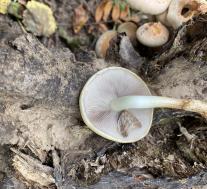
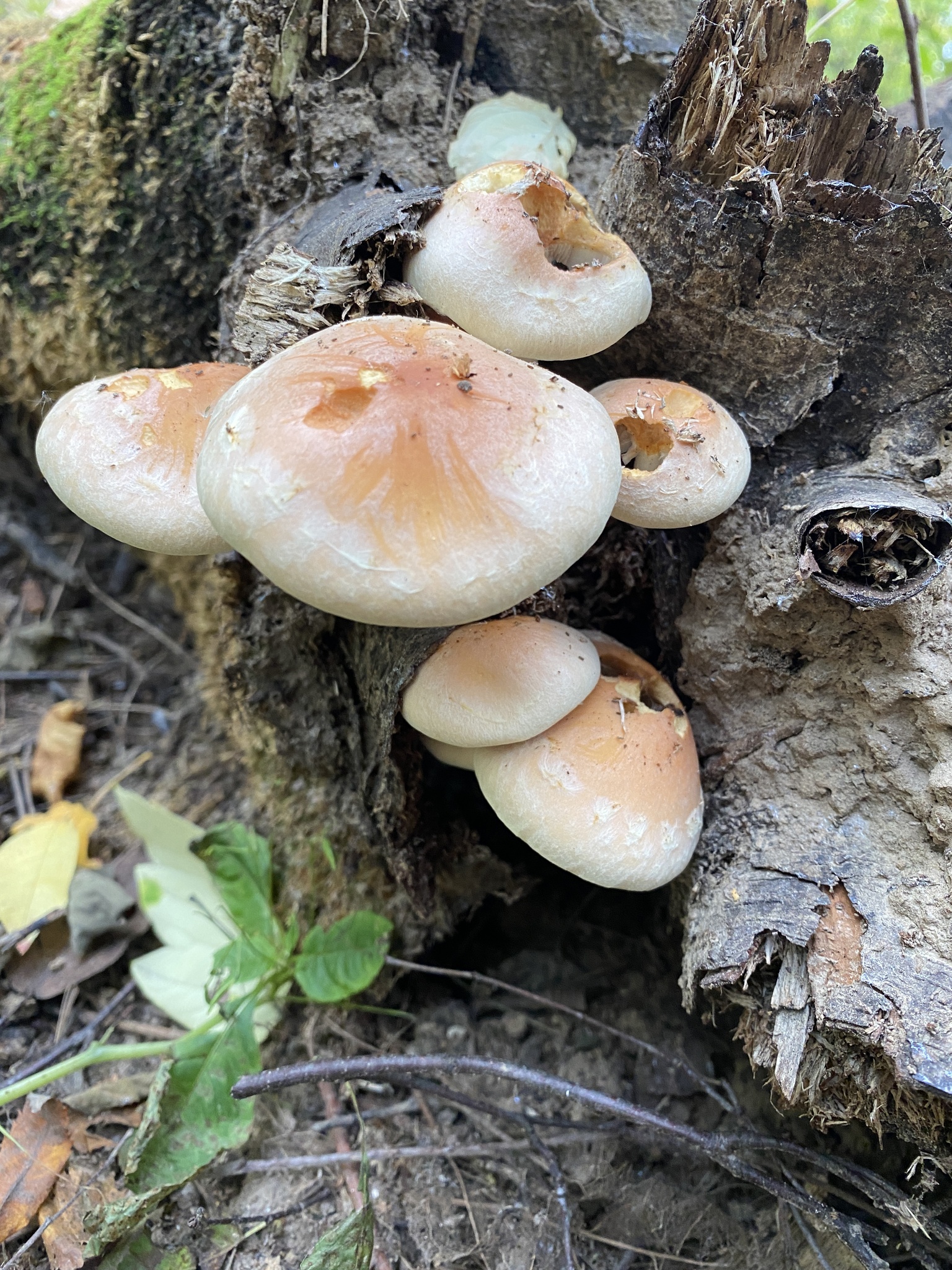
Cap 4–10 cm in diameter; initially hemispherical, with the underside covered by a whitish partial veil bearing whitish floccose remnants, reddish-brown to orange-yellow with a lighter, yellowish margin; later becoming convex to convex-expanded, with an incurved or downturned edge, bearing light floccose veil remnants along the margin; surface matte, pale yellow-orange, with a light yellowish or olive-yellowish margin and a brick-red center, often with a darker central area, sometimes marked with reddish-brown spots.
Hymenophore lamellate. Gills crowded, adnate or emarginate; initially light, yellowish-brownish or dirty yellow, later becoming gray-yellow-olive, and finally olive-brown with a violet tint.
Stem 5–10 cm long and 1–1.5 cm in diameter; even or tapering toward the base, often curved, dense, fibrous, sometimes bearing fibrous veil remnants; initially solid, later becoming hollow; pale yellowish at the apex, rusty brown toward the base.
Flesh thick, dense, yellowish, yellowish-brown in the stem, with a slightly bitter taste. Odor mushroom-like, faint.
Spore print dark purple. Spores cylindrical, narrowly ellipsoid.
Xylotroph. Grows abundantly in August and September in deciduous, broadleaf, and mixed forests on decaying wood of deciduous trees (birch, more often oak), on stumps and nearby, in groups, clusters, or colonies; frequently and annually. Widely distributed in America, Europe, and Asia.
Not listed in the Red Data Book of the Russian Federation or regional Red Lists.
- Sulphur Tuft (H. fasciculare) has an unpleasant odor of damp, freshly dug earth, is smaller in size and lighter in color, and has a much more bitter taste than the Brick Cap;
- Grey-legged Hypholoma or Poplar Hypholoma (H. capnoides) grows only in late autumn on coniferous fallen wood, is lighter in color, not bitter, and has gray gills without brown or greenish tints;
- Scarlet Scaly Cap (Pholiota astragalina) differs by its slightly decurrent yellow gills that darken only slightly with age, and a brighter, more orange tone of coloration; bitter when raw but not poisonous;
- Summer Honey Mushroom Kuehneromyces mutabilis has a strong mushroom odor, a distinctly zonately colored yellow-brown cap (the transition is smoother in false honey mushrooms), and slightly decurrent brownish gills without gray tones;
- Funeral Bell Galerina marginata is colored without red or gray tones, has a small, non-zonate yellow-brown cap (caps no larger than 5 cm in diameter), and a faint odor of dampness or flour. Deadly poisonous.
According to some sources, in ancient times Slavic healers used decoctions of the Brick Cap (*Hypholoma lateritium*) as an emetic and laxative.
Add new comment