Two-ringed Agaricus (Agaricus bitorquis)
Index Fungorum Agaricus bitorquis (Quél.) Sacc.
MycoBank Agaricus bitorquis (Quél.) Sacc.
Pavement Mushroom
Bitorquis, is (noun), from bi- [bis] in compounds meaning double, twofold + torquis (less often, torquēs), is necklace, collar, wreath.
Agaricus bitorquis var. validus (F.H. Møller) Bon & Cappelli, Docums Mycol. 13(no. 52): 16 (1983)
Agaricus campestris subsp. bitorquis (Quél.) Konrad & Maubl., Icon. Select. Fung.(fasc. 2): 60 (1926)
Agaricus campestris var. edulis Vittad., Descr. fung. mang. Italia: 41 (1835)
Agaricus edulis (Vittad.) Konrad & Maubl., Encyclop. Mycol. (Paris) 14: 102 (1948)
Agaricus edulis var. validus (F.H. Møller) F.H. Møller, Friesia 4(3): 203 (1952)
Agaricus rodmanii Peck [as 'rodmani'], Ann. Rep. N.Y. St. Mus. nat. Hist. 36: 45 (1884) [1883]
Fungus bitorquis (Quél.) Kuntze, Revis. gen. pl. (Leipzig) 3(3): 479 (1898)
Fungus rodmanii (Peck) Kuntze, Revis. gen. pl. (Leipzig) 3(3): 480 (1898)
Pratella bitorquis (Quél.) Quél., Fl. mycol. France (Paris): 72 (1888)
Pratella campestris var. bitorquis (Quél.) Quél., Enchir. fung. (Paris): 110 (1886)
Pratella peronata (Roze) Quél., Fl. mycol. France (Paris): 72 (1888)
Psalliota bitorquis Quél., Assoc. Franç. Avancem. Sci., Congr. Rouen 1883 12: 500 (1884) [1883]
Psalliota campestris var. edulis (Vittad.) Bres., Iconogr. Mycol. 17: tab. 825 (1931)
Psalliota edulis (Vittad.) N.F. Buchw., Spise og Giftsvampe: 125 (1937)
Psalliota edulis var. nanayi Bohus, Annls hist.-nat. Mus. natn. hung. 53: 187 (1961)
Psalliota edulis var. valida F.H. Møller, Friesia 4(1-2): 14 (1950) [1949-50]
Psalliota peronata Roze, Fl. champ. com. ven.: 44 (1888)
Psalliota rodmanii (Peck) Kauffman, Yearb. Agric. Sylvicult. Scienc. Poznań 26: 235 (1918)
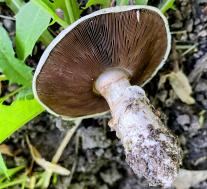
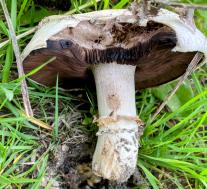
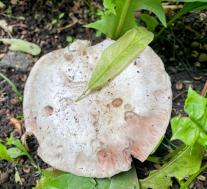
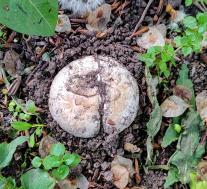
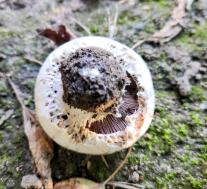
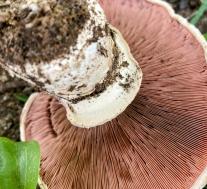
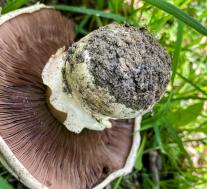
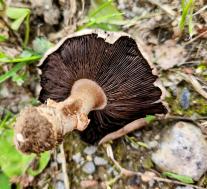
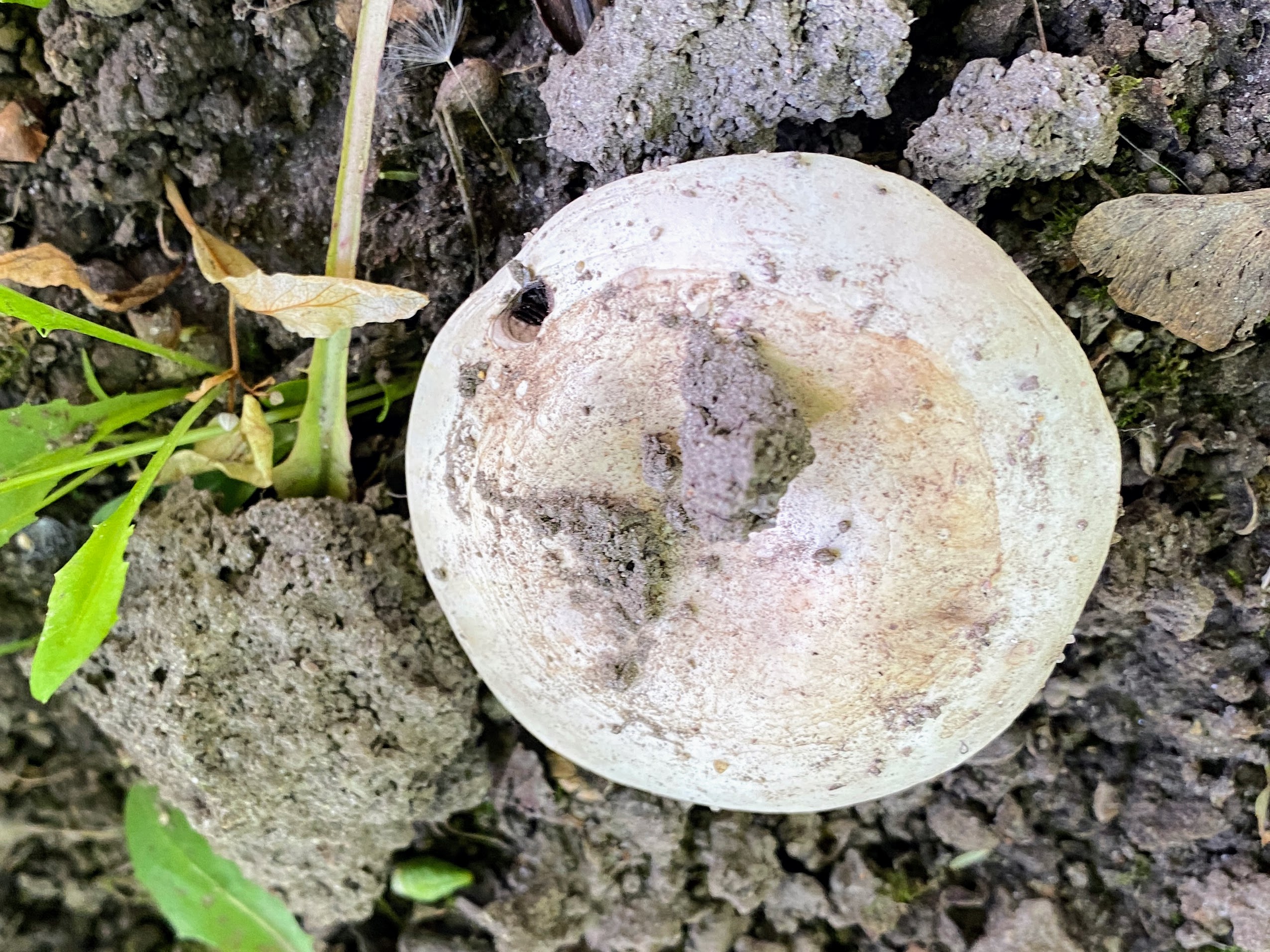
4–15 cm in diameter, initially spherical with an inrolled margin, at maturity expanding to flattened-convex and flattened, often depressed in the center. Surface dry, smooth, white to yellowish, with dirty-yellow spots where damaged. Gills free, whitish in young mushrooms, then becoming pink, at maturity reddish-brown and almost black with a violet tint; margin whitish, fringed under a lens. In early developmental stages, the gills of the Agaricus are reliably protected by a thick double ring.
Thick and short, 4–8 cm high, 1–4 cm in diameter, cylindrical, often slightly curved, usually with a small thickening at the base hidden in the soil, dense and firm. Surface whitish, creamy, or ochre. On the stipe is a characteristic and recognizable double ring, which gave the species its name. The upper part of the ring is formed by remnants of the partial veil, the lower part by remnants of the universal veil. On sandy soils, thick rhizoids develop at the base of the stipe.
Whitish, beige, turning pink on fresh cut. Taste weakly mushroom-like.
Pleasant, mushroom-like.
Spore print dark brown. Spores (4.5) 5.8–6.0 (8.3) × (4.1) 4.5–5.1 (6.0) µm, broadly ellipsoid, ellipsoid.
Grows in groups on soil, preferring grassy biotopes — fields, pastures, lawns. A ruderal species, well adapted to anthropogenic habitats. Common in any urban landscapes, including parks, avenues, lawns, and areas with compacted, trampled soil practically devoid of vegetation. A common mushroom in cities of central Russia. The Two-ringed Agaricus develops predominantly beneath the soil surface, which makes it inconspicuous. It is known for its ability to break through asphalt pavement and displace paving stones during the growth of fruiting bodies, for which it received the name Pavement Mushroom.
One of the most common and at the same time recognizable species of Agaricus. Distinguished by a low-growing, massive habit, characteristic double ring, and flesh that turns pink on cutting with a pleasant odor.
Common Mushroom (Agaricus bisporus) is often found in the same biotopes as the Two-ringed Agaricus, including strictly urban landscapes, and also turns pink on cutting. A species with highly variable cap coloration and texture, from matte white to glossy, covered with brown flat scales; light forms may resemble the Two-ringed Agaricus, but typically differ by a somewhat less massive habit and a small simple ring forming a narrow "cuff" on the stipe.
Bernard's Agaricus (Agaricus bernardii), with similar size and coloration, also turns pink on cutting, but smells of brine or iodine.
Yellow-staining Mushroom (Agaricus xanthodermus) — another common ruderal Agaricus species, often fruiting within city limits; this species is mildly poisonous and has an extremely unpleasant sharp taste and odor, resembling ink or carbolic acid. The resemblance between these species is only superficial — the Yellow-staining Mushroom is more slender, typically with a broader, hanging ring, often with grayish shades in the center of the cap and fine radial cracks on the surface, especially in dry weather. The key distinction is the rapid, bright yellowing of the cap surface when damaged; the flesh also yellows on cutting.
Analysis of nutrients has shown that this species contains 18 amino acids, including all essential ones.
Add new comment