Variegated Bolete, Yellow-brown Slippery Jack (Suillus variegatus)
Index Fungorum Suillus variegatus (Sw.) Richon & Roze
MycoBank Suillus variegatus (Sw.) Kuntze
Yellow-brown Moor Mushroom. It has the English common name velvet bolete, which can be translated as "бархатистый боровик" (velvety cep).
Variegatus, a, um — variegated, multicolored, colorfully patterned.
Basionym: Boletus variegatus Sw., Kongl. Vetensk. Acad. Nya Handl. 31 (1): 8 (1810)
Ixocomus variegatus (Sw.) Quél., Flore mycologique de la France et des pays limitrophes: 414
Versipellis variegata (Sw.) Quél., Enchiridion Fungorum in Europa media et praesertim in Gallia Vigentium: 157 (1886)
Versipellis variegata (Sw.) Quél.: 157 (1886)
Versipellis variegata var. variegata (Sw.) Quél.: 157 (1886)
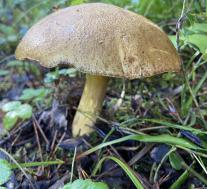
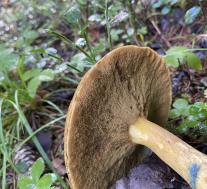
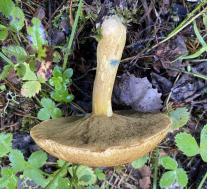
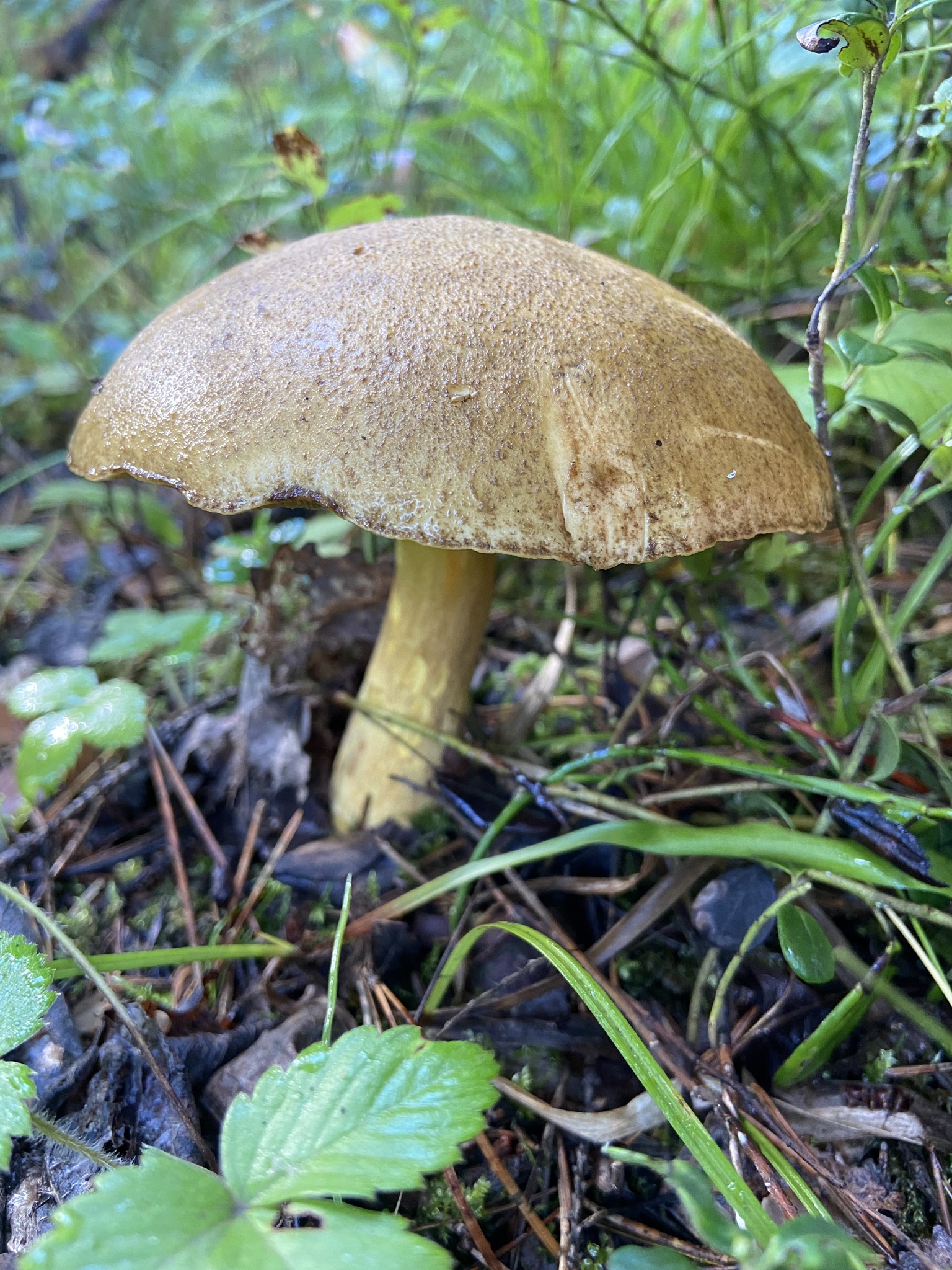
6–13 cm in diameter, initially hemispherical, later cushion-shaped; in young mushrooms during wet weather, intensely yellow-orange, becoming brownish-yellow, brownish, or sometimes with olive tones with age and in drier conditions. The surface is slightly sticky in wet weather; in youth, densely covered with woolly scales of brown, ochre, or brownish color; in rainy weather, the scales may partially wash off, but often persist and darken with age, giving old specimens a dirty-olive appearance.
The hymenophore is tubular, adnate, tobacco-colored, brown, or yellowish-olive, bluing when damaged. Pores rounded, approximately 1 mm in diameter.
6–10 cm long, 1.5–2 cm in diameter, cylindrical, sometimes expanding toward the base, more or less concolorous with the cap.
Flesh thick, dull yellow. On cutting, it turns blue, though not always intensely.
Pleasant, mushroom-like.
Spore print olive-brown in mass. Spores 7.9–10.6 × 3.1–4.1 μm, fusiform-ellipsoid, smooth, yellowish.
Variegated Bolete grows in pine and mixed forests. It forms mycorrhiza with pine (Pinus). It prefers acidic soils and moist habitats.
The dry, velvety cap distinguishes the Variegated Bolete from other large representatives of the genus Suillus, and its impressive size excludes confusion with the Jersey cow mushroom (Suillus bovinus). Similar "mohovik" species also do not occur—they are readily identified by their large-pored tubular layer of bright yellow-green coloration.
Variegatic acid (3,3',4,4'-tetrahydroxypulvinic acid) is an orange pigment found in certain mushrooms. It is responsible for the bluing reaction observed when the tissue is damaged. When mushroom tissue containing variegatic acid is exposed to air, this compound is enzymatically oxidized to blue quinone methide anions. It is formed from xerocomic acid, which is preceded by atromentic acid and atromentin, though the complete biosynthetic pathway remains unknown. In its oxidized form (due to the formation of a second lactone ring), it becomes variegorubin, which is similar to xerocomorubin.
It was first isolated from Suillus variegatus. The compound possesses strong antioxidant properties and also exerts a nonspecific inhibitory effect on cytochrome P450 enzymes. In vitro data confirm that this pigment reduces Fe3+.
Add new comment