Violet Knight (Lepista irina, formerly Collybia irina)
Index Fungorum Collybia irina (Fr.) Z.M. He & Zhu L. Yang
MycoBank Collybia irina (Fr.) Z.M. He & Zhu L. Yang
Lilac Knight, Bluish Knight.
Irinus, a, um — iris-like, iridescent. From *iris, is* and *idis* f. 1) rainbow; 2) iris (flower); 3) iris root + *-inus*. Also *Iris, idis* f. Iris (the goddess of the rainbow, messenger of the gods).
Lepista irina (Fr.) H.E. Bigelow, Canad. J. Bot. 37 (5): 775 (1959)
Tricholoma irinum (Fr.) P. Kumm., Der Führer in die Pilzkunde: 132 (1871)
Clitocybe irina (Fr.) H.E. Bigelow & A.H. Sm., Brittonia 21 (1): 172 (1969)
Rhodopaxillus irinus (Fr.) Métrod, Revue de Mycologie, Suppl.: 29 (1942)
Gyrophila irina (Fr.) Quél., Enchiridion Fungorum in Europa media et praesertim in Gallia Vigentium: 17 (1886)
When boiled, a light floral aroma is preserved, imparting a distinctive flavour to dishes. For those who do not enjoy this taste, it is advisable to salt or marinate these mushrooms using herbs and spices.
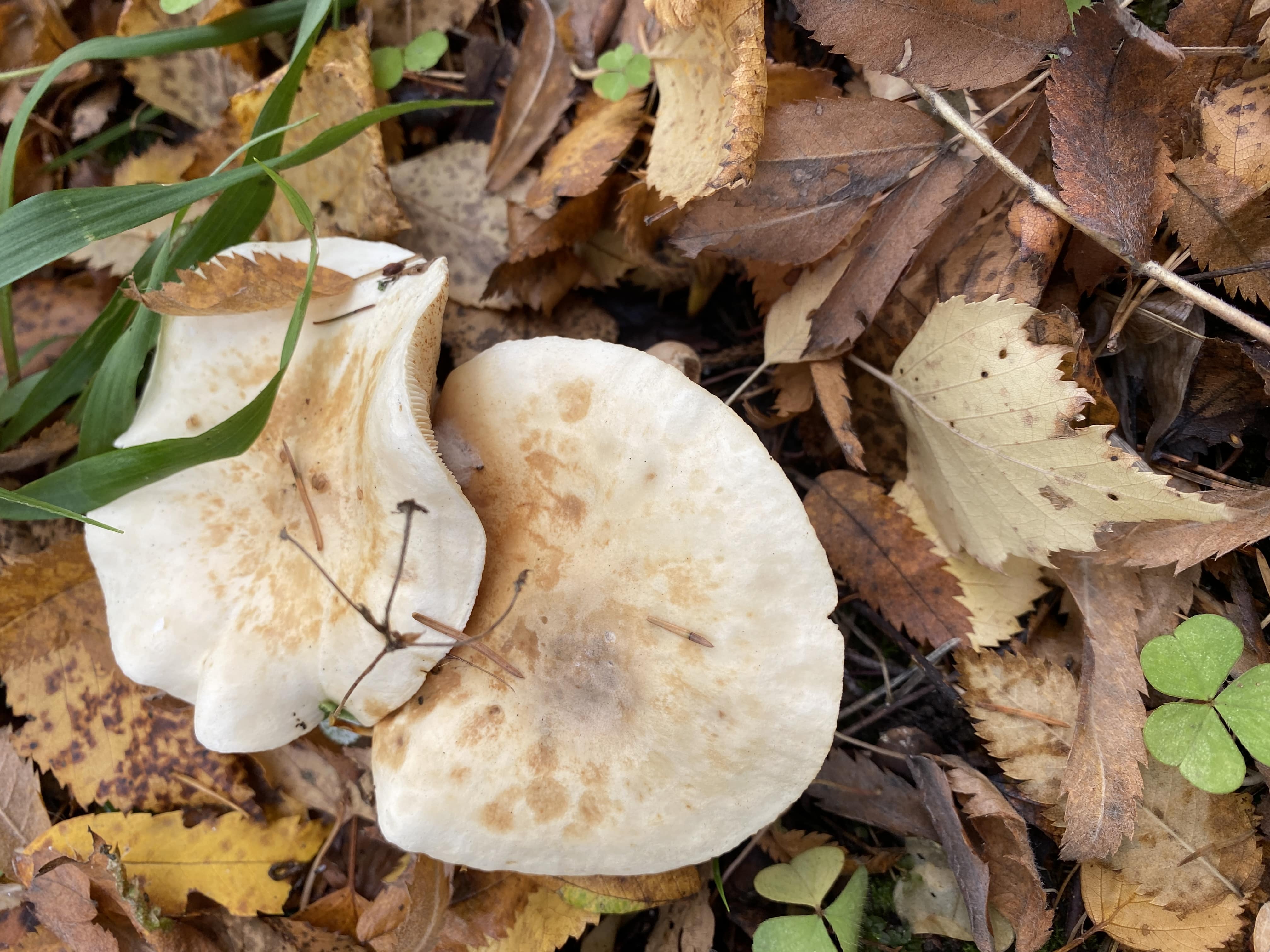
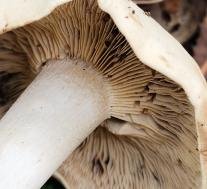
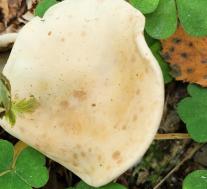
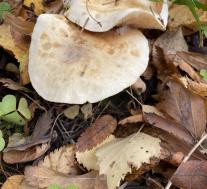
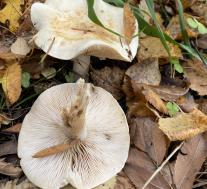
2.5–20 cm in diameter, initially convex with an inrolled margin, at maturity expanded with a broad umbo in the center or depressed. The margin remains inrolled for a long time, becoming wavy with age. Surface smooth, matte, hygrophanous, slightly sticky in wet weather. Color is variable and depends on age, habitat, and weather: in young mushrooms the cap is purple, violet-blue, or lilac; with time brown tones appear from the edges; gradually it becomes paler, brownish-lilac, and may eventually lose almost all purple tones in coloration. This color change is accelerated by freezing. Gills adnate, crowded, initially bright lilac, sometimes fading with age; gill edge smooth.
5–10 cm long, 1–3 cm in diameter, widening toward the base, clavate or with a tuberous thickening; solid or loosely fibrous, with cavities, especially in old mushrooms and in dry weather. The base of the stipe grows deeply into the substrate, enveloping fragments of litter. Surface longitudinally fibrous, with fine scales in the upper part, often forming a zigzag pattern. Color of the stipe — both surface and flesh — ranges from dirty-white to violet.
Lilac or whitish. Dense, juicy. Taste mild, pleasant, mushroom-like or nutty.
Strong, aromatic, sometimes with perfumery notes.
Spore print pink. Spores ellipsoid.
Grows in large groups on forest litter, found in both coniferous and deciduous forests. Often occurs in ruderal biotopes. Forms fairy rings, sometimes of very large size.
Grayish-blue Knight or grayish-lilac (Lepista glaucocana) — a very similar, closely related species. It may differ by even larger size and lighter, lilac-gray or bluish-gray, sometimes dirty-white coloration of the fruiting bodies, although some specimens can be quite brightly colored. It can also grow in large rows and rings. In Western Siberia, it prefers sub-boreal forests on rich, non-acidic soils. One of the typical species of old-growth sedge-bracken pine forests of the Ob region.
Blueleg (Lepista personata) resembles L. irina in all respects, but only the stipe is colored in bright blue or violet hues. Common in many regions of the country, in some places preferring meadows and pastures. It usually fruits late, in September–October. A good edible mushroom.
Dirty Knight (Lepista sordida) — overall a very similar, closely related species. It differs by significantly smaller and more delicate fruiting bodies, and typically grows singly or in small groups. Edible.
It can also be confused with some webcaps colored in violet tones, for example with the Violet Webcap (Cortinarius violaceus) or the Pale Violet Webcap (Cortinarius alboviolaceus).
The Violet Knight is cultivated in some countries. It is less demanding regarding substrate — it can be grown on substrate previously used for cultivating Agaricus mushrooms, is almost not susceptible to bacterial and fungal infections, but is highly dependent on temperature and humidity conditions.
Add new comment