Bulbous Honey Fungus (Armillaria gallica)
Index Fungorum Armillaria gallica Marxm. & Romagn.
MycoBank Armillaria gallica Marxm., Bull.
Gallic Honey Fungus.
Gallicus, a, um — geographic: Gallic. From Gallia, ae f. Gaul (a region roughly covering present-day France and Belgium) + -icus, a, um, denoting place.
Armillaria gallica itself can be subject to parasitism by other soil mycobiota. Several species of the genus Trichoderma, including Trichoderma polysporum, T. harzianum, and T. viride, are capable of penetrating the outer tissue of A. gallica rhizomorphs and parasitizing the internal hyphae. Approximately one week after infection, no living hyphae remain in the infected rhizomorphs. Entoloma abortivum is another fungus that can parasitize A. gallica. Whitish-gray deformed fruiting bodies may appear due to E. abortivum hyphae penetrating the mushroom and disrupting its normal development.
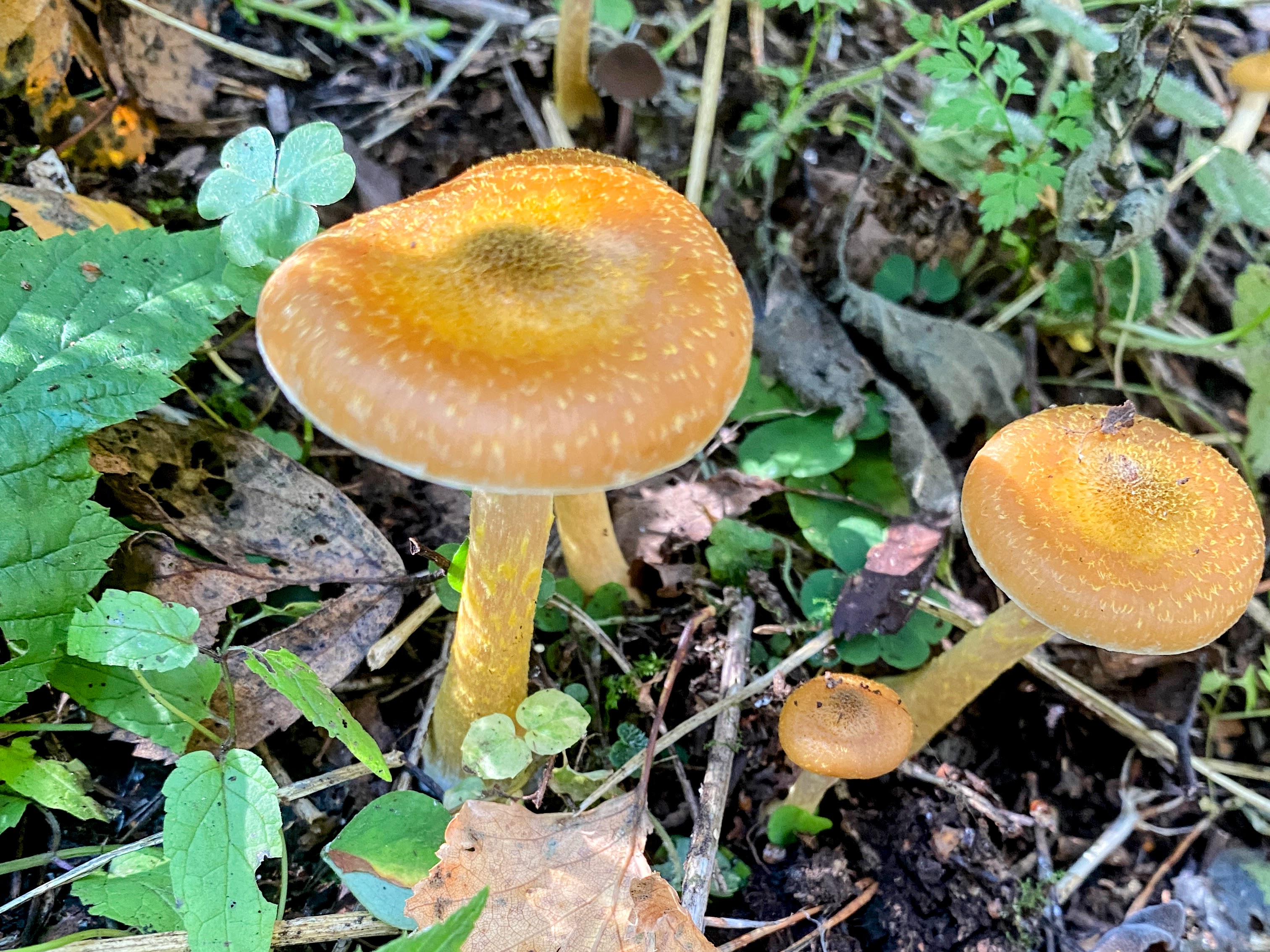
Up to 12 cm in diameter. In young specimens hemispherical or bell-shaped, with an inrolled margin. With age, the cap expands to nearly completely flat. With a characteristic umbo in the center. Cap color from dark brown to yellowish-brown. Young specimens are lighter in the center, mature fruiting bodies have a darker center. Cap margin slightly striate, velvety. With long-persisting flakes, remnants of the partial veil. Cap covered with small dark scales from light ochre to nearly black, fibrous. In young specimens, scales evenly cover the entire cap; as the cap grows, they concentrate in the center, leaving the margin bare.
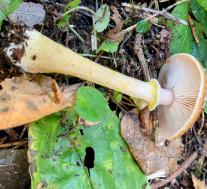
Gills adnate, slightly decurrent on the stipe. Narrow, sparse, with smooth or serrated edges. From mottled white to pinkish-brown. With age or in damaged areas, developing brown spots.
3–12 cm long and 1–3 cm in diameter, cylindrical with a club-shaped thickening. Surface fibrous. Brown at the base of the stipe. Chrome-yellow, less often whitish. Becoming reddish with age, then brownish to reddish-brown. The stipe is often encircled by whitish or yellowish remnants of the partial veil.
Numerous yellowish scales are located below the ring. They persist for a long time.
Ring fibrous, yellowish, thin and fragile. Tears in a star-shaped pattern.
Fibrous, tough. White when broken.
Mushroom-like, pleasant.
Spore print white. Spores 7.5–8.5 × 4.5–5 µm, bluntly cylindrical, narrowly ellipsoid. Basidia with clamp connections.
Found in temperate regions of Europe, North America, and Asia. Forms fruiting bodies singly or in groups on decaying wood or soil. The fungus was accidentally introduced to South Africa.
All honey mushrooms of the genus Armillaria are very similar to each other.
Honey Fungus (Armillaria mellea) grows in the southern and extreme western regions of our country.
Northern Honey Fungus (Armillaria borealis) has a more pronounced and durable veil that always remains as a ring on the stipe. Northern Honey Fungus grows in large clusters.
Inexperienced foragers may also confuse honey mushrooms with various Pholiota species, which are distinguished by more pronounced scales and a bitter taste.
Possesses bioluminescent properties.
Experiments have shown that the intensity of luminescence increases when the mycelium is damaged during growth. Bioluminescence is caused by the action of luciferases — enzymes that produce light through the oxidation of luciferin. The biological purpose of bioluminescence in fungi is not fully understood, although several hypotheses have been proposed: it may attract insects that help disperse spores, or it may be a byproduct of other biochemical functions.
Add new comment